

A relationship journal isn’t here to convince you everything’s fine. Sometimes the most useful line you can write is this: “I’m annoyed, and I don’t know why yet.” That’s it.
Relationship journal prompts give that half-formed thought somewhere to land. Before it turns into a 2 a.m. text. Before it becomes a pointless fight, or another lap around the same overthinking loop.
A study published in Psychological Science found that expressive writing about romantic relationships lined up with real shifts in how couples talked to each other, and with relationships that held together better over time.
Still, journaling isn’t a stand-in for the actual conversation. Think of it as the draft before the real one. It’s where you figure out what you actually want to say, before your partner is standing in front of you waiting for an answer.
If grounding yourself in the moment feels like the missing piece here, mindfulness journal prompts breaks that skill down on its own.
Quick answer: Relationship journal prompts are questions that walk you through your feelings, needs, communication patterns, boundaries, connection, and future with a partner. Answer them alone, together, or separately, then compare notes later. The best prompt isn’t the deepest one. It’s whichever one matches what’s actually going on right now.
Table of Contents
Disclaimer
This blog is written and edited with the help of AI, then reviewed by me before publishing. As a result, the content is for general reflection only, not therapy or medical advice, and I’m not a licensed mental health professional. If you’re in crisis, please contact 988 if you’re in US or a local crisis service of your country instead of relying on this site.
How to Use These Relationship Journal Prompts
Relationship journal prompts don’t work as a checklist. They work as tools for one specific moment. Pick the prompt that matches what you’re feeling. Decide if you’re writing alone or together. Then give the hard answers room to be honest, not room to become ammunition later.
Match the Prompt to What’s Actually Happening Right Now
Don’t reach for the “deepest” prompt just because it sounds meaningful. Start with the one that matches the problem sitting in front of you.
Feeling disconnected? Write about the last time you felt close. Still irritated after a fight? Unpack what actually happened before you decide your partner “always” does this. Things going fine for once? Reflect on what you want to protect. Don’t go looking for a problem that isn’t there.
The whole point is clearer thinking. Not manufactured drama.
Solo, Shared, or Exchange-and-Discuss: Which Format Fits You
You can journal alone, with your partner, or through an exchange where both people write first and talk after.
Solo journaling works when your feelings are a mess. You need to separate what you actually think from what you want to blurt out in the moment.
Shared journaling fits lighter prompts. Date nights. Conversations where writing together feels natural, not forced.
Exchange-and-discuss sits in between. You both answer privately. Then you choose what to share out loud. That boundary matters more than people expect.
If you want to build this into a wider habit, our guide on mindfulness journal prompts covers the broader practice these relationship journal prompts borrow from.
A Few Ground Rules Before You Open a Hard Prompt With Your Partner
Hard prompts deserve better timing than a heated argument. Wait for a calm moment. Agree upfront that private answers stay private, unless someone chooses to share theirs.
And don’t turn an entry into a “gotcha.” Especially not by reading your partner’s own words back at them mid-fight.
A journal is where you figure out what you think. It’s not evidence for the prosecution.
What Relationship Journal Prompts Can Actually Do (and What They Can’t)
Relationship journal prompts sharpen your own view first. Nothing else happens before that. A good prompt shows you the reactions you repeat, the needs you keep dodging, and the words you’ll need before a hard talk. Some people call these relationship reflection questions. Others call them journaling prompts for couples. Same tool either way.
Here’s what it won’t do. It won’t read your partner’s mind. It won’t settle an argument by itself. And it definitely won’t make someone change just because you wrote about it.
It Shows You Patterns. It Doesn’t Force Change
Pattern spotting is the actual value here.
Keep at it long enough and something clicks. Maybe you feel shut out right after texting goes quiet. Maybe the same fight always circles back to one need nobody named out loud. Maybe you apologize before you’ve even figured out what upset you.
That’s worth writing down.
It also matches how relationship researchers actually study couples. They track repeated patterns over time instead of judging one fight in isolation, which is the same skill behind good mindfulness journal prompts: noticing what keeps showing up, not just what happened once. The Gottman Institute, built on decades of work by John Gottman and Robert Levenson, has found that couples’ interaction patterns stay remarkably stable over the years.
But awareness isn’t control. You can write “I feel shut out every time we disagree.” Fair enough. You still can’t journal your partner into listening. That part stays outside the page.
One Entry Isn’t a Verdict
Don’t treat a single page like a final ruling.
A journal entry catches how one moment felt. It’s not a full account of your relationship. Write something sharp after a draining fight, and you might feel completely different two days later. Neither version is fake. Feelings move. Context shifts. One rough page shouldn’t become a courtroom verdict on the whole relationship.
Watch for repeats instead.
Same worry, three weeks running? That’s the one worth sitting with. A single bad night usually isn’t. If you want a wider net for catching those repeats, a running set of journal prompts for mental health can hold the ones that don’t fit neatly into a relationship category.
When Talking Beats Another Prompt
Sometimes another prompt is just stalling with better lighting.
Figured out what you need? Write it. Then say it out loud. Relationship journal prompts can get you ready for a hard conversation. They shouldn’t replace it. Gottman’s research also points at something just as important: how couples handle conflict, and how they repair things once the dust settles.
One rule holds up here. Journal to find the words. Not to avoid saying them.
Quick Relationship Journal Prompts for a 2-Minute Check-In
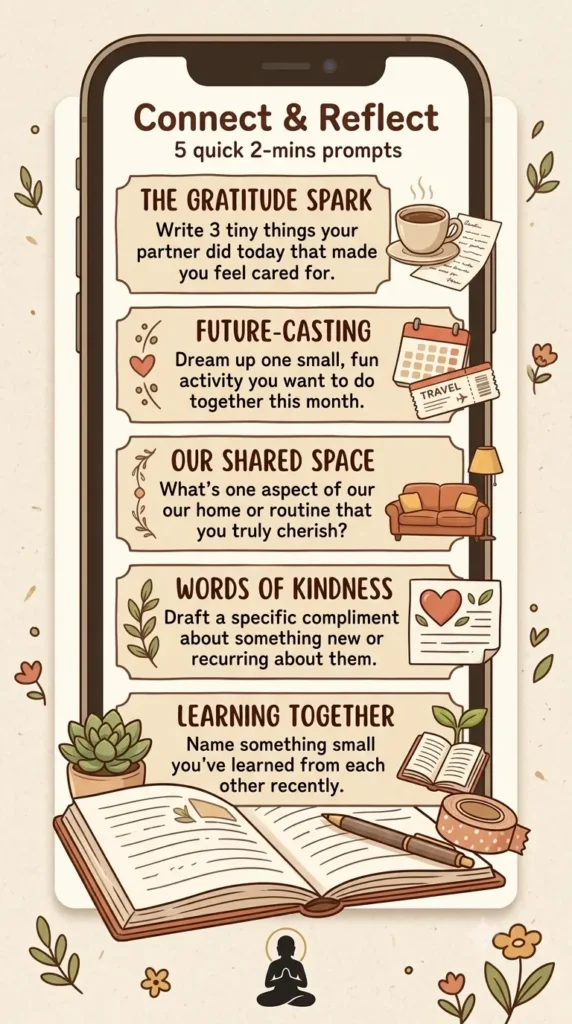
A 30-minute journaling session sounds nice. Most days, you don’t have it. Two honest minutes tell you more than an hour of overthinking ever will, and that’s the whole point of quick relationship journal prompts.
Use these when you feel slightly off. Or unusually close. Or you just want to check in with yourself before the day swallows the feeling whole.
Pick one prompt. Write without editing yourself.
- Connection: When did I feel closest to my partner today, and what created that feeling?
- Current emotion: What am I feeling toward my relationship right now, without trying to justify it?
- Appreciation: What small thing did my partner do recently that I genuinely noticed and liked?
- Something unsaid: What have I wanted to say but kept putting off?
- What today needs: What would make our relationship feel a little better today, more space, more attention, more honesty, or something else entirely?
Don’t rush every answer into a conversation. Sometimes the useful part is just knowing what you feel before you act on it. That’s the difference between reacting and responding.
If gratitude is the emotion that keeps showing up in your answers, it’s worth sitting with on its own. This guide on practicing gratitude breaks down how to build that habit beyond the relationship page. And if prompt three keeps landing on the same few things your partner does, a short list of things to be thankful for can help you notice more of them.
These quick check-ins work well alongside broader mindfulness journal prompts too. One tracks your relationship. The other tracks you. Both matter.
Relationship Journal Prompts for Deeper Connection and Communication
More texting doesn’t mean more connection. You can message someone all day and still feel unseen by them. That’s the gap relationship journal prompts exist to close. They slow you down long enough to name what you actually need. Then they help you turn that vague, tangled feeling into words your partner can actually work with.
Feeling Seen, Heard, and Safe Being Yourself
Being heard isn’t the same as being understood. Not even close. Psychologists Harry Reis and Phillip Shaver connect real intimacy to two things: opening up, and having your partner respond with genuine care and understanding. Miss either piece and something stays hollow, even in a relationship that looks fine from the outside.
These relationship reflection questions dig at that gap directly:
- When do you feel most like yourself around your partner?
- What do you wish they understood better about you?
- What do you hesitate to say out loud, and why?
How You Give and Receive Love (Love Languages Angle)
Love languages aren’t a personality test. Treat the framework that way and it stops being useful. The research doesn’t actually back the idea that everyone has one fixed way of loving. Use it instead as a door into conversation, not a label you get stuck wearing.
A few journaling prompts for couples built around this idea:
- How do you naturally show someone you care?
- What makes you feel genuinely appreciated? (A quick scan through things you’re grateful for can surface answers you’d otherwise skip past.)
- Are you giving affection the way you’d want to receive it?
Prompts for When You Feel Disconnected
Distance rarely announces itself. It creeps in quiet, one skipped conversation at a time, until one day you notice the gap and can’t pinpoint when it opened. These prompts help you trace it back:
- When did the distance actually begin?
- What do you miss most about how things used to feel?
- What would help you feel closer this week, specifically?
Turning Vague Frustration Into a Specific Ask
“You don’t care” tells your partner nothing they can act on. It’s a feeling wearing an accusation’s clothes. Swap it for something concrete instead, something they can actually respond to.
- What specifically happened?
- What did you feel in that moment?
- What do you need your partner to do differently, in plain terms?
Before and After a Hard Conversation
Preparing before a hard conversation changes how it lands. Before you sit down, ask yourself one thing:
what do I want them to understand? Not to win the conversation. Just to be clear about your own point before it gets lost in the moment.
After it’s over, ask a second question:
what did I learn, and what’s still unresolved? Some conversations don’t close clean. That’s fine. Naming what’s left open is still progress, even when the whole thing isn’t wrapped up in a bow.
If sitting with your own emotions is the harder part of any of this, the mindfulness journal prompts guide builds that muscle on its own, outside of any relationship context at all.
Relationship Reflection Questions for Conflict and Repeating Arguments
Reflection isn’t about who’s guilty. It’s not a courtroom. The goal here is simpler than that: understand the pattern well enough to change your part in it. Nothing more.
You’re not trying to fix your partner. That’s not your job. And honestly? Trying to fix them is usually what keeps the fight alive. Real reflection stays on your side of the fence.
If you’re building out relationship journal prompts for tough conversations, this is the part that actually moves the needle. Not the venting. The noticing.
What Keeps Triggering the Same Fight
Same fight, different outfit. Sound familiar?
Most couples aren’t fighting about the dishes. Or the money. Or being late again. They’re fighting about the same three or four things wearing new clothes each time. Ask yourself:
- What happened right before the argument started?
- What am I actually reacting to here?
- Have we had this exact fight before, just dressed up differently?
- How does it usually escalate once it starts?
A pattern you can name is a pattern you can interrupt. That’s the whole point of tracking it.
What’s Actually Mine to Own
Here’s the line most people blur. You own your words. Your reactions. Your assumptions. Your choices in the moment. You do not own your partner’s behavior. Full stop.
That distinction matters more than it sounds like it should. Ask:
- What did I actually contribute to this?
- Where did I get defensive, and why?
- What could I do differently next time this comes up?
Getting defensive doesn’t make you the villain. It makes you human. But noticing it? That’s where the shift starts.
What Am I Assuming About My Partner
It’s 10pm. They didn’t text back. Your brain fills the silence with a story, and it’s rarely a kind one. This is where most fights actually start, not in what happened, but in what you decided it meant.
Separate the two. Ask:
- What do I know for certain happened?
- What am I assuming they meant by it?
- What else could explain their behavior, one that has nothing to do with me?
Nine times out of ten, the story you told yourself was worse than the truth.
REFLECTION ≠ BLAME
Reflection: “What part of this pattern can I understand or change?”
Blame: “How can I prove this is their fault?”
A journal should sharpen the picture. Not build a case file against the person you love.
Relationship Journal Prompts for Intimacy, Attraction, and Appreciation
Most people only open a journal when something hurts. That’s backwards. Relationship journal prompts work just as well on an ordinary Tuesday, when nothing is wrong at all.
Use them to notice what’s working. What you still want. What quietly shifted without either of you naming it. These prompts stay focused on connection. Not on turning your relationship into a project you’re constantly optimizing. If you want the deeper reasoning behind why gratitude and reflection work at all, how to practice gratitude breaks that down well.
Emotional and Physical Intimacy
Closeness isn’t one fixed thing. It shifts by the day, sometimes by the hour.
Some moments feel like closeness without a single word said. Others need real conversation to get there. Both count. These prompts help you notice what actually builds that feeling for you, instead of guessing at what should.
- When do I feel closest to my partner?
- What makes me feel wanted, comfortable, or emotionally safe?
- How do I naturally express affection?
- What kind of affection would I like more often?
Sound too simple to matter? It isn’t. Small, honest answers here tend to say more than a long talk ever would.
Talking About Changing Needs
Needs change. That isn’t automatically a relationship problem.
What felt like enough a year ago might feel thin now, and that’s normal. Bodies change. Schedules change. Stress levels shift the whole equation without asking permission. Journaling gives you a private place to figure out what’s actually true before you try explaining it out loud.
- What do I need more of lately?
- Has the way I want affection changed?
- Is there something I feel awkward asking for?
- What would make this conversation easier?
Writing it first tends to make the real conversation shorter. And a lot less tense.
What You Still Love, Favorite Memories, Small Things That Matter
Don’t skip the ordinary moments. They add up faster than the big ones.
A relationship isn’t only built from anniversaries and grand gestures. It’s built from small, repeated things. The way your partner remembers your coffee order. The look they give you across a crowded room. None of it feels dramatic in the moment. Write it down anyway.
- What small thing does my partner do that I love?
- Which memory still makes me smile?
- What do I admire about them now?
- What initially attracted me, and what attracts me today?
If gratitude tends to open doors for you here, a few gratitude worksheets can guide that same noticing with a bit more structure. And keeping a running list, similar to things to be thankful for, works well for holding onto these small moments before they slip away.
What You Want to Experience Together
Shared experiences build their own history. Nobody hands that to you. You make it.
Every trip, inside joke, and late-night conversation becomes part of your shared story over time. So it’s worth asking what you actually want more of, rather than letting the calendar decide for you.
- What would I love for us to try?
- What kind of memories do I want us to create?
- What have we been postponing?
- What would make the next few months feel more like our life?
That’s the real shift. Not a bigger relationship. Just a more intentional one.
Want a broader set of reflection prompts beyond just the relationship lens? The mindfulness journal prompts guide and the 365 journal prompts for mental health collection both pair well with this list, especially on nights when the relationship prompts alone don’t feel like enough.
Relationship Journal Prompts for Your Future Together
You don’t need a five-year plan to ask if your lives actually fit. Not really. Future-focused relationship journal prompts do something more useful than predicting anything. They surface the gaps in what you each want, before those gaps turn into resentment. Where you’re headed matters less than whether your directions overlap at all.
Nobody’s writing a script here. That’s not the goal. The real question is simpler: does the future you want leave room for someone else in it? A solid set of journaling prompts for couples can answer that faster than months of assuming you’re on the same page.
Shared Goals, Lifestyle, and Independence
Compatibility isn’t about liking the same shows or the same weekend plans. It’s whether your daily rhythms actually mesh. One person craves constant togetherness. The other needs long stretches alone just to recharge. Neither one is wrong.
But somebody’s needs get quietly ignored if this never gets said out loud.
These relationship journaling prompts pull that conversation into the open before assumptions start making decisions for you.
- What kind of life do I want in five years?
- Which goals do I want to pursue together?
- How much independence do I need?
- What does quality time look like to each of us?
- Where do our lifestyles actually align?
Money, Work, Home, and Family
Money fights rarely start with money. They start with mismatched expectations nobody named early on. One partner treats saving as safety. The other treats it as missing out on life right now.
Add work, home, and family into that mix. The list of unspoken assumptions gets long fast.
This is exactly where journaling prompts for relationships earn their place. They force specificity. Not vague hopes about “someday.” Real answers, on paper, that both people can actually see. If you want a more structured way to slow down and get concrete, our gratitude worksheets work on the same principle, just aimed at a different part of life.
- How do I think about saving, spending, and financial responsibility?
- What role should work have in our lives?
- Where would I ideally live?
- What does “home” mean to me?
- Do I want children, pets, or neither?
- What family responsibilities matter to me?
What Commitment Means to Each of You
Commitment doesn’t automatically mean marriage. It doesn’t mean kids either. Or some traditional timeline borrowed from somebody else’s life. Two people can build something lasting without following a single one of those scripts.
Sound like a strange thing to question? Maybe. But most couples never actually define commitment for themselves. They just inherit a version from parents, friends, or whatever they grew up watching.
These relationship reflection questions get ahead of that before the mismatch surfaces at the worst possible moment.
- What does commitment mean to me?
- What would make me feel secure without feeling controlled?
- Which expectations about relationships did I inherit from others?
- What would a compatible future look like for both of us?
Use this as one entry in a bigger rotation. A relationship journal doesn’t need to cover everything at once. Some nights call for these future-facing questions. Others call for something lighter, like noticing one small thing you’re grateful for in your partner that day, an idea our piece on how to practice gratitude breaks down well beyond just relationships. Either way, the goal stays the same: understand each other a little better than you did yesterday.
Relationship Journal Prompts for Understanding Yourself
A relationship shows you things solitude never will. Your reactions. Your expectations. The habits you carry in without even noticing. Trace where they came from, and most of them start making sense fast. That’s really the whole point of these relationship journal prompts. Not fixing yourself. Just getting honest about what you actually bring into the relationship you’re in right now.
Think of it less like a fix-it list and more like a mirror. A good set of relationship reflection questions doesn’t hand you answers. It just points your attention somewhere you’d normally skip past.
Patterns From Past Relationships
Old relationships don’t stay in the past. Not really. They shape what feels normal now, even when the person in front of you is nothing like the one before.
Sound familiar? It should. Most people carry at least one old pattern into a new relationship without realizing it.
- What relationship pattern keeps repeating?
- What did I tolerate before that I wouldn’t tolerate now?
- What did I learn about love from past relationships?
- Do I expect my current partner to repeat something an ex did?
These four questions alone can surface more than a year of casual small talk ever would. That’s the value of sitting with a page instead of just replaying the thought in your head.
How Your Childhood Shaped Your Expectations
Home teaches you what normal looks like. It doesn’t have to decide what you accept as an adult. That part’s still yours to choose.
Here’s an honest take: most people don’t examine this until something in a relationship starts to feel oddly familiar, and not in a good way.
- How was affection shown in my family?
- How were disagreements handled?
- What did I learn about asking for help?
- What feels strangely familiar in my current relationship?
Notice a pattern forming as you answer these? That’s usually the moment worth writing more about, not less.
Who You Want to Be as a Partner
Most people obsess over whether their partner measures up. Wrong question entirely.
Ask who you’re becoming instead. That’s the harder question, and it’s the one that actually moves things forward.
- How do I want my partner to experience me?
- Where do I need more honesty?
- What habit would make me a better partner?
Self-understanding tends to work best alongside appreciation, not instead of it. If you want to pair this reflection with a steadier gratitude habit, this guide on how to practice gratitude breaks the process into small, repeatable steps. And if you’re looking for a running list to pull from on days your mind goes blank, things to be thankful for works well as a companion to these journaling prompts for relationships.
Relationship Journal Prompts for When You’re Questioning the Relationship
Doubt doesn’t mean you should walk. It doesn’t mean you should stay either. Relationship journal prompts exist for exactly this in-between space, when you’re not sure what you’re even feeling anymore.
One rough week feels loud in the moment. It rarely tells you much on its own. What matters is what keeps showing up after the week ends. That’s where journaling earns its place.
It separates a bad stretch from something you’ve been quietly excusing for months. If a slower, present-moment style of writing helps you settle first, a few mindfulness journal prompts can clear the noise before you dig into the harder questions below.
Rough Patch or Pattern?
One bad week says almost nothing. Repetition says everything.
Sit with these before writing anything else:
- Is this new, or has it happened before?
- What keeps repeating despite the conversations you’ve already had?
- When things get better, how long does “better” actually last?
- Am I reacting to one moment, or to a pattern I keep excusing?
Notice the tense shift in that last question. Not “what happened.” What keeps happening. That’s the whole difference between a rough patch and a pattern you’ve been quietly living with.
What Am I Actually Unhappy About?
“Something feels off” isn’t an answer. It’s just the starting line.
Get specific. Push past the vague version until something concrete shows up.
- What am I missing?
- What need feels unmet, again and again?
- When did this feeling first show up?
- If one thing changed tomorrow, what would matter most?
Vague discomfort hides the real issue. Naming it doesn’t fix anything by itself. But you can’t fix what you refuse to name first.
Am I Staying Because I Want To?
Fear dresses itself up as commitment more often than people admit.
Ask this one honestly:
- If I weren’t scared of being alone, would I still choose this?
- Am I staying for the relationship, or because leaving feels harder?
- What keeps me here besides history?
Sound uncomfortable? It should. That discomfort is the whole point of asking it. History with someone isn’t the same as wanting a future with them. Worth sitting with that difference longer than feels easy.
What Would I Want If Nobody Else Had an Opinion?
Strip it all away. Friends. Family. The feed you scroll before bed. Every expectation you’ve never actually agreed to.
- What would I choose, if I chose it privately?
- What future feels honest, not just convenient?
- What am I pretending not to already know?
Most people already know the answer before they write it down. Journaling doesn’t invent the truth. It just stops you from looking away from it.
If these questions surface more than a notebook can hold, talking to a trusted person or a therapist gives you a perspective a page can’t. That’s not a failure of journaling. It’s just a different tool for a heavier moment.
Relationship Journal Prompts for Couples to Answer Together
You don’t need candles. You don’t need matching notebooks. You don’t need a perfectly calm evening either.
Relationship journal prompts work because you answer them honestly, not because the scene looks romantic. That’s the whole difference. These journaling prompts for couples exist to help you notice each other, open up better conversations, and put words to what’s been sitting there unsaid.
Sound too simple to matter? It is. That’s exactly why it works.
Easy Relationship Journal Prompts for Date Night
Keep these light. Neither of you should feel like you walked into a relationship performance review.
- What is one small thing I did recently that made you feel cared for?
- What moment with me still makes you laugh?
- What is something you would like us to do more often?
- Which ordinary part of our relationship do you secretly enjoy most?
- What is one place you’d like us to visit together?
- What is something about us that feels uniquely ours?
Nobody needs a profound answer here. If you end up arguing over which terrible movie to watch next, that counts too. A relationship journal can hold space for conversation without turning every conversation into a problem to solve.
Deeper Relationship Journaling Prompts for a Quiet Night In
Save these for when you actually have time to listen, not just time to talk.
- When do you feel most understood by me?
- Is there something you wish I asked you about more often?
- What does feeling emotionally safe with someone mean to you?
- How have your expectations of relationships changed since we met?
- What part of yourself are you still learning to share with me?
- What do you think we understand about each other better now than when we started dating?
Don’t rush these. One honest answer beats ten prompts treated like a checklist. This same principle shows up across most reflective writing, including the mindfulness journal prompts built for noticing over analyzing.
Journaling Prompts for Relationships to Reconnect After a Rough Week
A bad week isn’t the time to decide who was right. Use it instead to figure out what each of you actually went through.
- What felt hardest about this week?
- When did you feel closest to me, even briefly?
- Was there a moment when you felt misunderstood?
- What do you need more of from me this week?
- What did we handle better than we might have in the past?
- What would help us feel connected again?
Some of these will sting a little. That’s fine. Naming what hurt is different from assigning blame, and these relationship reflection questions are built for the first, not the second.
Answer Separately, Then Exchange
Some questions land easier in private first.
Each of you writes your own answer before showing the other. Then you exchange journals, or just the answers you’re comfortable sharing, and talk through what came up.
Try:
- What am I finding difficult to say out loud?
- What do I appreciate about our relationship right now?
- What do I need to feel more connected?
- What am I assuming instead of asking?
- What is one thing I hope we understand about each other better?
Don’t treat your partner’s journal as evidence. That’s not the point. The goal is understanding, not building a case against each other.
If gratitude tends to soften these harder conversations for you, a quick look at how to practice gratitude or a set of gratitude worksheets can round out your rotation of relationship journal ideas. And on nights when neither of you knows where to start, pulling from a running list of things to be thankful for is an easy way back in.
If you’re looking for the complete prompt list, you can download this 60+ relationship journal prompt printable pdf below.
How to Go Deeper With Any Relationship Journal Prompt
A good relationship journal prompt does more than fill a page. It should show you what sits underneath your first reaction. Slow down. Separate what happened from what you assumed. Spot the patterns that keep showing up. Then turn what you learn into an honest conversation.
Ask “Why” Without Interrogating Yourself
You don’t need to chase “why” until you land on some childhood origin story. Not every time. Sometimes the real answer sits much closer to the surface.
Start with what you actually felt. Then ask what caused it.
Say your entry reads: “I felt ignored when they didn’t reply.” Instead of stopping there, push a little further:
- Why did the delayed reply bother me?
- What did I tell myself their silence meant?
- What was I hoping would happen instead?
- Have I felt this way before, in a different situation?
- What would have helped me feel more secure?
Notice the shift. You’re investigating a reaction. Not standing trial.
That distinction matters more than it sounds. Relationship journaling stops helping the moment every hard feeling becomes proof that something’s wrong with you. You can be disappointed without being “too needy.” You can want reassurance without automatically being insecure.
Researcher James W. Pennebaker’s work on expressive writing points at something useful here: putting emotional experience into words helps people organize it and work through it. The goal isn’t a perfect explanation. It’s clarity. That’s the whole shift these relationship journaling prompts are built around.
Separate Facts From Assumptions
Your journal should hold two things: what happened, and what you think it meant. Just don’t let the two blur together.
Try writing it out side by side.
Fact: “They cancelled our plans.”
Assumption: “They don’t care about spending time with me.”
Those two lines aren’t interchangeable. One describes an event. The other is a story you told yourself about it.
This one split can change the direction of your entire relationship journaling practice. Once you spot the assumption, you can question it without pretending your feelings aren’t real.
Ask yourself three things: What do I actually know? What am I guessing? What information am I missing?
That question set earns its keep fast. Especially when you’re journaling through a confusing text, a jealous spiral, or a fight that moved too quickly to think straight.
Look for Patterns Across Entries
One entry shows you what you felt on one day. Several entries show you what keeps happening.
So look back once in a while. Don’t treat every page like a standalone snapshot. Do you keep circling the same argument? The same unmet need? The same fear the moment your partner goes quiet?
Give recurring themes a simple label. “Communication.” “Reassurance.” “Boundaries.” “Quality time.” “Future.” Nothing fancy needed.
This is where relationship reflection questions start earning their place over a notes app full of scattered moods. You’re not building a case against your partner. You’re tracking your own patterns, and the patterns inside the relationship itself.
If you want a steadier structure for spotting those threads, a set of reflection worksheets can help turn scattered entries into something you can actually track over time.
Turn an Insight Into an Actual Conversation
Journaling isn’t the finish line. Sometimes the most useful sentence you write is the one you still need to say out loud.
“You never make time for me” rarely lands well. Dig one layer deeper and you might find the real version: “I’ve been missing intentional time together, and I’d like us to plan some without our phones.”
That’s a conversation your partner can actually meet you in.
This is really the whole point of journaling prompts for couples. Not just personal insight sitting alone in a notebook. A bridge to the conversation that insight was pointing toward all along.
Conclusion
A relationship journal won’t replace an honest conversation. Not even close.
Sometimes writing things down helps you find the right words. Other times it just confirms what already needs to change. Either way, the real value sits in one place: catching the pattern before it turns into another argument, another buried feeling, another midnight spiral you didn’t ask for.
Use these relationship journal prompts when you want clarity. Not when you’re hunting for proof that you’re right.
Write alone when you need to understand yourself first. That kind of quiet reflection works the same muscle as mindfulness journal prompts, just pointed at your relationship instead of your own head. Write together once you’re ready to understand each other, and lean on journaling prompts for couples when solo reflection starts to feel one-sided.
And if the same worry keeps showing up on the page? Stop journaling around it. Say it out loud instead. A page can hold a feeling. It can’t hold a relationship together on its own.
That’s the whole point. Let the insight turn into a conversation.
Frequently Asked Questions
What are relationship journal prompts?
Relationship journal prompts are questions that make you slow down and look at what’s actually happening between you and a partner. Your feelings. Your needs. The way you communicate. Where your boundaries sit.
A good prompt doesn’t hand you a verdict. It won’t tell you your relationship is “good” or “bad.” That’s not the job. The job is smaller than that. Notice what’s happening before you react to it. Nothing more complicated than that.
If present-moment noticing is new territory for you, the broader collection of mindfulness journal prompts builds that same muscle from a wider angle.
How do you start a relationship journal?
Pick one question. Answer it honestly in five minutes. That’s the whole start.
Forget the perfect format. A dated notebook works. So does a notes app or a private document sitting on your laptop. What matters is what goes on the page, not what it’s written in.
Useful relationship journal ideas keep it simple: what happened, how you felt, what you needed, what you wish you’d said out loud instead of swallowing. Four questions.
That’s usually enough to get moving. And if you want a bigger runway once these run dry, the 365 journal prompts for mental health collection gives you a full year to pull from.
Should couples answer prompts together or separately?
Both work. They just don’t do the same job.
Answer separately when you need private, unfiltered reflection, especially around conflict or something you’re still unsure about. Answer together when connection is the actual goal, not conflict resolution.
There’s a third option too. Write separately, then trade answers afterward. That middle path works well for journaling prompts for couples who want honesty and connection in the same exercise. One rule matters more than the format, though: neither person’s journal becomes evidence in the next argument. The second it does, the whole practice breaks.
If conflict tends to spike your anxiety before these conversations even start, gratitude journaling for anxiety is worth pairing with whichever approach you pick.
Can journaling actually help couples communicate better?
Sometimes. Not automatically.
Writing helps most when it sorts your emotions out before a hard conversation starts. Researchers Slatcher and Pennebaker have studied expressive writing and how written emotional disclosure connects to relationship processes.
Their work points to something simple: putting feelings into words changes how those feelings get handled next.
Journaling doesn’t replace the conversation, though. It’s not a stand-in for actually talking to your partner. What it does is get you there with clearer thoughts and fewer half-formed accusations.
That’s the real value of relationship journaling prompts. Not the writing itself. What the writing sets you up to say.
What if my partner doesn’t want to journal with me?
Don’t force it.
Joint journaling isn’t a relationship requirement. It never was. Keep a private relationship journal instead, and use it to sort through your own feelings, needs, and assumptions on your own time.
Something important surfaces? Bring it into a normal conversation. Don’t ask your partner to sit down and complete the same exercise you just did.
That turns a reflection tool into a demand, and demands tend to backfire. A one-sided practice still counts. It’s still real journaling prompts for relationships work, even if only one of you is holding the pen.

It’s Bhaskar!
Well, I am not a psychologist a monk, or a philosopher by training. I’m just an engineering graduate.
‘The Empty Self’ is where I write about that idea, and what it actually means for ordinary life, anxiety, identity, habits, the stories we tell ourselves about who we are. I don’t have a psychology degree, and I’m not offering therapy or clinical advice. What I do have is thought and clarity, and genuine curiosity about why we suffer the way we do and how much of it might loose once we shed this ‘fixed identity’.