

Some days, journaling feels harder than opening five unread group chats. The pressure to write something deep can kill a habit before it even starts. Not anymore. Funny journal prompts flip that script. They hand you permission to be weird, sarcastic, dramatic, or downright ridiculous. And that’s usually when the real thoughts show up.
Think of it as the goofier cousin to mindfulness journaling. Fewer rules. Way more room to be dumb.
Quick answer: Funny journal prompts are playful questions or scenarios that make you laugh. They still pull real thoughts out of you, just through the back door. That’s the trick. Funny journal prompts for adults work well for exactly this reason. You get a habit that sticks. Not a nightly performance review. Nobody’s asking for a big life lesson every time you open the notebook.
Table of Contents
Disclaimer
This blog is written and edited with the help of AI, then reviewed by me before publishing. As a result, the content is for general reflection only, not therapy or medical advice, and I’m not a licensed mental health professional. If you’re in crisis, please contact 988 if you’re in US or a local crisis service of your country instead of relying on this site.
What Are Funny Journal Prompts?
Funny journal prompts are silly, low-stakes questions built to make journaling feel less like homework. Not a test. Not a performance. Just you, being a little ridiculous on paper.
Search for journal prompts funny and most lists just hand you jokes. That’s not really the point. A good funny prompt uses humour to lower the pressure, so you write something honest without overthinking every word first.
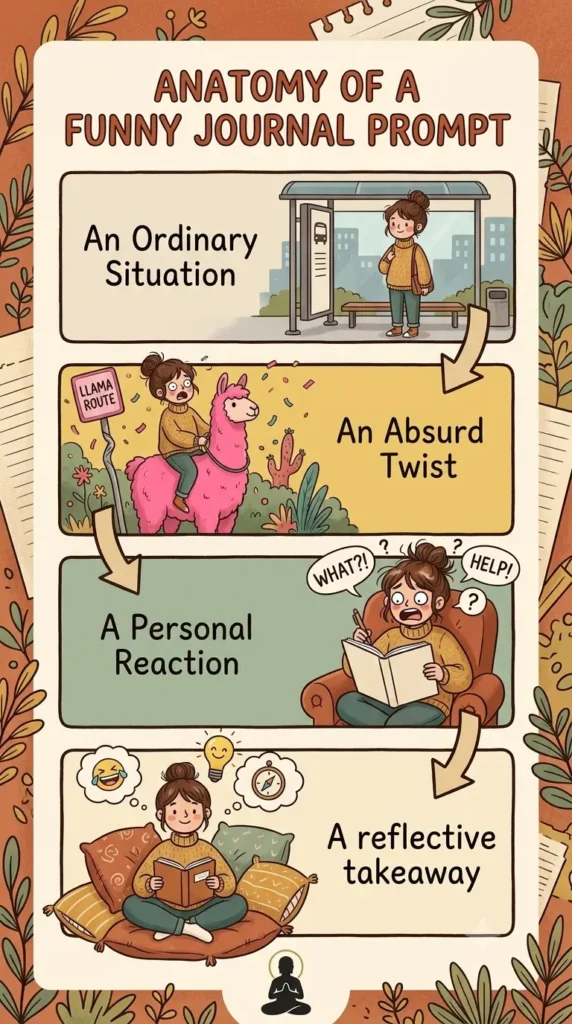
How funny prompts make journaling less intimidating
Here’s a myth worth killing. Every entry does not need a life-changing insight.
Most people believe it anyway. So they stare at a blank page, waiting for something profound to show up. It doesn’t. And a week later, the notebook’s closed for good.
Funny journal prompts skip that trap entirely.
Instead of “Who am I becoming?”, try this: “If your fridge left you a performance review, what would it say?” Same self-reflection. Different road there. You arrive through laughter, not pressure.
That shift changes everything. The goal stops being a “perfect” entry. It becomes answering something amusing. Your inner editor quiets down fast. Grammar stops mattering. Sounding wise stops mattering. You’re just playing with an idea.
Sound backwards? It kind of is. But playful writing often surfaces more honest reflection than forcing something serious ever does. Humour builds enough distance that admitting a bad habit, a quiet fear, or a weird contradiction stops feeling so exposed.
If you’d rather build confidence than dig into the silly stuff first, affirmation journal prompts work through a more intentional, statement-based angle instead.
Why humour can improve self-reflection
Humour doesn’t get in the way of self-reflection. It can make reflection feel safer to attempt.
Here’s why. Humour creates psychological distance. That distance lets you look at an uncomfortable thought without getting swallowed by it.
Researchers studying self-distancing, viewing an experience from a step back instead of reliving it, have connected that shift to steadier reflection and less repetitive overthinking, work led by Ethan Kross’s Emotion and Self-Control Laboratory at the University of Michigan. Humour tends to build that same distance on its own. It nudges you to view a moment sideways instead of treating it like a crisis.
Think about your last embarrassing moment. Replaying it exactly as it happened? Uncomfortable, every time. Now picture it as a sitcom scene. Or a ridiculous story you’ll tell friends in five years. Same event. Completely different emotional weight. Nothing about the moment changed. Your angle on it did.
That’s the real job of funny journal prompts. Not dodging hard emotions. Approaching them from a different direction instead. For plenty of people, especially anyone building a set of funny journal prompts for adults into a daily habit, that’s a far easier way to keep showing up than trying to sound profound every single day.
Still want more structure once the laughs settle? Pairing playful entries with a steady gratitude practice or a few gratitude worksheets rounds the habit out nicely.
How to Use Funny Journal Prompts Without Overthinking
Funny journal prompts fall apart the second you treat them like homework. You don’t need a punchline. You don’t need a clean page either. The goal is loose thinking, not a performance. Laughed? Cringed? Wandered off mid-sentence into something weird? Good. That’s the prompt working exactly as it should.
Write Quickly, Before Your Brain Steps In
Set a timer for five minutes. Start before your brain starts editing.
The first answer that lands in your head usually beats the polished one you build two minutes later. Sound backwards? It isn’t.
Treat funny prompts like improv, not an exam. Ask “What would your fridge text you if it could?” and your gut answer will beat anything you carefully construct. Speed creates honesty. That’s the whole mechanism.
This is exactly why humor sticks as a journaling habit when nothing else does. It feels like play, not a test. You spend less time hunting for the “right” line. You spend more time watching what your mind actually does when nobody’s grading it. Curious what that looks like across a longer stretch? The 365 journal prompts for mental health collection shows the same pattern on a bigger scale.
Don’t Worry About Sounding Smart
A journal isn’t a portfolio. Nobody’s checking your vocabulary here.
Some of the funniest entries come from nothing special at all. The group chat that survived another meltdown. The oat milk you forgot again. The imaginary court case your alarm clock keeps losing. Those small, dumb details often say more about you than three paragraphs of careful reflection ever could.
Perfectionism kills more journaling habits than anything else. Give yourself permission to sound messy. Sarcastic. A little ridiculous. That’s what keeps the habit alive past week one.
Want something more structured on the days perfectionism creeps back in? A few gratitude worksheets work the same muscle with a bit more scaffolding built in.
Follow the Prompt Wherever It Goes
A funny prompt is a starting line, not a destination.
Start writing about a zombie apocalypse. End up reflecting on your first part-time job instead. Don’t pull yourself back. Let it wander.
That’s how real self-reflection actually works, half the time. One weird idea drags in another, the same way one recommendation on a streaming app leads you somewhere you never meant to land. You rarely finish where you started. You usually find something worth keeping anyway.
Why does the detour matter more than the destination? Because forcing meaning into every prompt kills the very thing that makes it useful. James W. Pennebaker’s research on expressive writing backs this up. Writing works best when thoughts get to develop on their own, not when you censor them line by line. Sometimes the detour is the whole point. Nothing more complicated than that.
If the same wandering shows up when you write toward yourself instead of away from a prompt, the affirmation journal prompts guide covers that other half of the habit.
60 Funny Journal Prompts for Gen Z
Journal prompts funny enough to make you laugh at yourself work differently than most reflection exercises. They don’t ask for wisdom. They just ask for honesty, and maybe a little drama.
Forget sounding like a “deep journaling exercise.” These prompts hand you permission to be weird, blunt, and slightly over-the-top. Use them when overthinking every sentence feels exhausting, or when your journal has quietly turned into another self-improvement chore. If a calmer entry point feels better some days, the mindfulness journal prompts guide covers that side of the practice in more depth.
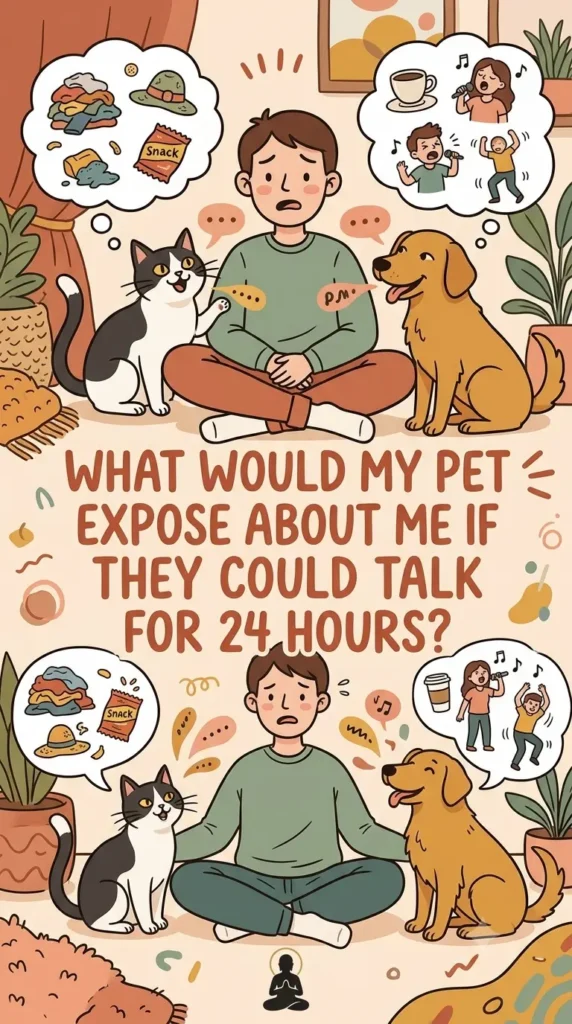
Funny prompts about yourself
Self-reflection doesn’t need a serious face. Or a cup of tea beside it either.
Sometimes the fastest way to notice your own habits and quirks is to laugh at them first. Not analyze them. Not fix them. Just laugh, then write down what’s actually there.
Try these:
- What is the most unnecessary thing I have ever spent money on, and do I regret it?
- If my personality came with a warning label, what would it say?
- What is my most dramatic reaction to a completely normal situation?
- What tiny inconvenience turns me into a full-time comedian?
- If my search history became a documentary, what would the title be?
- What weird habit do I secretly hope nobody notices?
Completely ridiculous “What If…” prompts
Impossible questions make the best funny prompts. There’s no correct answer to chase, so your imagination just takes over.
Try these:
- What if humans had to announce their thoughts out loud for one day?
- What if my fridge could write a review about my eating habits?
- What if I woke up tomorrow with the ability to understand every animal?
- What if my phone could reveal all the embarrassing moments it has witnessed?
- What if every person had a personal theme song that played when they entered a room?
- What if I accidentally became famous for something completely random?
Funny friendship prompts
Friendships run on inside jokes, chaotic group chats, and stories that make zero sense to outsiders. These prompts catch those moments before they vanish into old messages.
Try these:
- What is the funniest thing my best friend has ever done?
- If my friend group had a reality show, what would it be called?
- Which friend would survive a zombie apocalypse, and who would be gone in five minutes?
- What is the weirdest argument my friends and I have ever had?
- If my friends described me using only three memes, which ones would they choose?
- What friendship moment deserves to be turned into a movie scene?
Family chaos prompts
Family stories are rarely tidy. That’s exactly what makes them funny.
Small arguments. Strange traditions. The same joke told for the tenth time. These become the memories you actually appreciate later, usually once enough time has passed to laugh about them.
Try these:
- What is the most predictable thing someone in my family does?
- If my family had a group chat documentary, what would the funniest scene be?
- What family rule makes absolutely no sense but still exists?
- What is the funniest excuse someone in my family has used?
- If my family members switched personalities for one day, what would happen?
- What family moment would make the best comedy sketch?
Dating and relationship prompts
Most funny journal prompts skip relationships entirely. That’s a mistake. Dating is where some of the most relatable chaos happens.
Awkward conversations. Terrible first impressions. Expectations that never matched reality. All of it makes excellent journaling material, and honestly, most of it is funnier in hindsight than it felt in the moment.
Try these:
- What is the funniest dating advice I have ever received?
- If my dating life was a TV series, what would the title be?
- What is my most awkward romantic moment that I can laugh about now?
- What fictional character would probably give me terrible relationship advice?
- What is one dating rule I would happily delete forever?
- If my future partner read my journal, which entry would make them laugh the most?
Social media and internet prompts
Gen Z has a strange relationship with the internet. One notification, one accidental like, one old photo resurfacing, and suddenly there’s a whole emotional storyline running in five seconds flat.
Try these:
- What is the most embarrassing thing I have ever posted online?
- If my phone usage was turned into a monthly report, what would shock me?
- What meme perfectly describes my current life?
- If my favourite app disappeared tomorrow, what would I miss most?
- What internet trend do I secretly hope never comes back?
- If my algorithm could describe my personality, what would it say?
School, university and work prompts
Studying, starting a career, or figuring out the next move all come loaded with small, ridiculous moments. Most of them go unrecorded. That’s a shame, because they’re usually the funniest part of the week.
These funny journal prompts for adults work just as well for students juggling deadlines as they do for anyone deep into a nine-to-five.
Try these:
- What is the funniest excuse I have heard for missing a deadline?
- If my workplace or classroom had a reality show, what would happen?
- What task do I pretend to understand but actually confuse me?
- What is my most questionable productivity habit?
- If my laptop could complain about me, what would it say?
- What small work or study moment deserves an award?
Future-you prompts
Future journaling doesn’t have to mean serious goal-setting. Sometimes imagining your future self as slightly older, slightly wiser, and slightly more chaotic is far more interesting.
If you’d rather aim that future-focused energy at something steadier, the affirmation journal prompts guide builds confidence and self-belief using a similar forward-looking angle.
Try these:
- What ridiculous thing do I hope future me laughs about?
- What current habit will future me probably find hilarious?
- If future me sent a voice note today, what advice would they give?
- What random achievement would make future me proud?
- What trend from 2026 will future me make fun of?
- What question would I love to ask myself five years from now?
Random absurd imagination prompts
These prompts are pure nonsense. That’s the whole point.
Creative thinking often kicks in the moment you stop trying to make every idea useful. Nothing here needs to go anywhere. It just needs to exist on the page.
Try these:
- If my pet became my manager, what rules would they create?
- If vegetables had personalities, which one would be the drama queen?
- If my shoes could tell stories, what secret would they reveal?
- If I opened a restaurant with the weirdest menu ever, what would I serve?
- If aliens visited Earth and followed me around, what would confuse them most?
- If my life had a completely inaccurate narrator, what would they say?
Quick one-line prompts (rapid-fire)
Short prompts earn their place on the days writing feels like one more task on an endless list. One sentence is enough. Nobody’s grading a masterpiece here. The goal is showing up, not showing off.
Try these:
- My most unnecessary opinion is…
- Today’s weirdest moment was…
- A random thing that made me laugh…
- My brain at 2 AM usually thinks about…
- The fictional character who understands me most is…
- Something I take way too seriously is…
A funny journal entry doesn’t need to be clever enough for anyone else to read. Not ever. The best prompts are usually the ones that make you stop and think, “why did my brain even come up with that?” That confused little pause? That’s often where the real self-reflection starts.
Want to keep the reflection going once the laughing stops? Pair a few of these with something steadier, like gratitude worksheets or a running list of things to be thankful for. Funny and grateful aren’t opposites. They just work different muscles, something the how to practice gratitude guide breaks down further.
Funny Journal Prompts for Adults That Don’t Feel Childish
Adulthood doesn’t come with an instruction manual. It just comes with rent due dates and group chats that never stop buzzing. That’s where funny journal prompts actually earn their place. Not by forcing a joke. By noticing the weird little moments that already make up your week, the rent stress, the chaos in your messages, the dating app horror stories, the daily act of pretending you have it together.
Funny journal prompts for adults that match real life
Nobody said adulthood had to be a serious business. Not every day. Sometimes the most honest entry starts with laughing at the fact that your biggest win this week was replying to three unread texts.
These funny journal prompts for adults fit a specific stage of life. Your problems are real. Some of them are also a little ridiculous.
Try these on for size:
- What would my bank account say if it could send me a passive-aggressive text?
- If my monthly rent had a personality, what kind of person would it be?
- What’s the most dramatic thing I’ve done over a tiny inconvenience?
- If my group chat became a reality show, what would each person be known for?
- What’s the funniest excuse I’ve made for dodging a task?
- If my burnout wrote a review of my lifestyle, what would it say?
None of these need a perfect answer. Write the first ridiculous thing that comes to mind. That’s the whole exercise.
Humour around dating, work, and everyday chaos
Adult journaling gets more useful once it reflects your actual life. Not some imaginary version where mornings start with a green smoothie and a made bed.
Write about the awkward first date. The confusing work email you reread four times. The forgotten password. The impulse purchase you already regret. Or the five-minute pep talk you gave yourself before sending one simple text.
A funny prompt works like a pressure valve. It lets you look at a stressful moment from a slightly sideways angle, without brushing it off completely.
That sideways angle has actual research behind it. Work on emotional distancing suggests that stepping back from a situation, even through humour, changes how the brain processes it. The event doesn’t shrink. Your reaction to it does.
For Gen Z especially, humour already runs through daily communication. Memes, inside jokes, absurd observations about nothing in particular, these are already how frustration gets processed. Bringing that same energy to a page turns journaling into something closer to a conversation with yourself than a chore on a checklist. If you’d rather channel that same voice into building yourself up instead of laughing things off, the affirmation journal prompts guide picks up right where the humour leaves off.
Why Funny Journaling Actually Works
A blank page doesn’t ask you to be funny. Most people assume it does anyway.
That’s the real block. Funny journaling strips out the pressure to sound wise. Treat the page like a chat with yourself, not a performance, and reflection gets easier. It also gets more honest, almost by accident.
Makes journaling easier to stick with
The writing was never the hard part.
Opening a blank page is. Staring at it, wondering what you’re even supposed to say. That’s where most journaling habits die before they start.
Funny prompts kill that friction fast. “What would my pet roast me for?” gives your brain a place to land immediately. So does “what’s the weirdest hill I’d die on?” No overthinking required.
Here’s why that matters. Habits grow through repetition, not intensity. A messy five-minute entry you actually write beats the flawless one you keep pushing to tomorrow. Every time.
Funny journal prompts for adults also work well if traditional reflection feels too serious for your taste. Not every entry needs a breakthrough. Some nights, writing about your imaginary celebrity feud is the whole session, and that’s fine. The habit is the win, not the insight.
Helps reduce perfectionism
A journal is private. Nobody grades it.
It doesn’t need clean sentences. Or deep insight. Or anything that sounds remotely like a motivational poster.
Funny prompts lower those expectations on their own. They hand you permission to write badly, exaggerate wildly, complain about nothing, and chase a random thought off a cliff. That looseness makes the page feel smaller. Less like a test.
Psychologist James W. Pennebaker’s work on expressive writing points to something similar: putting thoughts into words helps people process what they’re carrying. The benefit sits in the expression itself. Not in how polished the sentence sounds.
Sound too simple to matter? It is. That’s exactly why it works.
Encourages creative thinking
Humor changes how you approach a question. You stop hunting for the “correct” answer and start chasing whatever’s strange or unexpected instead.
Take a prompt like “if my life had a completely unnecessary warning label, what would it say?” There’s no right response. Your imagination just has to show up.
This works like a warm-up. Writers use it. Artists use it. Anyone stuck in predictable thinking can use a playful question to shake something loose. It’s a small mental stretch before the real work starts.
Can support emotional wellbeing
Funny journaling won’t replace a therapist. It was never meant to.
But humor does shift how people relate to stress. The American Psychological Association’s guidance on handling life’s stressors points to humor and laughter as one of several tools that can genuinely support mental and physical health. That idea connects to cognitive reappraisal, where you change how you interpret a moment instead of just reacting to it on autopilot.
Nobody’s asking you to force a laugh when something actually hurts. That backfires. Every time.
The real value is an angle, not an escape. One where you can name an everyday frustration on the page without letting it take over the whole entry.
If you’d rather ease into reflection through structure than jokes, gratitude worksheets offer a gentler starting point, and how to practice gratitude walks through the habit step by step. Funny journal prompts and mindfulness journal prompts actually share the same goal underneath the tone: noticing what’s already there, without judging it first.
Common Mistakes When Using Funny Prompts
Funny journal prompts exist to make reflection easier. Not harder. Not a performance.
That’s the trap most people fall into. They forget humour works best when it uncovers honesty, not when it buries it. A solid funny journal prompt still says something real about your habits, your worries, your relationships, your whole personality.
Trying to Be Funny Instead of Honest
A funny journal entry doesn’t need to win a comedy contest. Nobody’s grading punchlines here.
That mindset backfires fast. It turns journaling into another stage.
Take a prompt like “What would your pet say about your daily routine?” You don’t need the cleverest possible line. The more interesting answer is usually simpler. Something like: “My cat would probably say I spend too much time staring at my phone and calling it rest.”
That’s it. That’s the whole entry.
The humour comes from noticing your own patterns, not performing for an invisible audience. Force every answer to sound clever, and you’ve built yet another mask to maintain. Journaling was never meant to be public. It’s not a caption. Not a tweet. Not a message for the group chat.
This is where funny journal prompts for adults actually earn their keep. Adult life comes loaded with pressure to seem put-together, even in private. A little absurdity strips that away. Some of the mindfulness journal prompts built around noticing your own patterns work the same way. Humour just gets there faster.
Writing Too Much
More words rarely mean deeper thinking.
A lot of people quit journaling early. Why? They assume every entry needs to fill pages. It doesn’t. A funny prompt can work with three sentences. A messy paragraph. Even a few bullet points scribbled before bed.
Think of prompts as a doorway. Not a homework assignment.
The job of a prompt is small: start a thought. Not produce a polished essay. If a single line captures the moment, stop there. Nothing wrong with stopping there.
Judging Your Answers
Here’s an honest take: your funniest entries are usually the ones you almost delete.
Something random. Something dramatic. Something borderline ridiculous. Let it stay anyway. The real value of journaling often comes from catching your raw, unfiltered thoughts before your inner critic gets a chance to edit them down.
Psychologist James Pennebaker’s research on expressive writing has looked at how writing freely about personal experiences supports emotional processing. Funny journaling runs on the same idea. Your first draft doesn’t need polish.
It just needs to be true.
If you’d rather work from a steadier structure while you build that habit, a few gratitude worksheets can hand you the framework, so the humour has somewhere honest to land.
Free Funny Journal Prompts Printable
A printable page sounds handy. Most people download it, open it once, then forget it exists. That’s the real problem with a funny journal prompts printable. Not the template. The prompts feel like homework.
A good one should do the opposite. Grab a page. Pick one ridiculous question. Write for five minutes. Don’t try to make it deep.
Why does that work better than a structured guide? Because there’s nothing to get right. No format to follow. No neat conclusion waiting at the bottom of the page.
Use it when your brain feels stuck. Use it when journaling feels too serious for the day you’re having. Or use it when you just want a lighter way to check in with yourself. Some days call for structure, like the prompts in mindfulness journal prompts. Other days call for nonsense. Both count.
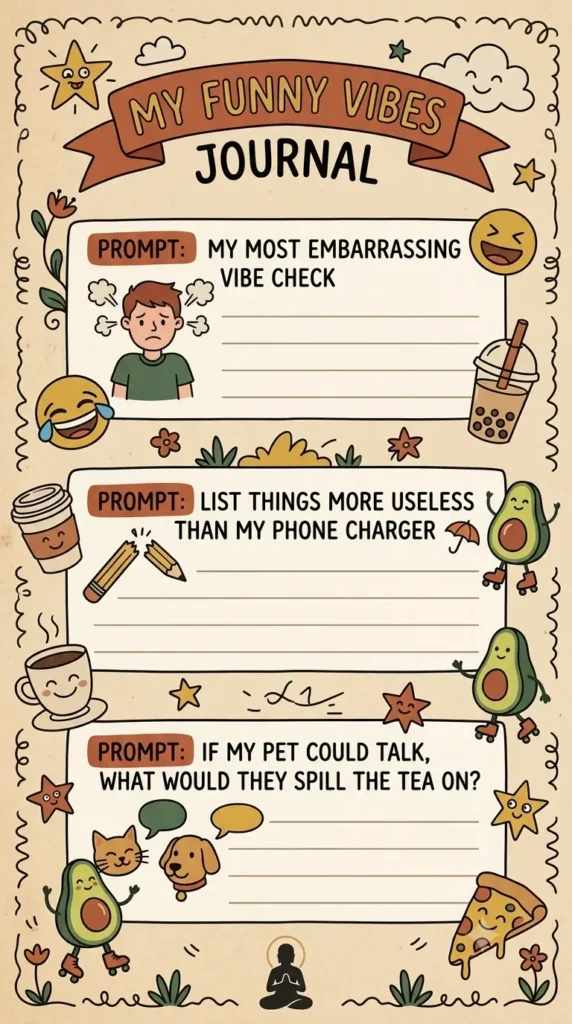
These funny journal prompts for adults aren’t meant to be polished. They’re meant to get a pen moving when nothing else will. Keep it messy. Keep it random. Some of the most honest entries start with a joke, and that’s exactly the point.
If gratitude is more your speed some days, gratitude worksheets sit at the other end of this same shelf.
Conclusion
Affirmations aren’t magic words. Writing “I am confident” on a rough day won’t erase every doubt you carry. That’s true. It doesn’t make affirmation journaling pointless, though.
The real value sits somewhere else. It comes from repeating the thoughts, beliefs, and actions you actually want to keep.
Think of your affirmation journal prompts as a simple check-in point. A place to question the negative loop in your head. A place to notice progress you’ve already made. A place to reconnect with what matters to you.
Psychologist Claude Steele’s self-affirmation theory backs this up. Later research on expressive writing points the same direction. Both suggest something simple: reflecting on your own values changes how you handle hard moments.
Start small. Pick one prompt. Write honestly about it, even the messy parts. Let the practice grow with you.
The goal isn’t becoming a new person overnight. Not even close. It’s about noticing who you’re already becoming, one prompt at a time.
Want to build on this? Pair your prompts with a steady gratitude practice, or work through a set of gratitude worksheets to track how your thinking shifts over weeks. If you’d rather ease in with something lighter, mindfulness journal prompts or a quick list of grateful affirmations make a good starting point too.
Frequently Asked Questions
What are some fun journal prompts?
Fun journal prompts are playful questions that make writing feel less serious and more personal.
They can include silly scenarios, unexpected opinions, embarrassing memories, or imaginative “what if” situations.
Examples include “What would my pet say about me?” or “What is my most dramatic overreaction ever?”
Can funny journal prompts improve mental health?
Funny journal prompts can support emotional wellbeing by making self-reflection feel lighter and easier to start. Humour can create psychological distance from stressful thoughts, helping you look at situations from a different angle. Research on humour and coping, including work by Martin (2007), explores this connection.
What are some funny AI prompts?
Funny AI prompts are creative requests designed to get unexpected or entertaining responses from tools like ChatGPT. Examples include asking AI to roast your daily routine, rewrite your life as a movie script, create absurd fictional characters, or imagine your future self giving advice.
How often should I use funny journal prompts?
You can use funny journal prompts whenever regular journaling starts feeling repetitive or forced. Some people enjoy answering one prompt daily, while others use them once or twice a week.
The goal is not consistency perfection, it is creating a habit that feels enjoyable enough to return to.
What’s the difference between funny journal prompts and creative writing prompts?
Creative writing prompts usually aim to create a finished piece, such as a story, poem, or scene meant for others to read. Funny journal prompts are different because they focus on private, unpolished reflection.
The audience is you, and the goal is exploration rather than creating something perfect.
Can adults use funny journal prompts, or are they just for teenagers?
Adults can absolutely use funny journal prompts. Humour is not limited to teenage experiences; adults also need ways to process awkward moments, work stress, relationships, and everyday chaos.
The best prompts feel relatable, not childish, because they reflect real parts of adult life.

It’s Bhaskar!
Well, I am not a psychologist a monk, or a philosopher by training. I’m just an engineering graduate.
‘The Empty Self’ is where I write about that idea, and what it actually means for ordinary life, anxiety, identity, habits, the stories we tell ourselves about who we are. I don’t have a psychology degree, and I’m not offering therapy or clinical advice. What I do have is thought and clarity, and genuine curiosity about why we suffer the way we do and how much of it might loose once we shed this ‘fixed identity’.