

Ten minutes on social media and suddenly your life feels small. Everyone else has better friends. Cooler vacations. A more exciting story to tell. Comparison sneaks in fast, and once it’s part of your daily scroll, it gets hard to be thankful of what you have. Even when your life is genuinely full of people, chances, and moments worth noticing.
Here’s an honest take on gratitude: it was never about pretending everything’s perfect. It’s about noticing what’s already working instead of chasing what’s missing. For teens, that one shift can turn a rough day into something lighter. Ordinary moments start to feel like they matter again.
Sound too simple? It is. That’s why it works.
This guide lays out more than 50 things you can genuinely be thankful for. Along with real ways to build a habit of noticing, one that feels true, not forced. If you want the full picture first, the complete guide to things to be thankful for covers the basics this list builds on.
Table of Contents
Disclaimer
This blog is written and edited with the help of AI, then reviewed by me before publishing. As a result, the content is for general reflection only, not therapy or medical advice, and I’m not a licensed mental health professional. If you’re in crisis, please contact 988 if you’re in US or a local crisis service of your country instead of relying on this site.
What Does It Mean to Be Thankful for What You Have?
Being thankful for what you have isn’t about lowering the bar. It’s not pretending your life is perfect either. It’s noticing the people, the small wins, the chances you already got. Even while you’re chasing something bigger.
Appreciating More Than Just What You Own
Most people hear “gratitude” and picture stuff. A new phone. A bigger room. But ask a teenager what actually matters and the list looks different. The friend who texts “you good?” after a rough day. A teacher who actually believes you’ll figure it out. Laughing so hard your stomach hurts. Learning something new just because you wanted to. Being thankful for what you have means clocking the stuff that holds you up quietly, day after day, the stuff you stopped noticing a while ago.
Gratitude Doesn’t Mean Ignoring Difficult Feelings
Here’s a myth worth killing. Gratitude does not mean smiling through everything. Not even close. Gratitude and hard feelings live in the same space, at the same time. You can be stressed about a test, mad at your family, gutted over a loss, and still see the people carrying you through it. That’s the whole point.
It doesn’t erase the bad stuff. It just makes room for the good stuff too. Forced positivity can’t do that. Curious how these two feelings sit side by side without canceling each other out? Can gratitude and anxiety exist at the same time breaks down exactly that.
Why It’s Easier to Notice What’s Missing
Teenage brains are still under construction. The parts that handle decisions, emotions, and reward are still catching up. So the brain locks onto what’s missing. Higher grades. More followers. Fitting in somewhere, anywhere. Gratitude doesn’t ask you to pretend none of that matters. It just nudges your focus somewhere else for a minute. Research from the Greater Good Science Center at UC Berkeley backs this up. Practicing gratitude regularly can build well-being and strengthen relationships over time, according to their gratitude research.
If you’re looking for a place to start, a gratitude list or a few gratitude examples make it concrete. Not abstract. Not a vibe. Actual things you can point to and say: that one, I’m keeping that.
Why Learning to Be Thankful of What You Have Matters
Being thankful for what you have changes how you read your own life. Not the big story. The daily one.
It won’t erase stress. It won’t erase disappointment either. But it will pull your attention toward the people, chances, and quiet wins you’d otherwise skip past. During your teen years, that shift shapes your confidence. It shapes your friendships too. And it sticks around longer than most habits do.
Perspective: You Start Seeing the Bigger Picture
Teen life feels loud. Almost everything is happening for the first time.
A bad grade. A fight with a friend. Missing one party. Any of these can feel like the whole world caving in.
Practicing gratitude doesn’t shrink those moments. It just adds context. You can be annoyed about a test and still notice a teacher who’s rooting for you. You can feel nervous about next year and still see how far you’ve already come.
That’s the real shift. One rough afternoon stops being the whole story.
Comparing Yourself to Social Media Gets Easier to Handle
Social media sells highlights. Vacations. Trophies. Perfectly angled selfies. Not the stress behind them. Not the self-doubt either.
Keep scrolling through someone else’s best moments and you’ll start believing you’re behind. That’s the trap. Being thankful for what you have interrupts it. Instead of asking “why don’t I have that?” you start asking “what do I already have that actually matters to me?”
Small shift. It won’t kill comparison overnight, but it loosens its grip on your mood fast.
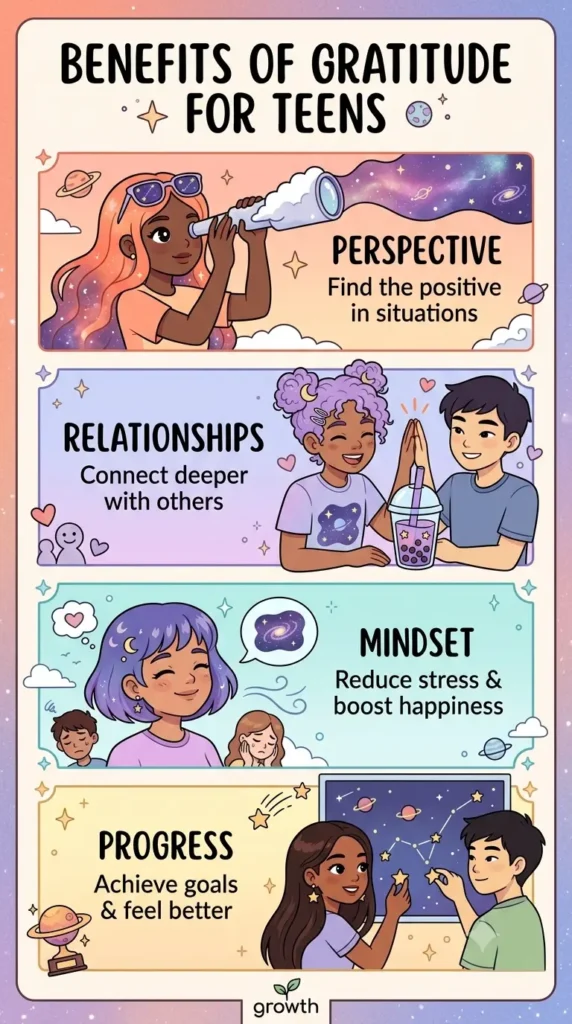
You Start Noticing Progress, Not Chasing Perfect
Most teens obsess over the finish line. Meanwhile, they forget how far back the starting line was.
Being thankful for what you have means clocking your own growth too. Maybe you finally speak up in class without your hands shaking. Maybe you handled a hard conversation better than you would’ve last year. Maybe you found a hobby that actually lights you up.
Progress is quiet. It doesn’t announce itself. Gratitude is what makes you notice it before your inner critic drowns it out.
Your Relationships Get Stronger
People feel it when their effort goes unnoticed. They feel it even more when it doesn’t.
Thank the parent who drives you to practice every week. Thank the friend who texts “you good?” after a rough day. Thank the teacher who stays late to help you get it. Small words. Real weight.
Gratitude isn’t just something you feel quietly inside. It’s something you show. And those small moments of “thank you” build connections that hold up over time.
Want to build the habit further? 365 Journal Prompts for Mental Health is a solid place to start writing it down daily.
It Builds a Healthier Mindset You’ll Carry Into Adulthood
A grateful mindset doesn’t promise an easy life. Nobody’s promising that. It just means believing something is still worth appreciating, even on the hard days.
That’s exactly why this habit matters most right now. It’s a skill, not a phase. The teenage years are practice for the rest of your life. The more you notice what’s working alongside what isn’t, the steadier your outlook becomes.
Sound too simple? It is. That’s why it works.
One bad day stops defining your whole week. That’s the whole point.
If anxiety tends to show up alongside your gratitude practice, Can Gratitude and Anxiety Exist at the Same Time? walks through exactly that tension.
Looking for more ways to practice being thankful for what you have every day? Check out our full guide: Things to Be Thankful For, covering hundreds of ideas and daily inspiration.
50+ Things Teenagers Can Be Thankful For
To be thankful of what you have doesn’t mean pretending life is perfect. It means noticing the people, chances, and small moments already adding value to your days. Practice spotting these things enough, and appreciating life gets easier, even with the hard parts still in the picture.
Most gratitude lists chase big milestones. But for most teens, the real stuff to appreciate is oddly plain. A friend who texts first. A teacher who believes in you. The playlist that calms you down after a rough day. Small on their own. Together, they shape your whole week.
At Home
Home isn’t perfect for everyone. Gratitude doesn’t ask you to pretend it is. Even in houses that feel messy or tense, small comforts still show up if you look. Looking for them isn’t about lowering your standards. It’s about training yourself to notice support that quietly fades into the background otherwise.
Here are a few things you might be thankful for at home:
- Family members who encourage you, even without the perfect words
- A place to sleep and rest after a long day
- Regular meals, homemade or takeout
- A favorite chair, corner, or room to unwind in
- Daily routines that create steadiness
- Someone who checks if you’ve eaten or made it home safe
- The freedom to make your space feel like yours
- Family traditions, inside jokes, shared memories that make home familiar
You don’t have to feel grateful every single day for every piece of home life. That’s not the goal. The goal is simpler: notice what brings comfort or safety, even when everything else feels shaky.
Friends & Relationships
Teen friendships shape your confidence. They shape your choices too. Good relationships aren’t measured by follower counts or contact lists. They’re measured by who stays once things get complicated.
Things worth appreciating include:
- Friends who let you be yourself, no performance required
- Someone who listens instead of jumping to fix everything
- Classmates who make school feel less heavy
- Teachers who notice your effort, not just your grades
- Coaches or mentors who push you to get better
- Siblings who get experiences your parents might not
- Neighbors or relatives who actually care how you’re doing
- The chance to meet people with different backgrounds and views
Strong friendships aren’t flawless. Why would they be? In practice, the healthiest ones run on honesty, forgiveness, and a lot of ordinary moments, not constant excitement.

Your Body, Health & Abilities
This isn’t about loving every inch of how you look. That’s a different conversation entirely. Gratitude for your body means appreciating what it lets you do, even on days your confidence takes a hit.
Your body runs thousands of small jobs daily without asking for credit. It carries you through school. It heals after injuries. It lets you take in the world through your senses.
Some things you can appreciate:
- The ability to walk, run, dance, or play your sport
- Eyes that let you watch sunsets, movies, your favorite creators
- Ears that let you enjoy music and conversation
- Hands that write, cook, create art, or play instruments
- A brain that keeps learning and adapting
- Your sense of humor
- Your creativity
- Your ability to bounce back after hard moments
- The energy to keep trying after setbacks
Plenty of teens spend years fixated on what they’d change about themselves. Gratitude nudges that attention somewhere better: toward everything already working in your favor. For a broader list of angles, check these unique things to be thankful for.
School, Learning & Future Opportunities
School wears people down. Homework piles up. Exams create pressure. Comparing yourself to classmates feels nearly impossible to avoid. Still, school offers more than what shows up on a report card.
Even on days you can’t stand the place, some parts deserve appreciation:
- Teachers who make hard topics click
- Access to books, libraries, and learning resources
- Skills that stick with you long after graduation
- Clubs, sports, music, and creative outlets
- The chance to find a subject you actually enjoy
- Meeting future friends and collaborators
- Mistakes that teach you to improve instead of quit
- The freedom to choose your own path over time
Academic pressure is real. That’s exactly why gratitude shouldn’t turn into another task on your list. A few minutes reflecting on something good after a rough school day tends to make the rest feel more manageable.
Technology & Modern Opportunities
Most people treat technology as either good or bad. Neither view holds up well. Teens today have access to chances that simply didn’t exist a generation back. Sure, technology can turn into a distraction machine. It’s also one of the strongest tools for learning, creating, and connecting when you use it on purpose.
Things worth being thankful for include:
- Internet access for learning almost any skill
- Platforms that make complex topics click faster
- Creative software for drawing, writing, editing, or music
- Video calls that keep you close to distant friends and family
- Online communities built around shared hobbies
- Free courses, tutorials, and learning videos
- Translation tools that ease conversations across languages
- The ability to share your creativity with people everywhere
Technology means a lot more when you’re using it to make something, not just scroll through what everyone else made.
Small Everyday Moments Easy to Miss
Gratitude usually grows in plain moments, not big ones. These experiences rarely make it to a highlight reel. They still make ordinary days better, quietly, every time.
Think about moments like these:
- Your favorite song playing at exactly the right time
- The smell of rain after a hot afternoon
- A meal that reminds you of home
- Laughing so hard with friends you forget your worries for a while
- Finishing a book or series you actually loved
- Watching the sky shift during sunset
- Time spent on a hobby, no interruptions
- A walk without checking your phone every few minutes
- A pet greeting you at the door
These moments slip by unnoticed because they happen so often. That’s the irony. It’s also exactly what makes them worth something. For a running list you can revisit, these things to be grateful for daily cover more of this ground.
Personal Growth & Difficult Experiences
For most people, the hardest experiences end up teaching the most. That doesn’t mean you owe gratitude to every painful situation. Some things just hurt. It’s fine to say so.
What you can appreciate instead is who you’re becoming because you made it through.
That might include:
- Learning that failure isn’t the end of your story
- Getting more patient after setbacks
- Building confidence by facing what once scared you
- Understanding your own values and boundaries
- Letting go of friendships that stopped helping you grow
- Finding strengths you didn’t know you had
- Becoming more compassionate because you’ve struggled too
- Realizing your identity runs deeper than grades, looks, or popularity
Growth rarely feels exciting while it’s happening. It’s a bit like exercise. You feel the soreness long before you notice the strength. Over time, though, those rough patches usually become the reason you’re ready for whatever shows up next. If you want to go further with this idea, these deep things to be thankful for dig into gratitude that goes beyond everyday comforts.
For the full picture on building a grateful mindset as a teen, the complete guide to things to be thankful for is worth bookmarking too.
How to Be Thankful for What You Have Every Day
Being thankful for what you have isn’t about faking a smile on a hard day. It’s not a switch you flip. Real gratitude grows from small habits that help you notice the good stuff already sitting in front of you. Learning to be thankful of what you have works like any other skill. It gets easier with reps. Not with the occasional burst of motivation that fizzles out by Thursday.
Keep a Gratitude Journal
Writing down what you’re grateful for trains your brain to catch the good moments. It doesn’t take much. Some days you might write about finally cracking a math problem that wrecked your head all week. Other days it’s a dumb joke from a friend, or how good your favorite hoodie feels after a long day.
Forget making it perfect. The goal is just paying attention.
If journaling tends to spiral into overthinking for you, gratitude journaling for anxiety breaks down how to keep entries light instead of heavy.
Try the “Three Things” Practice
Three things a day. That’s the whole practice. At the end of each day, write down three things you’re thankful for. A warm meal. Homework finished early. Your favorite song playing right when you needed it.
Give it a couple weeks. You’ll start noticing these moments while they’re happening, not just when you sit down to write about them, because some part of you already knows you’ll be looking back later. For more ideas on what counts, things to be grateful for daily has a running list worth stealing from.
Tell Someone You Appreciate Them
Gratitude doesn’t have to stay locked in a notebook. Send a quick text thanking a friend. Tell a teacher their class actually mattered to you. Let a parent know you noticed the thing they did without being asked.
Why does this work when a private journal entry sometimes doesn’t? Because it closes the loop. Saying thanks out loud strengthens the relationship and reminds you how many people are quietly holding your life up. Often, both people walk away feeling seen. Not just the one saying thanks.
Leave Yourself Small Reminders
Most people assume gratitude takes quiet time they don’t have. It doesn’t. It’s surprisingly easy to forget what matters when you’re stressed and running on fumes. A sticky note on your mirror. A gratitude app buzzing at the right moment. A phone wallpaper with one line that actually means something to you.
Keep it simple. The reminder doesn’t need to be clever. It just needs to interrupt the loop of constantly chasing what’s next.
End the Day with a Quick Reflection
For most people, the day plays back as a highlight reel of everything that went wrong. Before bed, spend one minute flipping that. Think of one moment that made the day a little better. Someone held the door. You laughed until your stomach hurt. You simply made it through a rough one, and that counts too.
This isn’t a big shift. It’s a small, boring habit repeated on purpose. But stack it over weeks and months, and your attention starts landing on what deserves credit instead of what went sideways. That’s how you actually learn to be thankful for what you have, even in a season that’s kicking your teeth in.
What to Do When You Feel Like You Have Nothing to Be Thankful For
Feeling like you have nothing to be thankful for doesn’t mean you’re ungrateful. It usually means you’re overwhelmed, hurting, or just trying to get through the day. Gratitude isn’t about pushing hard feelings aside. It’s about making room to notice small support sitting right next to the hard stuff. One step. Not a leap.
Validate How You’re Feeling First
Don’t force a list of blessings just because someone told you to. That backfires almost every time. When stress, loneliness, family problems, or anxiety take over, your brain locks onto what’s wrong. That’s normal. It’s wired into you. The same instinct that once spotted danger now dims the good stuff without asking permission.
Start by admitting what’s true: “Today is hard.” You don’t need to pretend otherwise before you can be thankful of what you have. Gratitude doesn’t wait for you to feel fine first.
Start Smaller Than You Think You Need To
Forget trying to feel deeply thankful for everything at once. That’s not how this works. Look for one small thing that made today a little easier instead. Maybe someone held the door open. Maybe your favorite song came on during the ride home. Maybe your dog met you at the door like you’d been gone a year.
Tiny moments aren’t smaller wins. Often, they’re where real thankfulness starts. Nothing more complicated than that.
Stop Measuring Your Life Against Everyone Else’s
Most comparison happens without you even choosing it. Social media makes ordinary life feel like it’s falling short. You start believing everyone else is happier, more put-together, more confident, mostly because you’re comparing your full day to someone’s best five seconds.
The more you compare, the harder it gets to be thankful of what you have. Sound too simple to matter? It isn’t. Pulling your attention back to your own life, even for a minute, uncovers people and chances that comparison tends to bury.
Look for the Support You Usually Don’t Notice
Notice this: not every form of support announces itself. Sometimes it’s the teacher who checks in. Sometimes it’s the friend who always answers. It could be a parent keeping dinner warm, or a quiet library corner where you can finally think straight.
Slow down enough and you’ll see it. You’re not carrying all of this alone. You never really were.
Remember That Gratitude and Hard Times Can Exist Together
Here’s a myth worth dropping: gratitude does not require constant happiness. You can dread an exam and still appreciate the friend who studies next to you. You can miss someone deeply and still be thankful for the time you had.
That’s the whole point. Gratitude isn’t a replacement for hard emotions. It’s a companion to them. If you want to sit with that idea longer, Can Gratitude and Anxiety Exist at the Same Time? walks through exactly how the two coexist. Sometimes the healthiest move isn’t picking gratitude over struggle. It’s letting both be true at once.
Simple Gratitude Exercises Teens Can Try This Week
Building gratitude doesn’t take a full lifestyle overhaul. Small, repeatable exercises stick better than big ones. Why? Because they’re easy to fit into a Tuesday. These five habits help you learn to be thankful of what you have, even during a stressful exam week, without waiting to “feel” grateful first.
One-Minute Gratitude Check-In
Set aside sixty seconds a day. Ask yourself one question: “What’s one thing that made today a little better?” Maybe you finished a hard assignment. Maybe your favorite song came on during the drive home. That’s it. The point isn’t finding something huge. It’s training your attention toward moments you’d normally scroll right past.
Journal Prompts That Go Beyond the Obvious
Writing the same three answers every night gets old fast. Try one deeper prompt instead. “What challenge helped me grow this week?” or “Who made me feel supported today?” push you past the surface. Stuck for ideas? Our gratitude list and gratitude examples guides are built for exactly this, nights when the journal feels repetitive and your brain feels empty.
Send One Thank-You Message
Pick one person this week. Send them a real thank-you text, not a quick “thx.” It could go to a parent who drove you somewhere, a teacher who pushed you, or a friend who let you vent at lunch. Short and sincere beats long and vague. Saying thanks out loud, even in a text, tends to shift your own outlook as much as theirs.
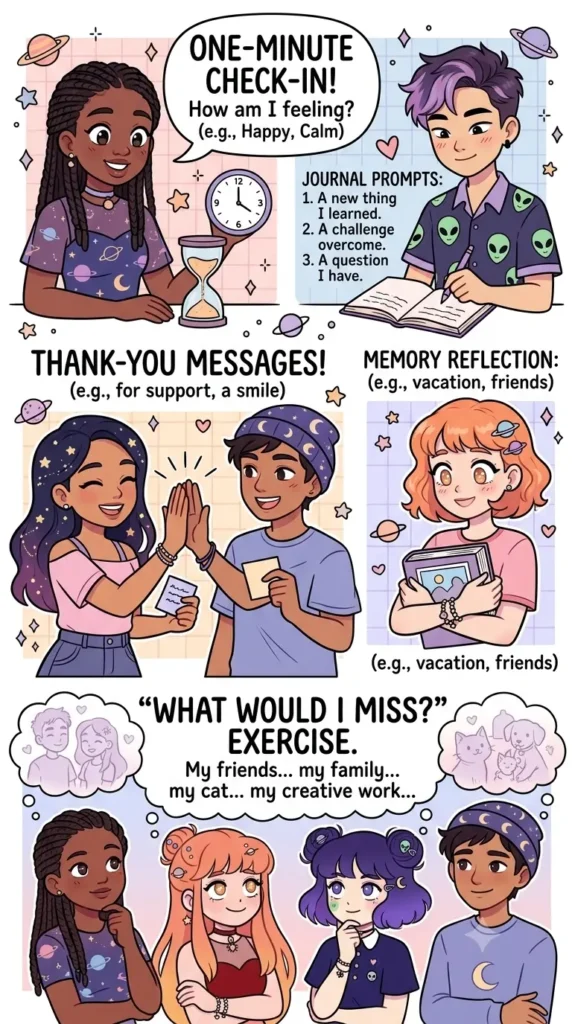
Reflect on a Meaningful Memory
Not every memory needs to be huge. A family trip, a birthday surprise, an ordinary afternoon with the right people, all of it counts. Revisit one. Sit with it for a minute. Doing this reminds you that your life already holds things worth appreciating, even on the days that feel flat.
Try the “What Would I Miss?” Exercise
Picture your Wi-Fi gone for a week. Or your dog. Or your favorite park. Pick one everyday comfort and imagine it missing. You don’t need to spiral into worst-case thinking here. The exercise has one job: show you how fast familiar comforts fade into the background, until they’re gone and suddenly you notice everything they gave you.
Conclusion
Being thankful for what you have does not mean you ignore what’s missing. Not even close. It means noticing the people, the moments, the small wins that are already sitting in your life. Most of it goes unnoticed until someone points it out.
Being a teen is messy. Everything shifts fast, and it’s easy to fixate on the gap between where you are and where you think you should be. That’s the trap. A simple habit changes that. Not a big one. Just a habit.
Write down one good thing today. That’s it. Do it again tomorrow, and watch what starts to shift in how you see your own progress and the people around you.
If you want more ways to build this into your day, this gratitude list is a solid place to start, and these things to be grateful for daily can give you fresh ideas whenever the well runs dry.
Start small. Notice one thing. Give yourself a reason to be thankful of what you have, right now, not once everything else falls into place.
Frequently Asked Questions
How do you become thankful for what you have?
Start small. Look at what’s already good in your life. People. Small comforts. Chances you didn’t earn.
That’s the real starting point.
Being thankful of what you have isn’t about big speeches or grand realizations. It’s about noticing what’s usually invisible. Write down one thing you appreciate each morning. Say thanks out loud sometimes, not just in your head. Small moments count more than the dramatic ones.
Not sure where to begin? A running gratitude list or a few prompts from a 365-day mental health journal makes it stick faster than trying to remember on your own. For the bigger picture on this whole idea, this guide to things to be thankful for is a good place to start.
How can teenagers become more grateful for their lives?
Teenagers build gratitude the same way adults do. Small habits, repeated often.
A journal helps. So does telling someone directly when you appreciate them. That’s it. Nothing fancy required.
Comparison is the real problem here. Scrolling feeds makes gratitude harder, not easier. Notice personal progress instead. What did you have last year that you don’t now? What’s changed for the better since then?
Gratitude journaling built for anxious moments can help teens who feel both behind and overwhelmed at the same time.
What are 5 benefits of being grateful?
Five, roughly speaking. A clearer view of your own life. Stronger relationships. Sharper emotional awareness. More bounce-back when things go sideways. Deeper appreciation for ordinary days.
Gratitude won’t erase your problems. Not even close. But it changes how those problems sit in your head.
For real examples of what this actually looks like, these gratitude examples show it in practice rather than theory.
Why is it hard for teenagers to appreciate what they have?
Attention drifts toward what’s missing. That’s just how the teenage brain works right now.
Social media adds fuel. Academic pressure adds more. Figuring out who you even are yet pulls focus too. All three drag attention toward comparison, away from what’s already good.
This isn’t a character flaw. It’s a stage. It passes.
Want starting points beyond the obvious ones? These unique things to be thankful for and these deeper picks go past family and health into territory most lists skip.
How can gratitude change the way teenagers think?
Gratitude shifts the lens. Not the facts. Just where attention lands.
Instead of counting failures, teens start noticing strengths. Instead of missing things, they start seeing what’s actually there. People who show up. Progress made. Chances still open.
Sound too simple? It is. That’s the whole point.
Want this built into daily life instead of a one-time exercise? These daily things to be grateful for are a solid place to build the habit. And if anxious feelings tend to show up alongside grateful ones, it’s worth knowing the two can exist together.

It’s Bhaskar!
Well, I am not a psychologist a monk, or a philosopher by training. I’m just an engineering graduate.
‘The Empty Self’ is where I write about that idea, and what it actually means for ordinary life, anxiety, identity, habits, the stories we tell ourselves about who we are. I don’t have a psychology degree, and I’m not offering therapy or clinical advice. What I do have is thought and clarity, and genuine curiosity about why we suffer the way we do and how much of it might loose once we shed this ‘fixed identity’.