
A coping skills handout hands you options fast. Stress climbs. Anxiety spikes. Anger shows up before you’ve said a word. Sadness sits heavy in your chest. You don’t need to search your memory for what might help. A simple reference sheet does that work instead, the same idea behind our full set of coping skills worksheets. Scan it. Pick a strategy that fits, then use it. That’s the whole point.
This one is built with teens and young adults in mind. Think school pressure. Friendship problems. Relationship stress. Overthinking that won’t quit. Loneliness. Mental exhaustion with no clear cause. A generic list of coping skills for adults skips half of that. This one doesn’t. It’s shaped around your actual week, not a stock list of tips.
The goal isn’t making hard feelings disappear. Nothing here promises that. What you get instead are real options. Calm your body. Sit with the emotion instead of running from it. Solve the actual problem in front of you. Ask someone for help. Or just get through the next five minutes. Small moves. Nothing dramatic required.
Quick Overview: This coping skills handout lays out simple, healthy strategies for stressful moments. Use the printable coping skills handout pdf to calm your body, work through hard emotions, solve problems, reach out for support, and build a coping skills plan that’s actually yours.
Not sure what you’re even feeling yet? This emotions worksheet is a solid place to start before you pick a strategy. And if five options isn’t enough, the ultimate list of coping skills covers a hundred more, sorted by age.
Table of Contents
Disclaimer
This blog is written and edited with the help of AI, then reviewed by me before publishing. As a result, the content is for general reflection only, not therapy or medical advice, and I’m not a licensed mental health professional. If you’re in crisis, please contact 988 if you’re in US or a local crisis service of your country instead of relying on this site.
What Is a Coping Skills Handout?
A coping skills handout is a quick reference. It shows healthy ways to respond to stress, hard emotions, or moments that feel like too much.
You’re not supposed to sit down and study it. That’s the whole point. When you’re already stressed, your brain doesn’t want to think hard. A coping skills handout works more like a menu. Scan it, pick one option, use it.
The American Psychological Association defines coping as using thoughts and actions to manage demands that feel too big for your current resources. That’s a clinical way of saying something simple: coping is what you do when life asks more of you than you have to give right now.
A good handout doesn’t feel like homework. It shouldn’t add pressure. It should make the next useful step obvious.
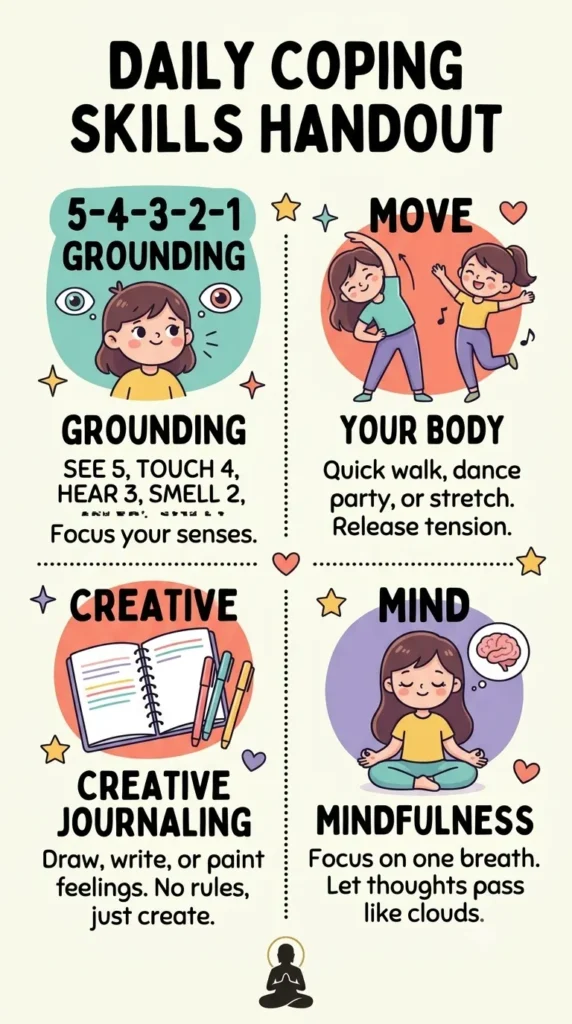
What a coping skills handout can help you do
A handout does a few specific jobs. Not vague ones.
It can help you:
- Name what you’re feeling before you react on autopilot
- Calm your body down when stress or a big emotion starts taking over
- Choose a response on purpose, instead of grabbing whatever habit is closest
- Break a hard situation into steps that don’t feel so huge
- Remember tools that worked before, right when you’re too overwhelmed to think straight
- Build a personal plan for the stressful situations you know will come back around
Here’s the part most lists skip. You don’t need every strategy on the page. Not even close.
A short list you actually understand beats a long list you never open. Five tools you’d really use in the moment do more than twenty you’d forget under pressure.
Coping skills vs. coping strategies
People use these two terms like they’re the same thing. Mostly, they are.
Coping skills and coping strategies both point to the same idea: actions or thought patterns you use to handle stress or a hard situation. A coping strategies handout usually just organizes the same tools a different way, maybe grouped by category instead of by feeling (APA Dictionary).
Want the deeper split? Coping isn’t the same as avoidance, and it isn’t the same as a defense mechanism either. Those get confused constantly. If you want that distinction laid out clearly, our guide on coping skills vs. avoidance and defense mechanisms breaks it down.
And if part of what’s driving your stress is naming the emotion itself, our emotions worksheet is a good place to start before you even get to the coping step.
Free Coping Skills Handout PDF
A good coping skills handout works when your thoughts are already loud. You don’t want ten pages of theory. You want a page that says: pick a category, try one thing, wait a few minutes before deciding what’s next.
That’s the whole idea behind this free coping skills handout printable.
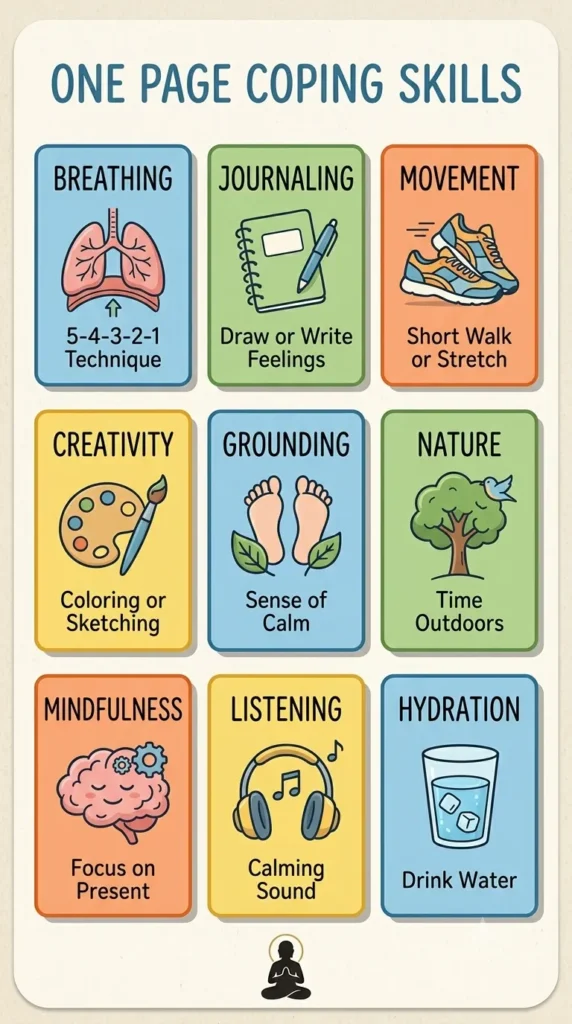
Quick Coping Skills Handout
This one-pager sorts practical coping strategies into nine categories. No scrolling through a long list mid-panic. Each tile gives you a short label and something you can actually do, right now, with no setup.
Some coping skills handout pdf resources try to cover everything at once. That’s not useful when you’re overwhelmed. Nine simple categories beat ninety scattered tips.
1. Calm Your Body
Try slow breathing, stretch your shoulders, take a warm shower, or relax one muscle group at a time.
2. Ground Yourself
Notice what you can see, hear, touch, smell, and taste. Bring your attention back to the room you’re in.
3. Move
Walk, stretch, dance to one song, shake out tension. Any movement that feels manageable counts.
4. Express the Feeling
Write it down, draw, make music, cry, or just name the emotion out loud. Don’t push it away.
5. Connect
Text a trusted person, sit with someone, ask for support. Or just tell someone honestly that today is hard.
6. Take a Healthy Break
Watch something comforting, read, play a game, listen to music. Give your mind some room to breathe.
7. Solve One Small Part
Identify what you can control. Pick the smallest useful action. Leave the rest for later.
8. Change Your Environment
Step outside, tidy one small area, cut the noise, put your phone away. Move somewhere calmer.
9. Set a Boundary
Say no. Pause a hard conversation. Mute notifications. Give yourself permission to step away.
That last one surprises people. Boundaries rarely show up on a list of coping skills for adults pdf. But saying no is a coping skill. Maybe the most underused one.
When to Use This Handout
Use this coping skills handout when you need ideas fast and don’t have the energy for a long guide. Print it. Save it to your phone. Keep a copy wherever stress tends to find you.
Sound too simple to matter? It is. That’s exactly why it works when longer guides get ignored.
This also works as a healthy coping skills handout for teens, young adults, counselors, parents, and teachers. Anyone building a personal coping skills plan can use it as a starting point.
You don’t need to try all nine. Pick one that fits your energy level today. Notice if it actually helps. That’s the test, not how many strategies you’ve collected.
If naming the feeling itself feels like the hard part, our emotions worksheet can help you get more specific before you pick a coping strategy. And if gratitude tends to settle you faster than distraction does, the gratitude worksheets pair well with the “Express the Feeling” and “Take a Healthy Break” tiles above.
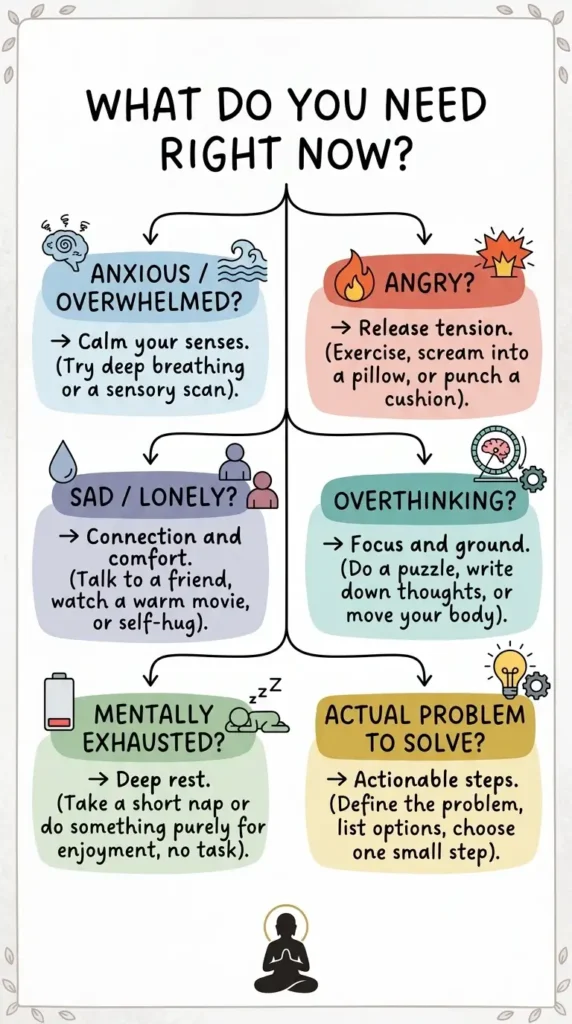
Coping Skills by What You Need Right Now
The most useful coping skill isn’t the most popular one. It’s whatever matches what’s actually happening in your body, your thoughts, or your situation. Not a trending list. Not someone else’s go-to.
That’s the whole idea behind a coping skills handout like this one. Name what you need first. Then pick one skill that fits it. Skip the rest.
When You Feel Anxious or Overwhelmed
Anxiety makes everything feel urgent. It isn’t. That’s the trick it plays.
So don’t try to solve every racing thought at once. Slow your body down first. Try slow breathing, both feet flat on the floor, or naming a few things you can see and hear right now. A short walk works too. So does stepping away from a loud room.
Your thoughts will still be there in five minutes. They usually make more sense once your body isn’t in panic mode.
When You Feel Angry or Frustrated
Anger doesn’t want a solution yet. It wants space.
Put distance between yourself and whatever set you off. Move your body. Pace, stretch, shake out your hands, whatever gets the tension out of your muscles. Write down what you actually want to say, then sit on it. Give yourself time before you send that text or start that conversation.
Ten minutes later, most of what felt urgent won’t feel that way anymore.
When You Feel Sad or Lonely
This isn’t a feeling you distract your way out of. Not really.
Sadness usually asks for comfort and connection, not a screen to disappear into. Message someone you trust. Put on music that matches or shifts your mood. Journal for a few minutes, or spend time outside if you can. Sometimes a familiar routine helps too, something that makes an empty room feel a little less empty.
When You Can’t Stop Overthinking
Get the thoughts out of your head. Put them on paper instead.
Write down what you actually know, what you’re assuming, and what’s genuinely within your control. Most overthinking is a tangle of all three, and separating them takes the loop apart fast. Once that’s clear, pick one small action. Or decide, on purpose, to pause the problem until you’ve got more energy for it.
When You’re Mentally Exhausted
Big self-care routines fail here. They ask for energy you don’t have left.
Go smaller instead. A shower, quiet music, a stretch, a simple meal, fewer notifications buzzing at you. Even a few minutes of journaling counts, if you can manage it. None of it needs to look impressive. It just needs to be doable today.
If putting feelings into words is the hard part right now, these journal prompts for mental health are built for exactly that kind of low-energy day.
When You Have an Actual Problem to Solve
Not every hard feeling needs to be calmed down. Some need to be dealt with.
If there’s a real problem sitting underneath the stress, name what actually needs attention. Break it into one manageable step. Then ask what you’re missing: information, action, or support from someone else. A coping skill can help you get steady enough to face the problem. It’s not a way to dodge it.
Still not sure which category your stress falls into? Working through a full coping skills worksheet can help you sort feeling from fact before you pick your next move.
Coping Skills for Teens and Young Adults
A good coping skills handout doesn’t hand you one script for every bad day. It matches the moment. Racing thoughts before an exam need something different than a fight with a friend. That’s the whole point of a solid coping strategies handout: real options, sorted by what you’re actually facing right now.
School, College, or Work Stress
Deadlines pile up fast. Trying to fix everything at once just freezes you. Pick one action you can actually control instead.
Put your phone in another room for twenty minutes. Take a few slow breaths before you open the laptop. Break the task into one small piece and start there. Or ask a teacher, professor, or coworker what actually needs attention first. That question alone can cut a mountain down to one hill.
None of this makes the workload smaller. It just gets you moving instead of staring at it.
Friendship and Relationship Problems
Conflict doesn’t wait for calm words. It shows up while you’re upset, phone in hand, and a long angry message feels like relief.
Don’t send it yet. Give yourself time to cool down first. Write out what you actually want to say, even if nobody reads it but you. Or talk it through with someone you trust before you respond to the person who upset you.
Sound too slow when you’re this worked up? It is. That’s why it works. If a relationship keeps leaving you feeling unsafe or drained, no matter how many times you cool down and try again, a boundary counts as a coping skill too. Sometimes the healthiest move isn’t a calmer reply. It’s distance.
Social Media and Digital Overload
This isn’t about willpower over your phone. Nobody wins that fight by trying harder.
Sometimes the best move is stepping away from the feed entirely. Turn off notifications that aren’t essential. Put the phone in another room, not just face down on the desk. Take a short walk. Switch to something that doesn’t keep your brain waiting for the next buzz.
A phone that never stops pinging trains your nervous system to stay on alert. Getting away from it, even for fifteen minutes, gives that alert system somewhere to land.
Uncertainty About the Future
You don’t need a full five-year plan to cope with uncertainty. Nobody actually has one of those anyway.
Focus on the next decision that’s actually yours to make. Not the next ten. Just the one in front of you. Journaling can also help sort out what you know, what you’re only worried might happen, and what you can do about either one. Those three things tend to get tangled together in your head. On paper, they separate fast.
A written coping skills plan doesn’t need to predict the future. It just needs to hold today’s decision steady.
When You Don’t Want to Talk to Anyone
Talking isn’t the only option. Some days it’s genuinely too much, and that’s fine.
Try music. Drawing. Movement. A shower. A grounding exercise, or just writing down what you’re feeling without showing it to a single person. None of these require another human being to work.
Want more hands-on ideas for exactly this kind of day? Our coping skills activities for teens page walks through practical ways to manage stress and hard emotions, no conversation required.
Healthy Coping Skills Handout: What Counts as Healthy?
A coping skills handout exists for one reason. You need something to grab when stress hits and thinking clearly isn’t an option yet.
A healthy coping skill does one of four things. It calms your body. It helps you process a feeling. It connects you with support. Or it makes a stressful problem smaller.
The APA defines coping as the thoughts and actions people use to manage demands that outpace what they’ve got left to give. That’s the whole idea behind this healthy coping skills handout, minus the jargon.
Skills That Help You Regulate
Your body hits a high before your mind catches up. That’s regulation’s whole job. Bring the body down first.
Slow breathing works. So does stretching, a hot shower, or a short walk outside. Even calming music can buy you enough space to respond instead of reacting on the spot. None of these fix the actual problem. They just lower the volume long enough for you to think.
The goal isn’t erasing the feeling. Not even close. It’s making the feeling small enough to carry.
Skills That Help You Process
This isn’t about calming down. Not this time.
Processing means giving a feeling some attention instead of shoving it away. Journaling does this. So does drawing, naming the emotion out loud, or just sitting quietly with your thoughts for a minute. Talking with someone you trust works too, and often faster than any of the solo options.
Here’s what that shift can look like. “I’m furious” becomes “I’m actually hurt because I felt ignored.” Small change. It rewrites what you do next. If naming the feeling is the part that trips you up, our emotions worksheet is built for exactly that gap, and it pairs well with any coping skills for adults you’re already trying.
Skills That Help You Solve Problems
Some stress won’t budge with a deep breath. It needs a plan.
Say your assignment is overdue. Your roommate keeps crossing a line you’ve drawn twice already. You’re dreading a conversation you can’t put off much longer. Problem-focused coping steps in here. Break the mess into one manageable next step. Ask for clarification. Set the boundary you’ve been avoiding. Get help when the load is too heavy to carry solo.
A short coping skills plan works better than trying to remember your strategy mid-crisis. Write it before you need it. Use it when you do.
Skills That Help You Connect
Healthy coping isn’t a solo sport.
Texting a friend counts. So does calling family, talking to a teacher, or asking a counselor for support. Reaching out cuts isolation fast, and it often shows you an angle on the problem you couldn’t see from inside it. You don’t need the perfect explanation ready before you reach out. “Rough day, can you talk?” does the job.
Skills That Give You Temporary Relief Without Creating a Bigger Problem
Distraction gets a bad reputation it hasn’t fully earned. Sometimes a break is just a break.
Watching something familiar, playing a game, taking a walk, doing something creative. All of it can give an overloaded mind the pause it actually needs. The question that matters isn’t whether you distracted yourself. It’s this: does the break help you come back with more capacity, or does it keep you stuck avoiding the thing entirely?
Some people want more than a short list. If a printable coping skills wheel, an A to Z coping skills pdf, or a fuller list of coping skills for adults pdf sounds more useful than this quick coping strategies handout, our Healthy vs. Unhealthy Coping Skills Worksheet breaks the whole split down further, worksheet and all.
Pairing that with a few journal prompts for mental health turns a quick reference into something you can actually sit with when you’ve got more than five minutes.
Free Coping Skills Plan
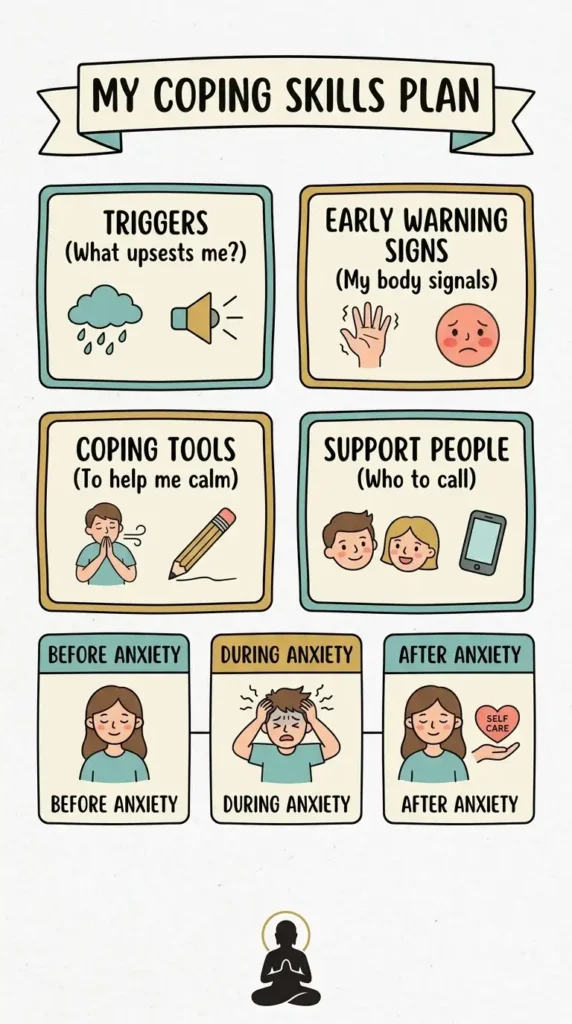
A coping skills plan beats scrambling for answers mid meltdown. Write down your triggers, your warning signs, your go to tools, and the people you can call. One page. That’s the whole idea behind a coping skills handout you’ll actually reach for instead of one you forget in a drawer.
My Common Triggers
Start by naming what throws you off balance. Your triggers might be an upcoming exam, a fight with a friend, or a hard family talk. Maybe it’s too much work piled up. Or money stress. Or hours lost online when you’re already running on empty.
Be specific. “Stress” is vague. “Checking my grades after a hard exam” isn’t. That’s something you can actually spot next time.
My Early Warning Signs
This part isn’t about waiting until you’re already overwhelmed. Early warning signs show up first. Restlessness. Snapping at people. Ducking messages. Replaying the same thought on a loop. Losing focus. Tight shoulders or a clenched jaw.
Catch these early. You get more time to use a coping skill before things peak. Struggling to name what you feel? An identifying emotions worksheet can help you spot these signals faster.
What Helps Me Calm Down
One coping skill won’t cover every moment. Keep a few on hand. Write down the ones with a real shot at helping in the moment.
Try breathing exercises, a short walk, or music. Journaling works too. Grounding through your senses helps. So does stretching, stepping away from your phone, or sitting somewhere quieter.
None of these need to be fancy. Just useful, on the day you need them.
People I Can Contact
Handling everything alone doesn’t always work. That’s fine. List the people you’d actually reach out to. A friend. A sibling. A parent. A teacher, counselor, or mentor. Anyone you trust enough to be honest with.
If reaching out feels hard, plan how too. Text first? Call? Show up in person? Decide now, while you’re calm.
What I Can Do Before, During, and After a Stressful Situation
A good coping plan covers more than the crisis itself. Plan one action for before a stressor hits. One skill for the middle of it. That’s the setup. One step to help you recover after.
That’s the whole shift, planning for the full arc, not just the worst five minutes.
Coping Skills for Adults
Stress doesn’t retire when you turn eighteen. It changes uniforms. A tough exam turns into a rough shift at work. Family tension gets replaced by a partner who won’t drop an argument, a stack of bills, or a to-do list that never actually empties.
Most young-adult coping skills still work here. The setting is just different.
Adults need strategies that fit around real life, not ones that ask for a clean break from it. Sound too basic? It is. That’s the whole point. A good coping skills handout should hold up between meetings, right after a hard conversation, or at midnight when your brain refuses to shut off.
Coping Skills for Adults PDF
A coping skills for adults PDF earns its keep on the days you’re too tired to think of anything helpful on your own. You open it, you scan it, you pick one thing. That’s the job.
Skip anything that reads like a to-do list of forty items. Look for a handout built around real situations instead.
A few examples:
- Workplace stress: Step away from the screen for five minutes. Write down the next single task, nothing more. Talk it through with someone you trust.
- Financial pressure: Split the immediate problem from the bigger worry sitting on top of it. Name one thing you can control today. Build one concrete plan instead of replaying worst-case scenarios on a loop.
- Relationship conflict: Give yourself time to cool off first. Write out what you actually want to say. Come back to the conversation once you can listen, not just respond.
- Burnout: Cut demands you don’t actually need to carry. Protect basic rest like it’s non-negotiable. Notice the moment pushing harder stops solving anything.
None of this requires a retreat or a total life reset. A working coping skills plan is smaller than that. It’s a short list you can reach for mid-shift, not a project for a free Sunday.
Want something more hands-on? Our guide to coping skills activities for adults walks through more active exercises built for exactly this stage of life.
List of Coping Skills for Adults PDF
A list of coping skills for adults PDF only earns a spot on your desk if you’ll actually open it again. Otherwise it’s just another file buried in a folder you forget by March.
Pick a handful of strategies that genuinely match your routine. Keep those together. That’s your real list, not the twenty-item version everyone downloads and never reads twice.
Looking for the fuller picture? Our ultimate list of coping skills rounds up a broader set of healthy coping strategies across every age group and situation.
Free Printable Coping Skills Wheel PDF
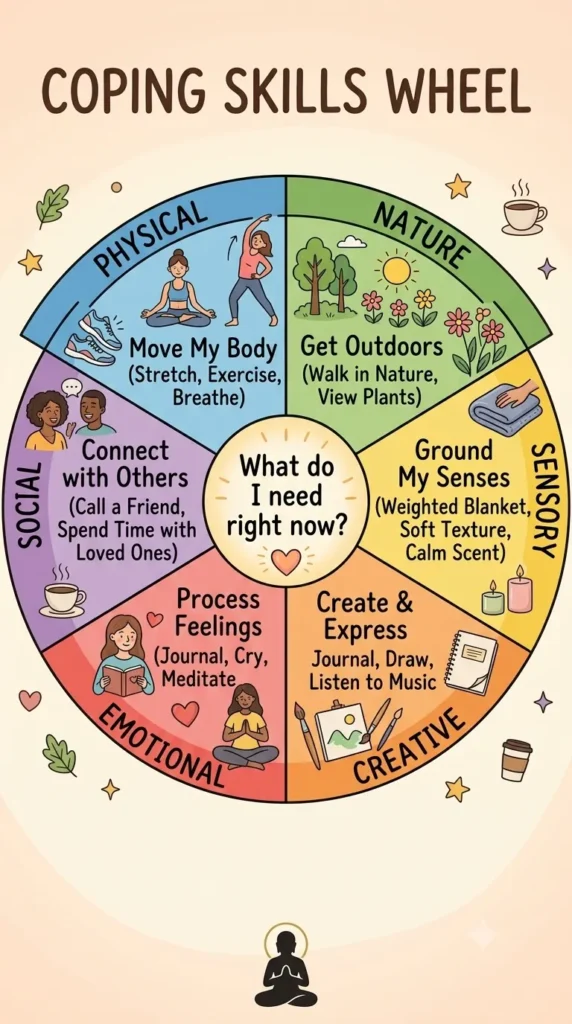
A coping skills wheel turns a coping skills handout into something you’ll actually reach for. Stress makes decisions harder. That’s not an opinion, it’s just how a stressed brain works.
So instead of scanning a long list of options, you look at a wheel, pick a category, and try it. No overthinking. No second-guessing whether it’s the “right” strategy. Just something that fits what you need right now.
How to Use the Coping Skills Wheel
Start by naming what you need. Not the big-picture need. The right-now one. Do you need to calm your body? Say something out loud? Talk to someone? Clear your head? Or just step away for a minute? That’s the whole first step.
Then pick one section of the wheel and try something from it for a few minutes. You don’t have to finish it. You’re not being graded. The goal is smaller than that: feel a little more settled, or buy yourself enough space to figure out the next move.
Sound too simple? It is. That’s the point. If the first strategy doesn’t land, move to another category. Coping isn’t one-size-fits-all. A technique that calms anxiety might do nothing for anger, and what works when you’re wired might fall flat when you’re just tired.
What’s Included in the Coping Skills Wheel?
Most coping strategies handouts cram everything into one flat list. A wheel organizes it instead, which is why it works better under pressure. Here’s how the categories break down:
- Grounding: Use your senses to land back in the present moment.
- Body: Stretch, move, breathe, or shake off physical tension.
- Mind: Challenge a thought that isn’t helping, or focus on something small and manageable.
- Feelings: Journal, draw, talk, or give an emotion a place to go. (Our emotions worksheet is a good next stop if this is the category you keep landing on.)
- Connection: Reach out to a friend, family member, counselor, or anyone who steadies you.
- Creativity: Music, art, writing, cooking, anything that gets your hands moving.
- Environment: Change your surroundings, cut the noise, or get outside for a few minutes.
- Rest: Let yourself pause. Not everything needs fixing right away.
This is a solid starting shape for coping skills for adults, but it also works as a base for a broader A to Z coping skills PDF if you want to expand each category later.
Download the Free Printable Coping Skills Wheel PDF
Keep this coping skills handout PDF somewhere you’ll actually see it. Your journal. Your backpack. Your phone’s files. It’s built to be a quick-reference tool, especially on the days you’re too maxed out to think of a strategy from scratch.
Want to go a step further? Pair the wheel with a coping skills plan so you’ve already picked your go-to strategies before the stressful moment shows up. It’s easier to choose calmly now than to choose well when you’re already overwhelmed.
A to Z Coping Skills PDF
A quick coping skills handout beats another long worksheet when you just need a jumping off point. Nobody wants to fill out five pages before they’ve calmed down.
The alphabet works here as a simple prompt generator, not a list you have to memorize. Pick a letter, borrow the idea, and move on. For the full set, the ultimate list of 100 coping skills covers every age group in far more depth than a single handout ever could.
A–Z Coping Skills at a Glance
This isn’t homework. Nobody finishes A through Z in one sitting, and nobody should try. Think of it as a sampling plate. Taste a few, keep what fits.
A — Affirmations. Swap the harsh inner voice for something realistic and steady. Not “everything is amazing,” just something you can actually believe on a hard day.
B — Breathing. Slow, even breaths interrupt a stress spiral before it builds. Ten seconds is often enough for a real pause.
C — Coloring. A simple creative task gives your attention somewhere else to land. The point isn’t the drawing. It’s the fifteen minutes your mind spends somewhere quieter.
D — Distraction. Choose one safe activity that puts distance between you and an overwhelming thought. Distraction isn’t avoidance when it’s short and deliberate.
E — Exercise. Walk, stretch, dance, whatever your body can manage right now. Movement doesn’t need to be intense to matter.
J — Journaling. Write down what happened, what you’re feeling, and what you actually need. If a blank page feels intimidating, these journal prompts for mental health give you a starting line instead of a blank one.
M — Music. Play something that matches your mood, or something built to shift it. Either use counts.
R — Reach out. Text, call, or sit with someone you trust. You don’t need the perfect words. “Rough day, can you talk?” does the job.
S — Sensory grounding. Notice what you can see, hear, feel, smell, and taste around you. It pulls your attention out of your head and back into the room.
Want more than nine letters? The ultimate list of coping skills fills out the rest of the alphabet, plus a much bigger bank of ideas sorted by age and situation. No reason to duplicate that resource here when it already does the job well.
How to Use an A–Z Coping Skills PDF
An alphabetized handout works best when you’re not sure where to start. That’s its whole job. Pick one skill that matches your current energy, not the one that sounds most impressive. Try it for a few minutes. Then check whether anything shifted.
Sound too easy to matter? It usually is, and that’s kind of the point. A coping skills handout isn’t meant to replace a full coping skills plan or a deeper toolbox. It’s meant to hand you one small, doable move when your brain is too maxed out to invent one from scratch.
Nothing happened after you tried it? That’s not failure. That’s information. Coping is mostly trial and error, matching a strategy to you, to the moment, and to whatever kind of distress showed up this time. A skill that works during a stressful meeting might do nothing for grief, and that’s normal, not a sign you’re doing it wrong.
If you want something more structured than a single-page coping skills handout pdf, whether that’s a full list of coping skills for adults or a printable wheel you can spin instead of scan, the larger resource walks through healthy coping skills handout options for kids, teens, and adults side by side.distress you’re experiencing.
How to Choose the Right Coping Skill
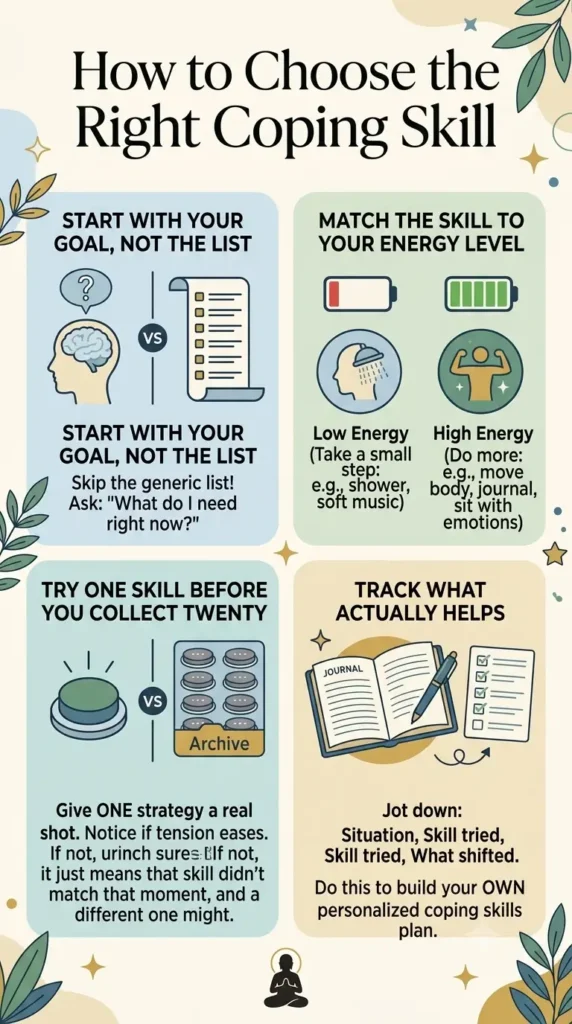
The right coping skill depends on the moment. Not on how good it sounds on paper. Before you touch a list, ask yourself something simpler: do you need to calm your body, sit with a feeling, fix something fixable, reach out to someone, or just get through the next ten minutes? That single question does more work than any coping skills handout ever will.
Start With Your Goal, Not the Biggest List
A long list helps, right up until you’re already drowning in it. Fifty options can turn into another chore when your chest is tight and your thoughts won’t stop circling.
So skip the list first. Ask one question instead: “What do I need this to do for me right now?” Body wired and jumpy? Try grounding or slow breathing. Mind stuck on repeat? Get it out of your head and onto paper, the way these journal prompts for mental health are built to do. Problem actually fixable? Fix it. Trying to relax your way around a solvable problem rarely works.
You don’t need the perfect skill. You need one that fits.
Match the Skill to Your Energy Level
Energy changes everything. A technique that demands motivation falls apart on the days you have none left.
On low-energy days, keep it small. A shower. Familiar music. Lying somewhere quiet. One text to someone you trust. On days with more in the tank, journal it out, move your body, clean one corner of the room, or sit with whatever you’ve been avoiding using an emotions worksheet. Neither day is wrong. They just call for different tools.
Good coping should be usable. Not impressive.
Try One Skill Before You Collect Twenty
Give one strategy a real shot before jumping to the next five. Then notice what happens after. Did the tension ease, even a little? Did the thought loosen its grip? Could you take one more step than before?
Nothing changed? That’s not failure. It just means that skill didn’t match that moment, and a different one might.
Track What Actually Helps
The skills worth keeping are the ones that work more than once. This is where most people stall out. It’s 9pm, the list is still sitting there, and nothing on it feels like it’s helping because none of it has been tested against real life yet.
Jot down the situation, what you tried, and what shifted. Do that enough times and a generic list turns into something built for you, a real coping skills plan instead of another coping skills handout pdf gathering dust in a folder.
Start your own coping skills log and build the version of this list that’s actually yours.
When a Coping Skills Handout Isn’t Enough
A coping skills handout helps in the moment. It can’t fix everything. If distress keeps coming back, gets in the way of your life, or makes you feel unsafe, that’s your sign to bring in more support. A person. A professional. Something beyond paper.
When stress keeps interfering with daily life
Coping skills work when they get you through a hard feeling without making things worse. But sometimes they’re not enough on their own. If anxiety, sadness, anger, or overwhelm keeps messing with your sleep, your work, your relationships, or your eating, a printable handout won’t cover it.
Watch the pattern. Don’t wait for things to fall apart. If you’re constantly needing to escape situations, can’t focus for more than a few minutes, pulling away from people you actually care about, or feeling low most days, that’s worth a conversation. Talk to a doctor. A counselor. Someone you trust.
A coping skill can be one piece of your coping skills plan. It was never meant to be the whole plan.
When you feel unable to stay safe
If you feel like you might hurt yourself or someone else, put the handout down. This isn’t a moment for a worksheet. It’s a moment for a real person.
In the United States and its territories, call or text 988 to reach the 988 Suicide & Crisis Lifeline, a free, confidential crisis service available 24/7.
If you’re outside the U.S., contact your local emergency service or crisis line, or go to the nearest emergency department if you’re in immediate danger.
When professional support may help
You don’t have to wait until you’re in crisis to ask for help. That’s a myth worth dropping. Professional support makes sense when your coping strategies aren’t giving you enough relief, when the same problems keep circling back, or when you can’t quite figure out why you feel overwhelmed in the first place.
A therapist or counselor can help you look past the surface feeling and work on what’s actually driving it. Bring your handout with you. It’s a useful starting point, something concrete to point to when you’re explaining what you’ve tried and what’s actually helped, right alongside tools like an emotions worksheet or a few journal prompts for mental health.
Conclusion
A coping skills handout is most useful when it gives you something practical to do, not just something to read. You may need a grounding exercise after a stressful day, a simple plan before a difficult conversation, or a reminder of healthy ways to handle emotions when your usual strategies aren’t working.
Keep the handouts that fit you, mark the skills that actually help, and adjust your coping plan as your needs change. You don’t have to use every strategy on the page. Start with one that feels manageable, give it a fair try, and build your own set of coping tools from there.
Frequently Asked Questions
What should be included in a coping skills handout?
A useful coping skills handout should include practical strategies that are easy to understand and use during stress. It can cover calming the body, grounding, emotional expression, problem-solving, social support, healthy distraction, and self-care. The best handouts also help you choose a skill rather than simply giving you a long list.
What are the best coping skills for teens and young adults?
The best coping skills depend on what you need in the moment. For example, slow breathing or grounding may help when you feel overwhelmed, while talking to someone, journaling, taking a walk, or making a small action plan may fit other situations. A personal shortlist is usually more useful than trying every strategy.
Where can I get a free coping skills handout PDF?
You can use a free coping skills handout PDF that provides practical strategies in a printable format. Look for a resource with clear categories, simple instructions, and space to identify which skills work for you. A good handout should be a quick reference, not another overwhelming document to work through.
What is the difference between a coping skills handout and a coping skills plan?
A coping skills handout gives you a collection of strategies you can try, while a coping skills plan makes those strategies personal. A plan can identify your common triggers, early warning signs, preferred coping skills, supportive people, and next steps. In practice, the handout gives you options; the plan helps you decide what to use.
What are some healthy coping skills for adults?
Healthy coping skills for adults can include taking a walk, getting enough rest, journaling, breathing exercises, talking with someone you trust, setting boundaries, breaking a difficult task into smaller steps, and making time for enjoyable activities. The right choice depends on whether you need to calm yourself, process an emotion, or address the underlying problem.
Can a coping skills handout replace therapy?
No. A coping skills handout is a self-help or educational resource, not a replacement for therapy, diagnosis, or professional mental-health care. It can give you practical ideas to try between difficult moments or alongside professional support. If distress is persistent, severe, or affecting your safety or daily life, seek appropriate professional help.

It’s Bhaskar!
Well, I am not a psychologist a monk, or a philosopher by training. I’m just an engineering graduate.
‘The Empty Self’ is where I write about that idea, and what it actually means for ordinary life, anxiety, identity, habits, the stories we tell ourselves about who we are. I don’t have a psychology degree, and I’m not offering therapy or clinical advice. What I do have is thought and clarity, and genuine curiosity about why we suffer the way we do and how much of it might loose once we shed this ‘fixed identity’.