
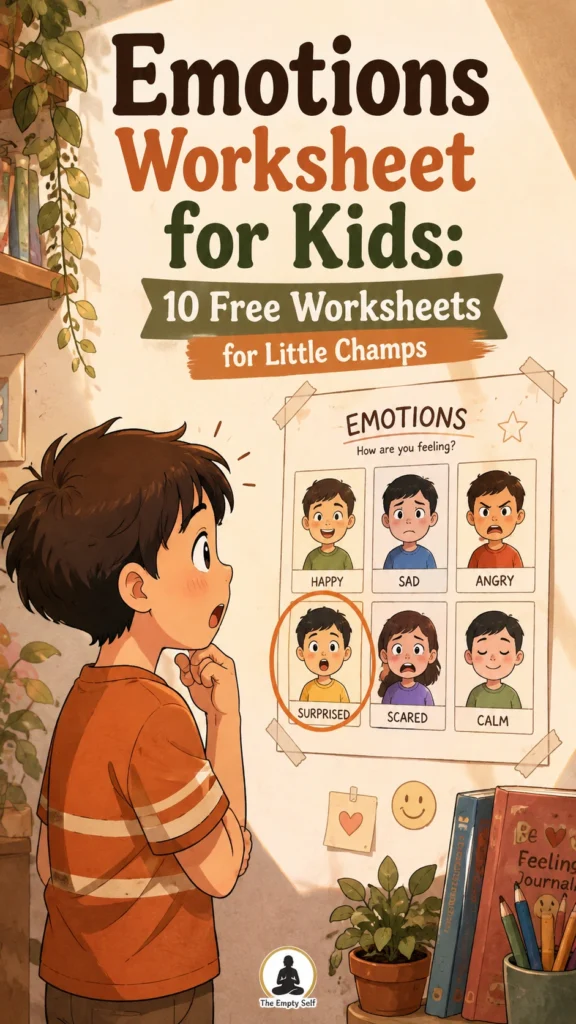
A child might say “I feel bad.” That’s it. No more detail than that.
But bad could mean worried. Or embarrassed. Or so mad they want to slam a door. Kids feel plenty. They just don’t have the words yet. That’s exactly where an emotions worksheet for kids earns its place.
A good feelings worksheet for kids does three things. It names the feeling. It points to what’s happening in the body. And it asks what might help next. Sound simple? It is. For kids between 6 and 11, that simplicity matters. School fights. Sibling fights. A friend who didn’t save a seat at lunch. Real moments call for real words, not vague comfort dressed up as advice.
The worksheets below are built for exactly that. Practical. Visual. Something a kid can actually finish without a parent hovering over their shoulder the whole time.
Quick Overview: Free emotions worksheets help kids name feelings, build emotional vocabulary, notice body signals, spot triggers, and work through big emotions without falling apart. Most fit ages 6–11, whether at home or in a classroom. For a deeper look at why this practice sticks long-term, our emotions worksheet guide breaks it down further.
Table of Contents
Disclaimer
This blog is written and edited with the help of AI, then reviewed by me before publishing. As a result, the content is for general reflection only, not therapy or medical advice, and I’m not a licensed mental health professional. If you’re in crisis, please contact 988 if you’re in US or a local crisis service of your country instead of relying on this site.
What Is an Emotions Worksheet for Kids?
An emotions worksheet for kids does one job. It helps a child name what they feel, out loud, on paper, without guessing. For ages 6 to 11, a good one skips the “match the happy face” stage. It links a feeling to a moment, a body signal, a thought, and a choice.
That’s the real difference. Most printables stop at recognition. This one keeps going.
What Does “Emotion” Mean?
Psychologists don’t define emotion as just a mood. The APA Dictionary of Psychology describes it as a complex reaction tied to experience, behavior, and the body’s physical response to something that matters.
Strip the jargon and it’s simple. An emotion is what happens in a child’s mind and body when something counts to them. Getting picked for the team. A fight with a friend. That knot before a test.
So a feelings worksheet for kids shouldn’t stop at “which face shows happiness?” It should ask four things. What happened? What am I feeling? Where do I notice it? What can I do next?
Four questions. That’s the whole shift.
Got a younger one at home? If your child is 3 to 5, our emotions worksheet preschool guide is the better starting point. This set is built for kids who can already read a sentence and sit with a feeling for more than ten seconds.
Want the full set, all ages, every format? Browse the complete emotions worksheet collection for more free printables.
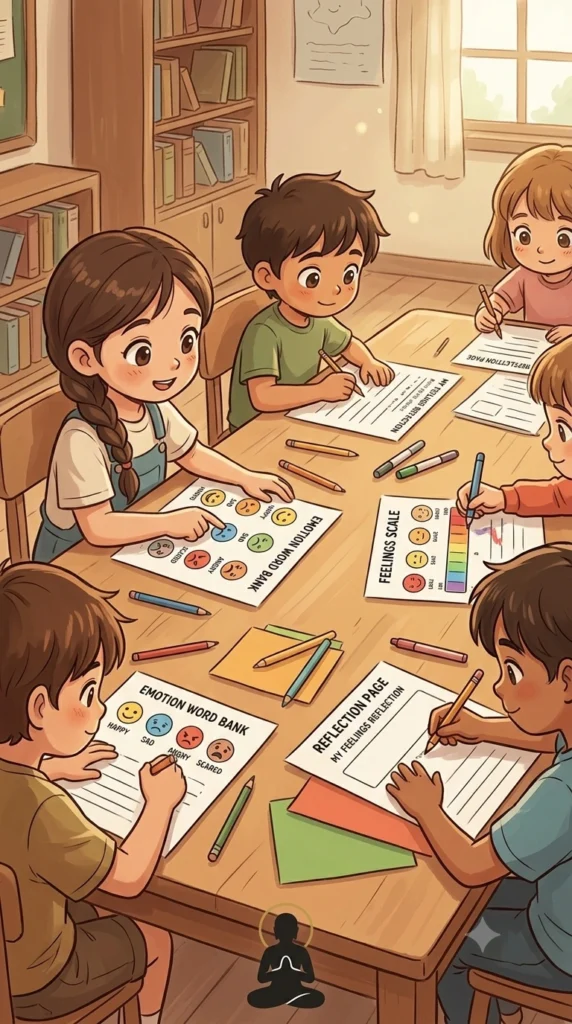
10 Free Emotions Worksheets for Kids
An emotions worksheet for kids works differently once a child hits six or seven. Naming a happy face isn’t enough anymore. Kids this age can start noticing patterns, body signals, triggers, and how strong a feeling actually is.
That shift matters. It’s roughly the window the CDC calls middle childhood, and it’s exactly where these ten worksheets are built to land.
Every worksheet below teaches a different skill. Pick the one your child needs today, not the whole stack at once.
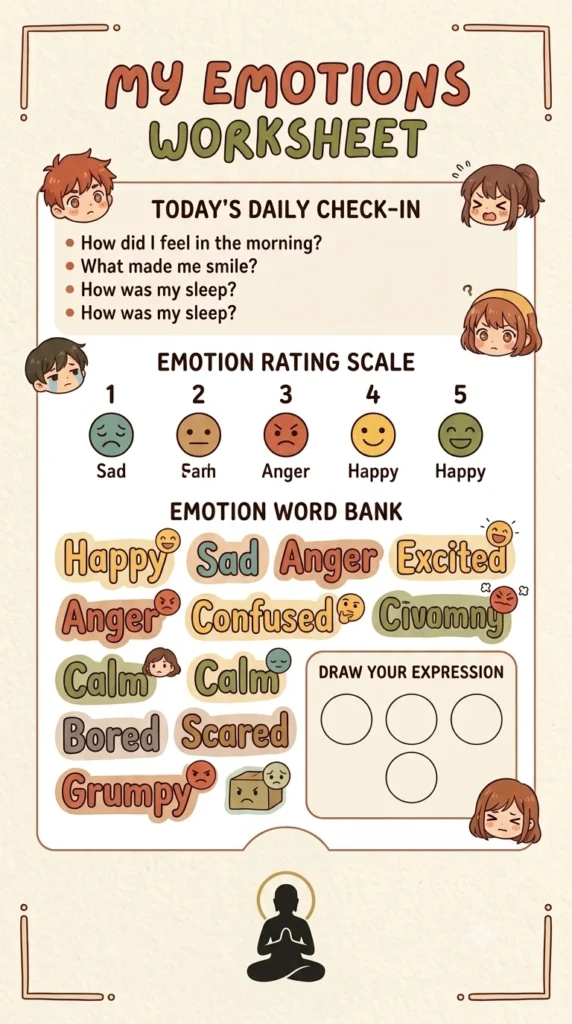
1. My Emotions Worksheet
This isn’t another page where a child circles a happy or sad face. A my emotions worksheet for kids works best as a short daily check-in. At six to eleven, most kids can connect a feeling word to what happened, how strong it was, and what they noticed in their own body.
Build the word bank wider than usual:
- Happy, excited, calm, proud, curious
- Nervous, worried, frustrated, annoyed, angry
- Disappointed, embarrassed, lonely, sad, confused
The child picks whatever fits their day. Then a few short prompts follow:
- Today I feel: __________
- The strongest feeling is: __________
- I felt it when: __________
- My feeling was: 1 2 3 4 5
- My face/body showed it by: __________
Keep the drawing element too, just smaller. After picking an emotion, the child sketches the face they think matches it. That keeps the visual piece useful without letting face-matching swallow the whole exercise.
There’s no correct answer here. A kid might write excited and nervous before a school performance. Both count. The worksheet just gives them room to notice that.
2. Feelings Vocabulary Worksheet
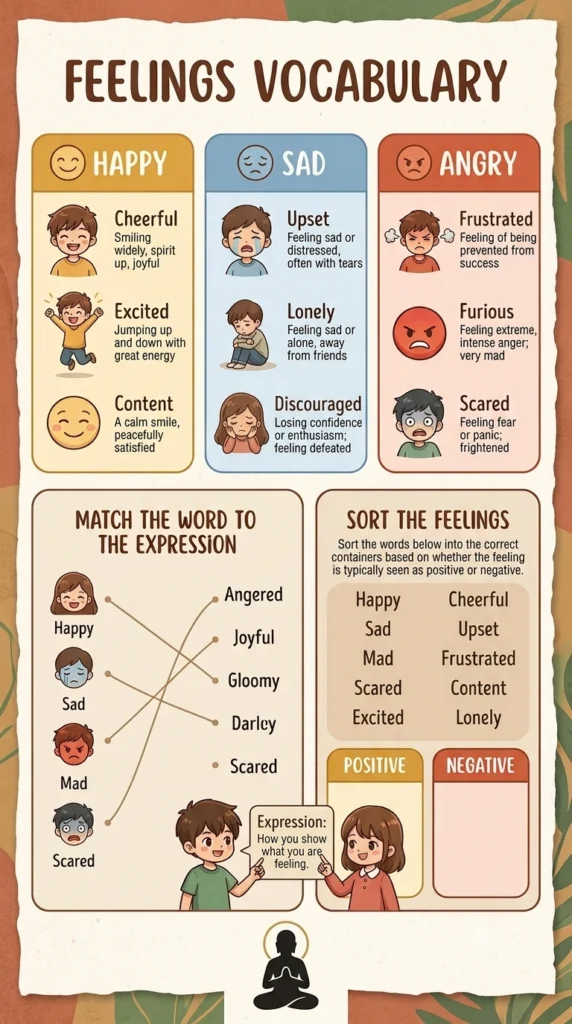
A Feelings Worksheet for Kids should push past “good,” “bad,” “happy,” and “mad.” Those words are a fine starting point. They just don’t say much. A wider emotional vocabulary gives a child more ways to explain what’s actually going on.
Compare these two lines:
“I’m mad.”
“I’m annoyed because my friend kept interrupting me.”
The second one gives an adult something to actually work with.
This worksheet can group related emotions and ask kids to match, sort, or finish a sentence:
| Basic feeling | More specific words |
|---|---|
| Happy | excited, proud, joyful, relaxed |
| Sad | lonely, disappointed, hurt, homesick |
| Angry | annoyed, frustrated, irritated, furious |
| Scared | nervous, worried, frightened, uneasy |
| Surprised | shocked, amazed, confused |
Younger elementary kids do better with pictures and short definitions next to unfamiliar words. Older kids can push a step further by picking the closest word for a real situation.
Try this one: “You studied for a test but got a lower score than you expected.” Ask the child to choose between sad, disappointed, frustrated, and angry. There’s no single right answer. The useful part is asking why they picked it.
3. Different Emotions for Kids Worksheet
Kids often know plenty of feeling words already. They just treat them as interchangeable. A different emotions for kids worksheet targets that gap directly. It helps a child notice that two emotions can sit close together without meaning the exact same thing.
Start with pairs a child is likely to run into:
- Worried vs. nervous. Both involve uncertainty, but nervousness usually shows up before something specific, like a test or a game.
- Annoyed vs. angry. Annoyance can be a smaller reaction. Anger often feels bigger.
- Sad vs. disappointed. Sadness can come from almost anywhere. Disappointment usually follows something that didn’t go as expected.
- Embarrassed vs. ashamed. Both feel uncomfortable. They’re still not the same thing.
- Excited vs. nervous. A child can feel both right before a stage performance or a first day somewhere new.
Give the child a short scenario and ask them to circle the emotion that fits closest. Then add a box: “Could it be another feeling?”
That second question does the real work. Feelings aren’t multiple choice. This worksheet is building emotional granularity, the ability to describe a feeling with more and more precision, not teaching a child that every situation has one approved answer.
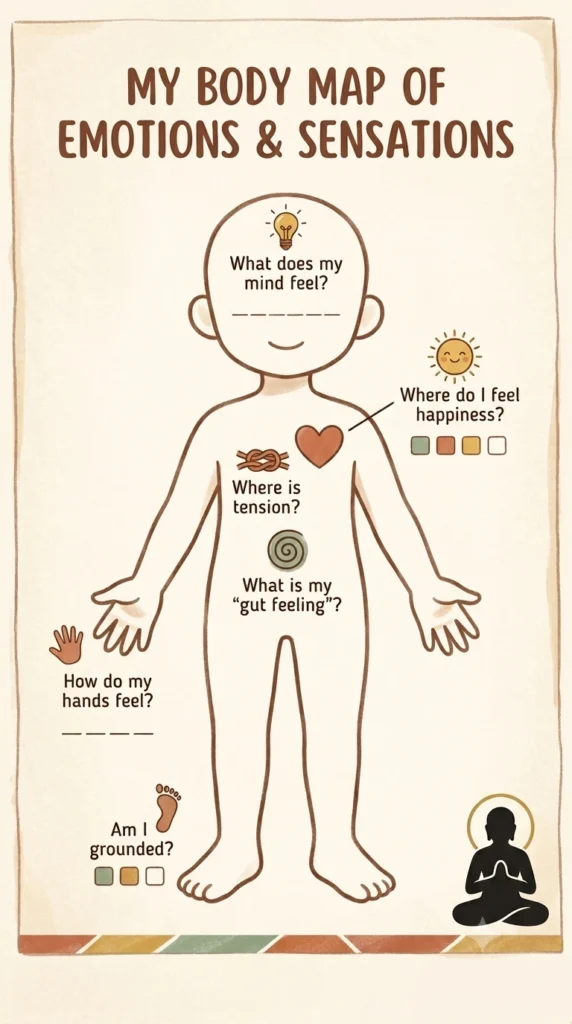
4. Where Do I Feel It? Body Emotions Worksheet
Naming an emotion is only half the job. This worksheet for kids on emotions asks something different. Where does the feeling actually show up? A tight stomach before a test. Warm cheeks after something embarrassing.
Give the child a simple outline of a person and ask:
Where do you notice this feeling?
They can color or mark:
- Head
- Face
- Chest
- Stomach
- Hands
- Legs
- Shoulders
Pair the body map with a few short prompts:
- My emotion: __________
- I notice it in my: __________
- My body feels: __________
- What happened: __________
Describe the sensation. Don’t lock it to one meaning. A racing heart might mean scared, excited, nervous, or just running around the yard.
This one earns its keep with kids who say “I don’t know how I feel” but can still tell you exactly what their stomach is doing.
5. Emotion Intensity Worksheet
Emotional regulation worksheets for kids work better once a child separates two questions: what am I feeling, and how strong is it? An emotion-intensity worksheet gives them a plain 1 to 5 scale for exactly that.
- 1 — Tiny feeling
- 2 — Small feeling
- 3 — Medium feeling
- 4 — Big feeling
- 5 — Huge feeling
A child might rate mild disappointment a 2. A blowup with a friend might land at 5. Same emotion. Different day, different number.
The worksheet can include:
- My emotion: __________
- My intensity: 1 2 3 4 5
- What made it stronger? __________
- What helped bring it down? __________
A thermometer picture works well for kids who respond better to images than numbers. You can also have them mark intensity before and after trying a coping strategy.
One thing worth saying out loud: regulation isn’t about making strong feelings vanish. It’s about responding safely. Nothing more complicated than that.
6. What Made Me Feel This Way? Trigger Worksheet
Kids don’t always link a reaction to what caused it. A trigger worksheet slows that chain down:
Event → Thought → Feeling → Action
Keep the examples familiar for elementary age.
A test scenario might read:
- Event: I got my math test back.
- Thought: “I probably did badly.”
- Feeling: Worried and disappointed.
- Action: I wanted to hide the paper.
A friendship scenario:
- Event: My friends made plans without me.
- Thought: “They don’t want me around.”
- Feeling: Hurt and angry.
- Action: I stopped talking to them.
And a team scenario:
- Event: I missed an important shot during the game.
- Thought: “Everyone thinks I’m terrible.”
- Feeling: Embarrassed and frustrated.
- Action: I wanted to leave.
The point isn’t ruling on whether the child’s thought was true. It’s showing the sequence. Event, interpretation, feeling, action. This same event-thought-feeling loop is the backbone of the CBT triangle used across a lot of clinical worksheets, just simplified for a nine-year-old.
That creates a useful pause. Instead of only thinking “I got angry,” a child starts noticing something happened, they thought something about it, and then the anger showed up.
7. Mixed Feelings Worksheet
A child doesn’t have to pick just one emotion. Most people assume they do. A mixed feelings worksheet pushes back on that, showing kids that two different feelings can sit in the same moment.
A child moving to a new school might feel excited and nervous. A kid heading off on vacation might feel happy and sad, missing someone back home. Before a sports final, proud and worried can both show up at once.
Use a simple two-column format:
- I felt: __________
- I also felt: __________
- What happened? __________
- Why did each feeling make sense? __________
For older elementary kids, add a small section asking which feeling felt stronger. It connects naturally with the intensity worksheet without repeating it.
This distinction matters more than it looks. Kids sometimes assume a “negative” feeling cancels out a positive one. It doesn’t. Nervous about something doesn’t mean you don’t want to do it. Sad during a happy event doesn’t mean you’re not grateful for it.
8. My Calm-Down Choices Worksheet
Here’s an honest take on coping skills: they work far better when a kid has already practiced them while calm. Emotional regulation activities for kids land better as a personal menu than as a list an adult pulls out mid-meltdown.
The worksheet can ask:
When I feel overwhelmed, I can try:
- ☐ Take slow breaths
- ☐ Get some quiet time
- ☐ Draw or write
- ☐ Take a short movement break
- ☐ Talk to a trusted adult
- ☐ Drink some water
- ☐ Listen to calming music
- ☐ Use another strategy that works for me: __________
Then add:
When I am angry,
- I might try: __________
- When I am worried, I might try: __________
- When I am sad, I might try: __________
Personalizing this part is the whole point. A strategy that calms one child can irritate another. Some kids need movement. Others need five quiet minutes. The worksheet should help a child find safe options that work for them, not hand down one universal technique.
For an elementary-age kid, add a “My first choice” box too. One familiar go-to is easier to remember mid-meltdown than a list of ten.
9. Emotions Check-In & Reflection Worksheet
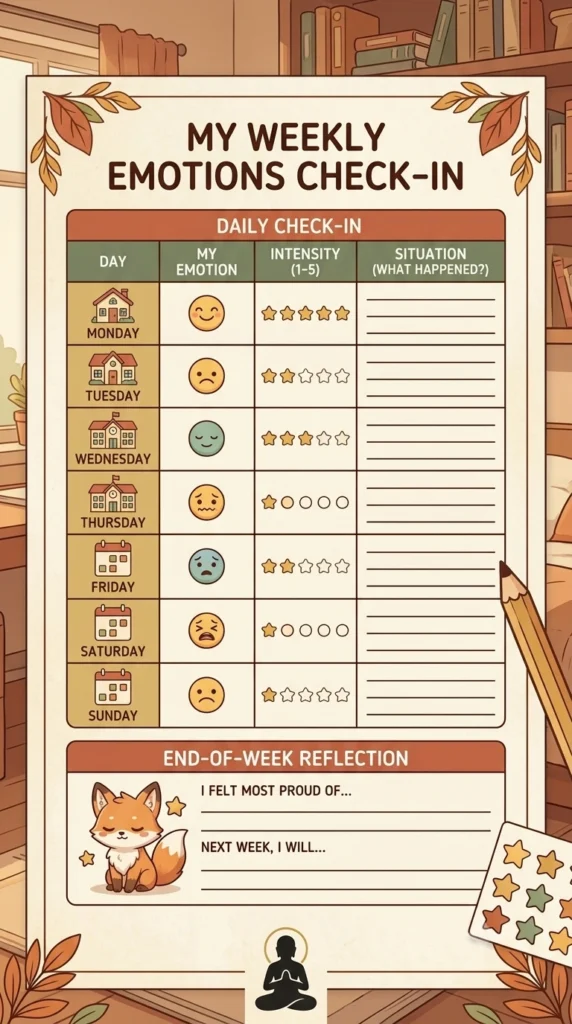
Most single-day worksheets miss the bigger picture. A worksheet about emotions for kids gets far more useful once it tracks patterns across several days instead of one moment. This weekly reflection sheet does exactly that.
Skip the long journal entry. Keep the daily check-in short:
| Day | Main emotion | Intensity | What happened? |
|---|---|---|---|
| Monday | Worried | 3/5 | Math test |
| Tuesday | Proud | 4/5 | Finished a project |
| Wednesday | Annoyed | 2/5 | Friend interrupted me |
At the end of the week, ask:
- I noticed I often felt: __________
- A situation that came up more than once: __________
- Something that helped: __________
- Something I’d like to handle differently: __________
Look for patterns without turning every one into a problem. A child who keeps logging worried before school might just be handing you something worth a conversation. The worksheet isn’t there to diagnose anything.
An emotions kids worksheet should open a conversation, not make a child feel like they’re under a microscope.
10. Feelings & Emotions Journal Page
Save the most flexible page for last. This printable emotions worksheet folds identification, body awareness, intensity, and reflection into one daily page a kid can finish in a few minutes.
A page might include:
- Today I feel: __________
- The strongest feeling is: __________
- I noticed it in my: __________
- It felt like a: 1 2 3 4 5
- What happened? __________
- What did I need? __________
- What helped? __________
No paragraph required. A child can write one word, draw a picture, circle an option, or write a full sentence, whatever fits their age and mood that day.
That flexibility is why this works so well as a regular feelings and emotions worksheet for kids. Use it after school. Use it Sunday night. Drop it into a classroom social-emotional learning routine.
For older kids, leave more writing space and let them record a situation that stood out. For younger elementary kids, keep the prompts short and visual.
One worksheet shows you a single moment. A journal page used again and again shows a child how their own feelings shift across different situations. That’s the real payoff.
How to Choose the Right Worksheet for Your Child
Not every emotions worksheet for kids fits every kid. Start with the skill your child needs most. Naming a feeling. Explaining it. Sizing up how big it feels. Or picking what to do next. Skip the urge to grab the most colorful page first.
Match the worksheet to what’s happening right now, not what looks fun on the shelf. (For the full breakdown of worksheet types by need, our complete emotions worksheet guide covers the rest.)
Can’t Name the Emotion
Does your child shrug and say “I don’t know” every time you ask how they feel? That’s the sign to start simple. Worksheet
both work here. They hand kids clear words to pick from. No need to explain anything deeper yet. Just point and choose.
Knows It, Can’t Explain It
Some kids can say “I’m angry” or “I’m nervous.” They just can’t explain what’s happening underneath. Try
Trigger Worksheet works too. Both link a feeling to something concrete: body clues, the situation, a thought, an action. That’s what turns a label into real understanding.
Big Reactions
Big feelings need a different plan. For kids who react hard and fast, start with
Big emotions aren’t the problem. Nobody’s trying to shut them down. The goal is noticing how strong a feeling runs, then picking something that actually helps.
Preschool-Age
Three to five years old? Skip the older-kid worksheets. Use resources built for that stage instead. Our emotions worksheet preschool guide walks through age-appropriate options that fit how preschoolers actually think and learn.
Elementary-Age
Elementary-age kids can handle more. They’re ready to look past simple labels. Four worksheets do that well:
- Different Emotions for Kids Worksheet
- Trigger Worksheet
- Mixed Feelings Worksheet
- Emotions Check-In & Reflection Worksheet
Each one pushes past naming a feeling. Kids start spotting patterns, reading context, and noticing how their own reactions shift.
How to Use Emotions Worksheet for Kids Activities
An emotions worksheet for kids works when it feels like a chat, not a school assignment. Use it when your child is calm. Hand over some control. Stay curious instead of hunting for the “right” answer. That’s the whole aim. Build awareness they’ll actually reach for later.
Start During Calm Moments
Pick a quiet stretch of time. Not one already loaded with stress. After school works. So does a lazy Saturday afternoon, or the ten minutes before bed. A feelings worksheet for kids only lands when there’s enough headspace left to notice what’s going on inside.
Mid-meltdown isn’t the moment. Not even close. When emotions spike, safety comes first. Calming down comes second. The worksheet? That can wait.
Come back to it once things settle. Talk through what happened. The emotions worksheet becomes far more useful in hindsight than in the middle of a storm.
Let the Child Choose
Ownership changes everything here. Don’t hand over a page and say “fill this out.” Offer two options instead. Let your child pick.
A kid who had a rough day with a friend might reach for a trigger worksheet. Another might prefer an emotion-intensity scale. Small choice. Big shift. It stops feeling like homework and starts feeling like theirs.
This works especially well with a printable emotions worksheet, since you can keep a few formats on hand and swap them in based on the day.
Discuss, Don’t Grade
There’s no wrong answer when a child names a feeling. None. If your child says, “I felt angry because my teacher moved my seat,” resist the urge to correct it. Don’t minimize it either.
Ask instead. “What did you notice in your body?” “What helped you feel better?” Keep the questions gentle. A good emotions worksheet for kids preschool age or older should open a conversation. It shouldn’t test emotional vocabulary like a quiz.
Sound too simple? It is. That’s exactly why it works.
Turn It Into an Activity
Pair the worksheet with something your child already loves. Act out a feeling. Draw it. Grab a stuffed animal and describe a tricky situation through its eyes. Build a small weekly routine out of it.
For older kids, save the finished pages in a folder. Patterns get easier to spot once feelings are tracked over time, the same way a running emotions journal reveals things a single entry never could.
Want a lighter entry point first? Pairing a simple emotions worksheet for kids with a five-minute gratitude practice can make the whole routine feel less like a task and more like a habit worth keeping.
7 Emotional Regulation Activities to Pair With These Worksheets
A worksheet teaches the words. Real practice happens somewhere else entirely. Emotional regulation activities for kids work best when they turn worksheet skills into something a child can actually use mid-feeling, not later, not after the moment has already passed.
The goal isn’t to make big emotions disappear. Why would you want that? A kid still needs to feel frustration, worry, even anger. What changes is what happens next. Does the child notice the feeling, name it, and choose a response? Or does the feeling just take over?
Here’s what that looks like in practice.
1. Emotion Charades
Pick an emotion from the worksheet, then act it out. No words allowed. Everyone else guesses, simple as that.
But something bigger is happening underneath. The child is linking a feeling word to a face and a posture. That connects straight back to a real moment from their own life.
For older kids, raise the bar. Have them act out emotions that sit close together: nervous versus worried, or annoyed versus angry. That gap is real nuance. A basic feelings worksheet for kids won’t teach it alone.
2. Mirror the Expression
Stand at a mirror together. Make different faces. Ask one question: what might this face be feeling?
Then go further. Connect that expression to something real, maybe school, maybe a friend who didn’t save a seat. This pairs naturally with a feelings worksheet for kids built around emotion vocabulary. The worksheet supplies the word. The mirror supplies the face.
3. Feelings-and-Movement Break
Emotions live in the body before they turn into words. Shake out the arms when frustration hits. Stretch when things feel tense. Stand still and breathe slow when worry creeps in.
The movement itself isn’t really the point. Noticing is. A child who learns that feelings show up physically has an early warning system most adults never got.
4. Worry Jar
Hand your child a small jar and some slips of paper. When something’s bothering them, they write it down, or draw it, and drop it in.
Set a regular time each week to open the jar together. Read through the notes. Talk about what’s still bothering them and what already faded.
This works especially well for the everyday stuff, tests, friendships, an upcoming game, the things that feel huge on a Tuesday and forgotten by Friday. If your family already has a rhythm around reflection, the gratitude worksheets routine pairs well with this one.
5. Feelings Journal Streak
A short daily check-in, one week straight. Emotion, intensity, what happened, what helped. That’s it.
Keep it brief. The second it feels like homework, it stops working. Families already using journal prompts for mental health or the five-minute journal prompts at home will find this streak slots right in as the kid-sized version.
6. Five-Senses Reset
When a feeling gets too big, pause. Name one thing you can see. One you can hear. One you can touch, smell, taste.
Nothing complicated about it. The senses pull attention back into the room and away from the spiral. This kind of grounding sits close to the ideas in mindfulness journal prompts, just built for a kid standing in a hallway instead of sitting with a notebook.
7. Pick a Calm-Down Choice
Build a short menu: drawing, walking, slow breathing, music, quiet time, or talking to someone they trust. Then step back and let your child choose.
Don’t hand them the “right” answer. That’s the whole point. A worksheet can list the options, but a calm-down strategy only sticks once a child has picked it themselves, tried it, and felt it actually work.
Emotions Worksheets by Age
A good emotions worksheet for kids fits three things. Reading level. Attention span. The emotional vocabulary a child already has. Something that lands well at age 6 can feel babyish by age 10.
That gap is exactly why age bands matter here. Use them as a starting point, then adjust based on what your own kid actually responds to.
Ages 5–7
Kids this age are usually done with just “happy,” “sad,” and “angry.” That trio gets old fast. At 5 to 7, a simple emotions worksheet for kids works best with pictures, short sentences, and situations a child already knows.
Pick worksheets that push a child to:
- Name a wider range of feelings, like worried, excited, frustrated, proud, or disappointed
- Match emotions to situations or body clues
- Rate how big a feeling is, using a plain 1 to 5 scale
- Practice picking a calming response when a feeling gets too loud
Here’s how that plays out on paper. A child reads, “I studied for my test, but I still feel nervous.” Then they name the emotion and circle how strong it is. Small step. Real connection. That’s what turns an emotion word into something they actually recognize in themselves.
Ages 8–11
Kids 8 to 11 can handle more. A feelings worksheet for kids in this range should ask about triggers, mixed feelings, thoughts, and how they respond, not just what they felt.
Look for worksheets that explore:
- What happened and how it made them feel
- Where the emotion shows up in the body
- Whether it’s mild, moderate, or intense
- Two feelings happening at once
- Different ways to handle a hard moment
Sound like schoolwork? It shouldn’t. Avoid turning every page into an assignment. A short reflection about a friendship fight or a disappointing game beats a page of abstract emotion words every time.
That’s where real emotional regulation activities for kids start working, in the moments that actually happened that week, not in a list of vocabulary.
For ages 3–5, our preschool emotions worksheets walk through simpler matching and picture-based activities built for that stage. And if you want the full range of tools this collection is built from, our main emotions worksheet guide covers 20 of them.
Feelings vs. Emotions: Does the Difference Matter for Kids?
Feelings and emotions overlap a lot. They aren’t the same thing though. An emotion is the response itself, the surge that happens in the body and brain. A feeling is how a person notices that surge and puts words to it.
For kids, that distinction barely matters. What matters is having simple words for what’s happening inside.
What Is an Emotion?
An emotion fires in response to something happening around a child, or inside one. Fear shows up before a class presentation. Anger follows an argument with a friend. Excitement builds before a school trip.
The body gets involved too. So do thoughts, facial expressions, and behavior. Emotion, in the language of the APA Dictionary of Psychology, is a complex reaction tangled up with physiological and psychological changes that shape thought and behavior. That’s the clinical version.
Kids don’t need the clinical version. Skip the lecture. The useful question is short: “What emotion might be happening right now?”
What Is a Feeling?
A feeling is the part a child actually notices. It’s the conscious read on an emotion, described in whatever words they’ve got. A child might experience the emotion of fear and land on the word “scared.” Or “nervous.” Or “worried.” Same emotion, three different labels, and each one tells you something slightly different.
That’s the whole case for a feelings worksheet for kids. It hands children words before the moment turns into crying, yelling, shutting down, or a flat “I don’t know.” Give a kid the label early, and the meltdown often loses some of its grip.
Does the Difference Matter on a Worksheet?
Not really. In day-to-day conversation, “feelings” and “emotions” get used interchangeably, and that’s fine. Nobody needs a vocabulary quiz mid-tantrum.
What matters more is the jump from “I feel bad” to something with actual shape, like “I’m disappointed because my friend didn’t invite me.” That extra detail gives parents, teachers, and kids something to actually work with.
A well-built emotions worksheet does exactly that. It also helps to pair the language work with age-matched tools, whether that’s an emotions worksheet built for preschoolers or one focused on identifying feelings with more precision.
When an Emotions Worksheet Isn’t Enough
A worksheet helps a child name feelings. It’s a start, not a finish line. Kids trace a face, circle a word, maybe write a sentence about why they’re mad. That’s useful. It’s also limited.
Here’s the honest part. Worksheets teach vocabulary. They don’t fix a pattern that keeps repeating at school, at home, or with friends. If the same struggle shows up week after week and starts crowding out normal life, it’s worth looking past the page.
When to Look Beyond the Worksheet
A worksheet is a tool, not a diagnosis, and definitely not a cure. Sound too simple? It is. That’s exactly why it has limits too.
Watch for the pattern instead of the moment. Does your child consistently struggle to calm down once big feelings hit? Have they pulled back from things they used to love?
Is this bleeding into everyday routines, homework, bedtime, friendships? If yes, a conversation with a pediatrician or a qualified child-development professional can help you figure out next steps.
Nobody’s trying to slap a label on a kid over a coloring sheet. That’s not the goal here. Look at frequency. Look at duration. Look at whether it’s actually interfering with normal life. Those three things tell you more than any worksheet result ever will.
For parent-focused guidance on this, HealthyChildren.org from the American Academy of Pediatrics is a solid place to start.
Check Developmental Expectations, Too
Kids don’t develop emotional skills on a fixed schedule. Some hit milestones early. Some take their time. That’s normal.
A child who struggles with one emotional skill isn’t automatically a child with a problem. Context matters more than a single skill gap. Comparing where your child sits against typical developmental milestones gives you something worksheets can’t: a bigger picture.
The CDC’s developmental milestones resources lay out what kids commonly do at different ages. If something still feels off, bring specific examples to the pediatrician. Not a worksheet score. Actual moments. What happened, how long it lasted, how your child reacted.
Don’t Forget the Parent’s Emotions
Here’s something that gets skipped constantly. Helping a child through a meltdown takes something out of you too, especially when it’s the third meltdown this week over the same thing.
Your own emotional state matters just as much. Not as an afterthought. Journaling gives you a private space to dump the frustration, the worry, the exhaustion, before you respond to your kid instead of just reacting.
Need a place to start? These journal prompts for mental health are built for exactly this kind of parenting overflow.
Conclusion
An emotions worksheet for kids is most useful when it helps a child do more than circle a happy or sad face. The right worksheet can help children ages 6–11 name what they feel, notice body signals, understand what triggered an emotion, and choose a healthier way to respond.
Keep the process relaxed and let your child’s answers guide the conversation rather than correcting their feelings. You don’t need to complete a worksheet every day, either.
Start with the page that matches what your child is struggling with right now, then build from there. Emotional skills grow through small, repeated moments of practice.
Frequently Asked Questions
What is an emotions worksheet for kids used for?
An emotions worksheet for kids helps children recognize, name, describe, and understand what they are feeling.
Depending on the activity, a worksheet can also help children notice body signals, identify emotional triggers, rate intensity, or choose healthy ways to respond when feelings become difficult to manage.
What emotions should kids learn first?
Children can start with common emotions such as happy, sad, angry, scared, surprised, and worried.
As their emotional vocabulary grows, introduce more specific feelings such as frustrated, disappointed, nervous, embarrassed, proud, or excited.
Learning more precise words can make it easier for children to explain what they need.
How can I teach my child to identify and name their emotions?
Start by naming emotions during ordinary moments rather than waiting for a difficult situation.
An emotions worksheet can make this practice easier by giving children pictures, words, and situations to discuss.
Try asking, “Which feeling fits?” instead of telling your child how they should feel.
Are emotions worksheets appropriate for preschoolers?
Yes, but younger children usually benefit from simpler, more visual activities than older elementary students. Preschool worksheets often focus on recognizing faces, matching basic feelings, and coloring.
For ages 3–5, see our emotions worksheet preschool guide for developmentally appropriate printable activities.
How can emotional regulation worksheets help kids manage big feelings?
Emotional regulation worksheets help children connect a feeling with its intensity, physical signals, triggers, and possible responses.
For example, a child might identify anger as a 4 out of 5, notice tense hands, then choose a calming strategy. The worksheet creates practice before another difficult moment occurs.
What’s the difference between these worksheets and the preschool emotions worksheets?
These worksheets are designed mainly for children ages 6–11 and move beyond basic emotion recognition into vocabulary, intensity, triggers, mixed feelings, regulation, and reflection.
Preschool worksheets use simpler visual activities for ages 3–5. If your child is preschool-age, start with our preschool emotions worksheets instead.

It’s Bhaskar!
Well, I am not a psychologist a monk, or a philosopher by training. I’m just an engineering graduate.
‘The Empty Self’ is where I write about that idea, and what it actually means for ordinary life, anxiety, identity, habits, the stories we tell ourselves about who we are. I don’t have a psychology degree, and I’m not offering therapy or clinical advice. What I do have is thought and clarity, and genuine curiosity about why we suffer the way we do and how much of it might loose once we shed this ‘fixed identity’.