
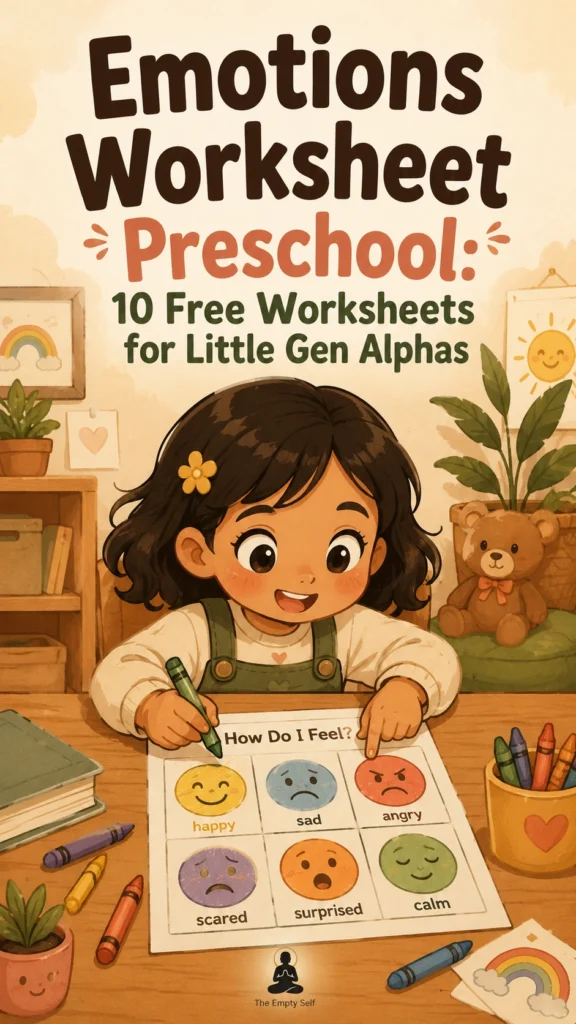
A preschooler is usually 3 to 5 years old. That age gap changes everything about what an emotions worksheet should look like. Take a sheet built for a seven-year-old, cut a few words, and call it preschool-ready? Doesn’t work that way.
Young kids can’t read fluently. Most can’t write on their own yet either. So emotion activities need to lean on pointing, coloring, matching, circling, drawing, and talking instead of paragraphs and prompts.
Quick Overview: An emotions worksheet preschool activity helps young children recognize, name, and express basic feelings through simple visual tasks. The goal is simple. Turn a feeling nobody can see into something a child can point at. That’s it.
The best worksheets do exactly that. They give parents and teachers an easy way into a conversation that’s otherwise hard to start cold.
Want the full picture? Check out the full library of emotions worksheets across every age for options beyond the preschool years.
Table of Contents
Disclaimer
This blog is written and edited with the help of AI, then reviewed by me before publishing. As a result, the content is for general reflection only, not therapy or medical advice, and I’m not a licensed mental health professional. If you’re in crisis, please contact 988 if you’re in US or a local crisis service of your country instead of relying on this site.
10 Free Emotions Worksheets for Preschoolers
A three-year-old feels everything at full volume. Naming it is the hard part. These emotions worksheet preschool activities are built for ages 3 to 5, right when kids are learning to spot a feeling and say what’s happening inside them.
Nothing here asks a child to sit still and write a paragraph. Matching, coloring, drawing, cutting, pointing. That’s the whole toolkit. If you want the broader picture for older kids and adults too, the full emotions worksheet guide covers that range.
1. Match the Emotion Faces
A preschooler reads a face before they can name what’s on it. This emotions worksheet for kids leans straight into that skill.
The child matches simple expressions to basic words: happy, sad, angry, scared, surprised. For younger kids, an adult reads the word out loud and lets the child point. No reading required yet.
Ask “Which face looks happy?” before showing the written word. Then flip it. Point to the word first and let the child hunt for the matching face.
That small swap changes everything. A matching page turns into a real conversation about faces, not a quiz.
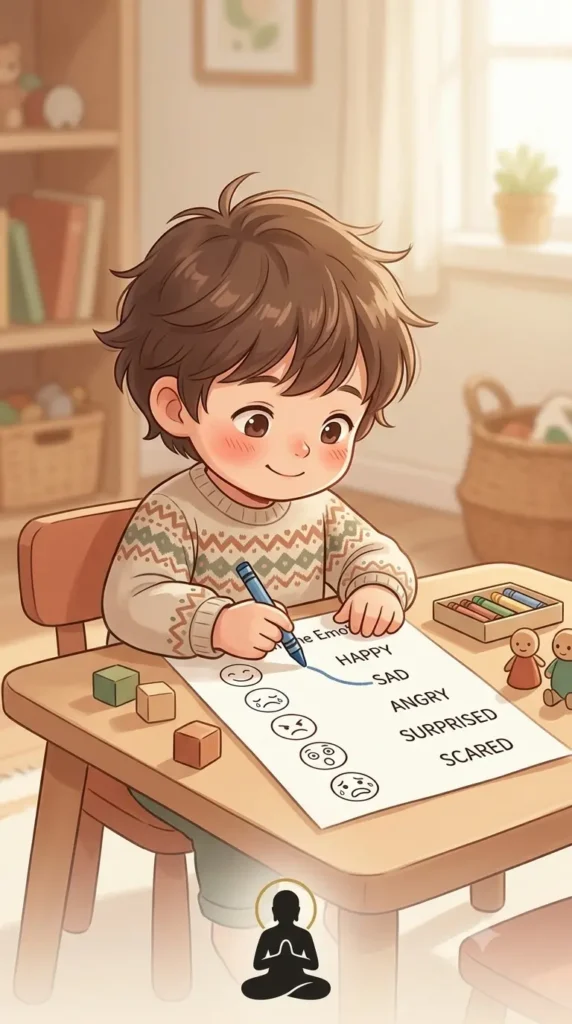
2. Color the Feelings
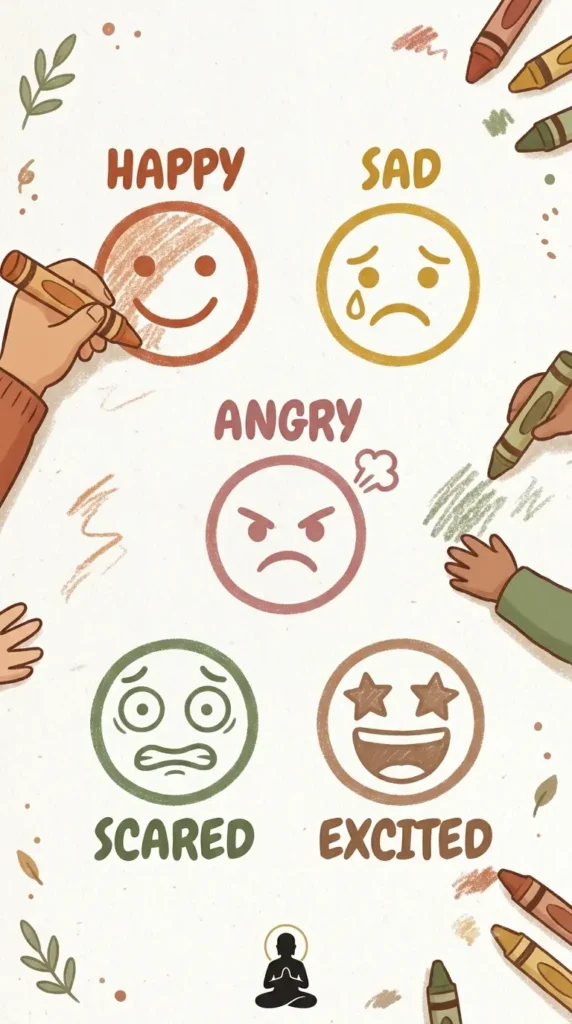
Not every preschooler has the words yet. Coloring fills that gap. This emotions worksheet preschool coloring activity pairs familiar faces with a creative task.
The child colors faces for happiness, sadness, anger, fear, or surprise. There’s no correct color here. Let the child pick. That choice alone opens up a conversation worth having.
Try asking:
- “What color would you give a happy face?”
- “Which face looks like you when you’re upset?”
- “What does your face look like when you’re surprised?”
Recognition matters more than a tidy page. That’s the whole point of this one.
3. Cut and Paste the Feelings
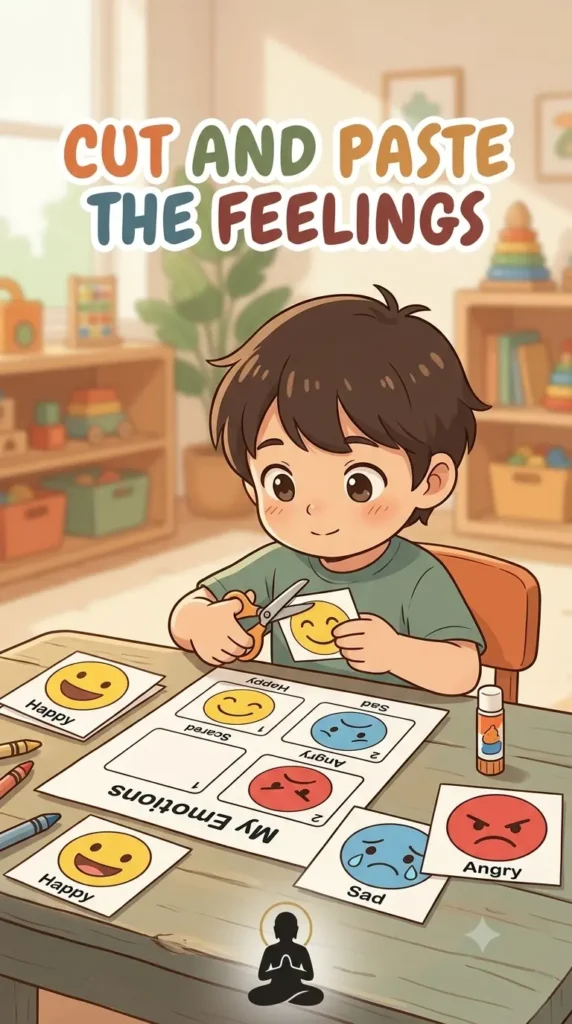
Some kids need to touch the lesson, not just look at it. A cut and paste emotions worksheet preschool activity gives them exactly that. Instead of pointing at pictures, they sort them by hand.
The task is simple. Cut out an emotion face and place it beside the matching word or scene. Scissors not ready yet? An adult preps the pieces and the child does the sorting.
Start small. Happy, sad, angry, scared, surprised is plenty for a first round.
Once that clicks, push a little further. A picture of a child losing a toy might lead somewhere less obvious, sadness, anger, or honestly, both at once.
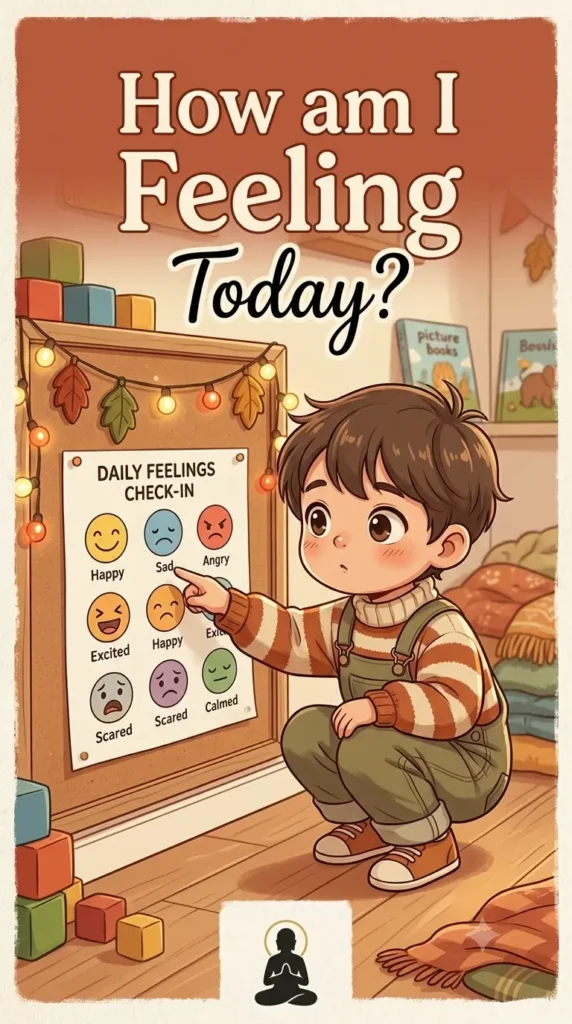
4. How Am I Feeling Today?
This isn’t about deep reflection. It’s about the habit of checking in. The feelings worksheet preschool version can be as simple as circling one face that matches right now.
A three-year-old might just point. That’s enough. An older preschooler might draw a second face or explain the choice out loud.
Keep it tied to a routine. Before school. After coming home. Right before bed. The moment matters more than how much gets written down.
One follow-up question does a lot of work: “Do you want to tell me about that feeling?” If the answer is no, leave it there. Awareness shouldn’t turn into forced disclosure.
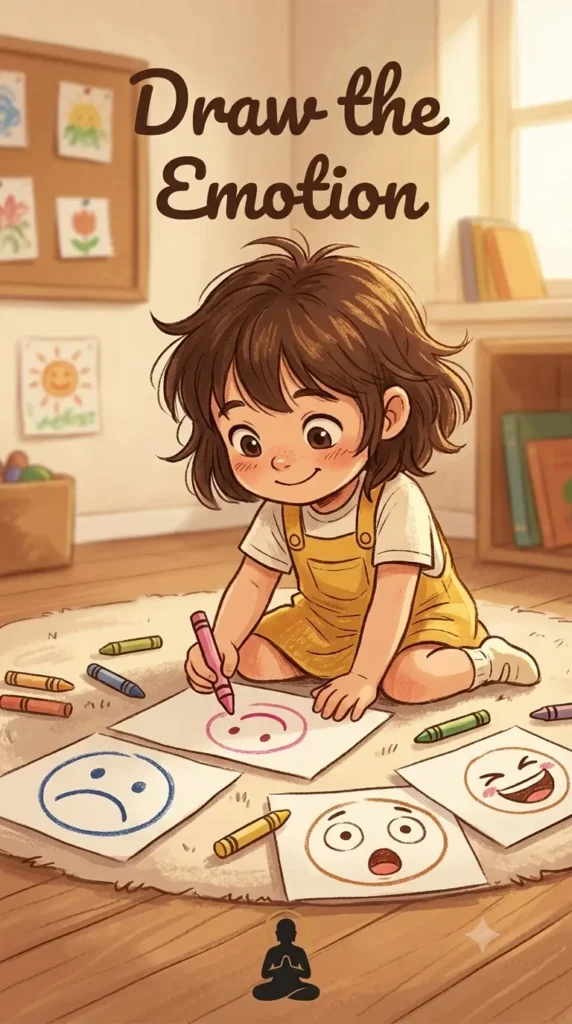
5. Draw the Emotion
Writing is hard at this age. Drawing isn’t. This emotions worksheet preschool writing and drawing activity asks the child to draw a face that shows one feeling.
Go one emotion at a time. Happy first. Then angry. Then scared. Ask the child to make the face themselves before putting it on paper.
For a kid starting to write, leave a small blank for a word or a sentence starter like “I feel happy when ___.”
That writing piece stays optional. Handwriting has nothing to do with whether the lesson lands.
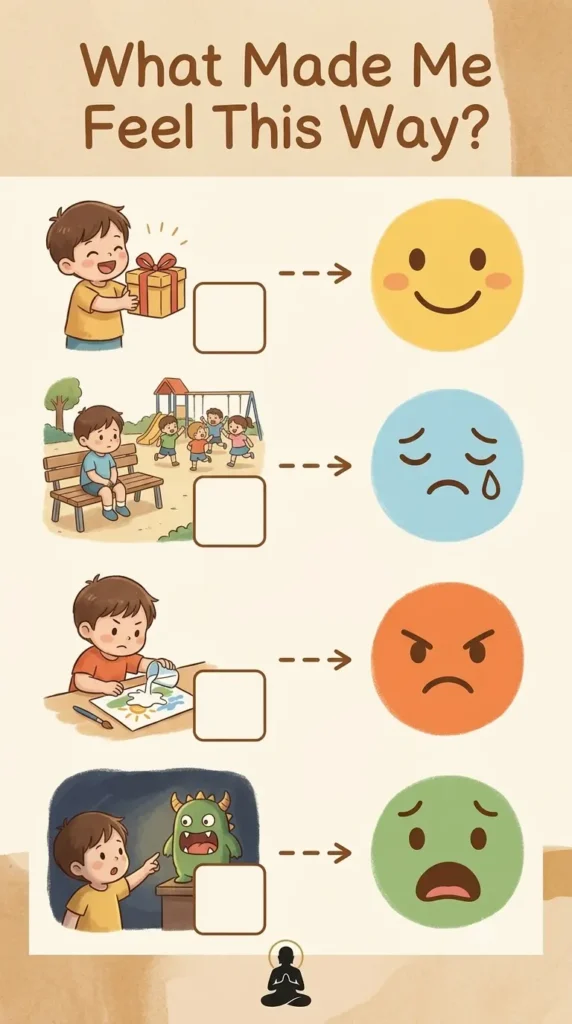
6. What Made Me Feel This Way?
Feelings don’t come from nowhere. This worksheet on emotions for preschool ties a simple event to the feeling that follows it.
Stick with scenes a preschooler actually recognizes:
- A friend shares a toy.
- Someone takes your toy.
- You fall down while playing.
- A parent leaves for work.
- You get a surprise.
- You finish something you worked hard on.
Ask which feeling fits. Then add the twist that makes this worksheet worth doing: two kids can feel completely different things about the same moment.
One child gets excited about starting preschool. Another gets nervous. Neither one is wrong.
That’s where a matching page stops being vocabulary practice. It starts teaching kids to notice the thread between what happens and what they feel.
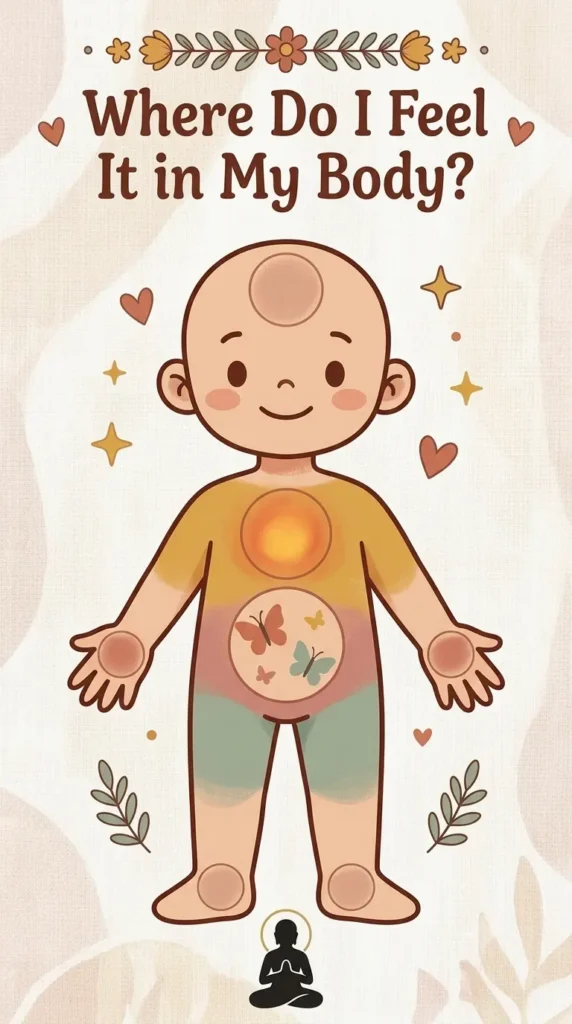
7. Where Do I Feel It in My Body?
Feelings show up in the body before the word does. This body-awareness worksheet helps a preschooler notice that. Tummy, chest, face, hands, wherever it lands.
Keep the language plain:
- “Does your tummy feel funny?”
- “Are your hands still or wiggly?”
- “Does your face feel hot?”
- “Do you want to hide, move, cry, or stay close to someone?”
There’s no fixed map here. One kid feels nervous in the stomach. Another notices sweaty hands or a racing heart. The goal is noticing, not memorizing a formula.
Want the teen and adult version of this same idea? The body-map emotions worksheet in the main guide covers that ground.
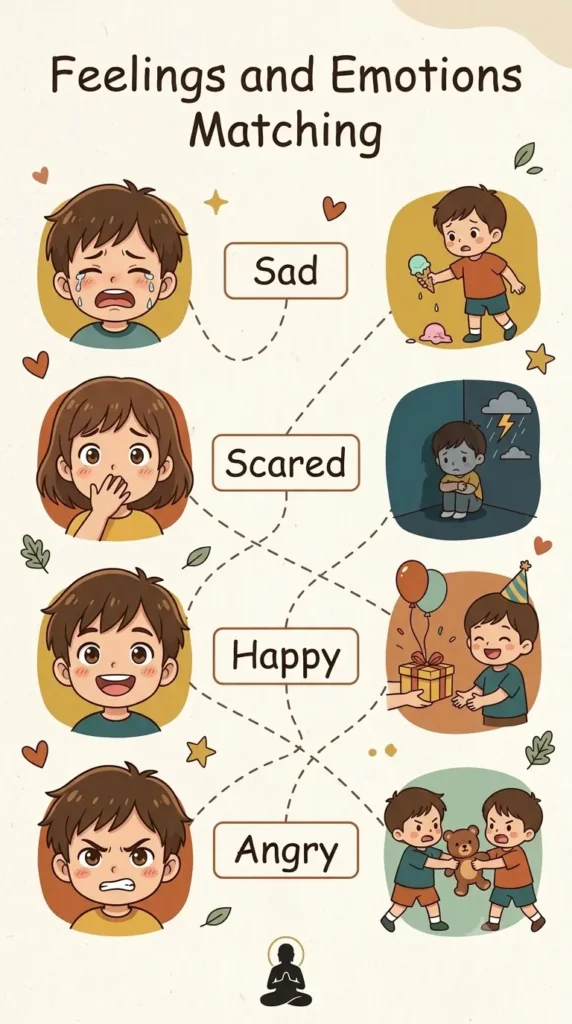
8. Feelings and Emotions Matching Worksheet
Three pieces, one page. A feelings and emotions preschool worksheet connects a word, a face, and a small scene.
A hug pairs with a happy face. Dropped ice cream might lead to sadness, or frustration, sometimes both.
There’s no single right answer baked in here. Kids should learn early that two people can respond differently to the exact same thing.
Push the conversation further with “What do you think this child feels?” followed by “Would you feel the same way?”
That second question is where the actual learning happens.
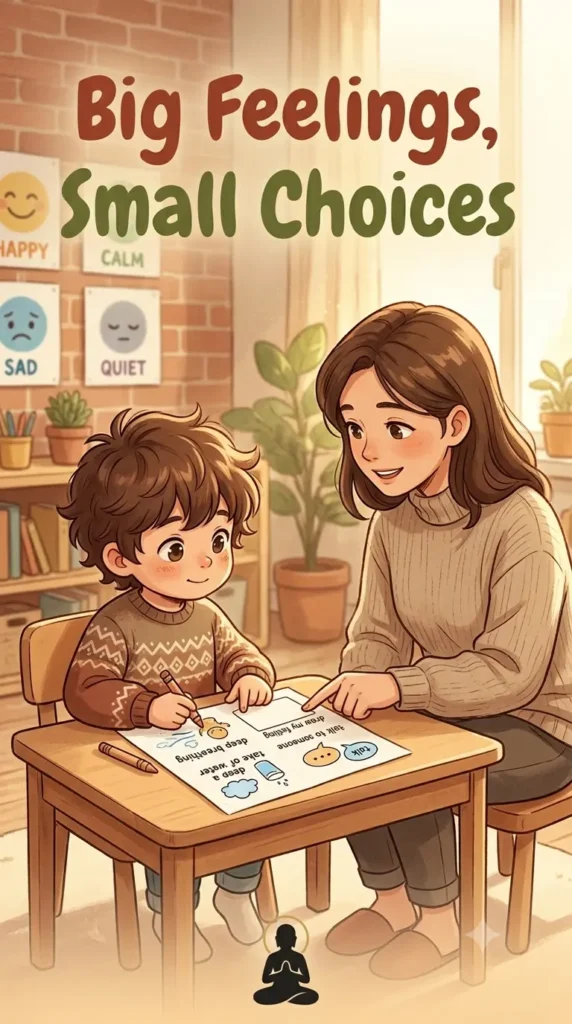
9. Big Feelings, Small Choices
Big feelings aren’t the problem. Not knowing what to do with them is. This worksheet introduces one small idea: name the feeling, then pick a helpful next move.
A few options to offer:
- Take a few slow breaths with an adult.
- Ask for help.
- Move to a quieter space.
- Use words to say what happened.
- Get a hug or another form of comfort.
- Wait before grabbing, hitting, or shouting.
Preschoolers won’t master this alone. Not yet. ZERO TO THREE describes co-regulation as the process where a caregiver helps a young child manage big feelings, and notes that responsive caregiving builds coping skills over time. (ZERO TO THREE)
Worth remembering. An emotional regulation worksheet for kids can hand a child a choice. Using it still usually takes a calm adult standing right there.
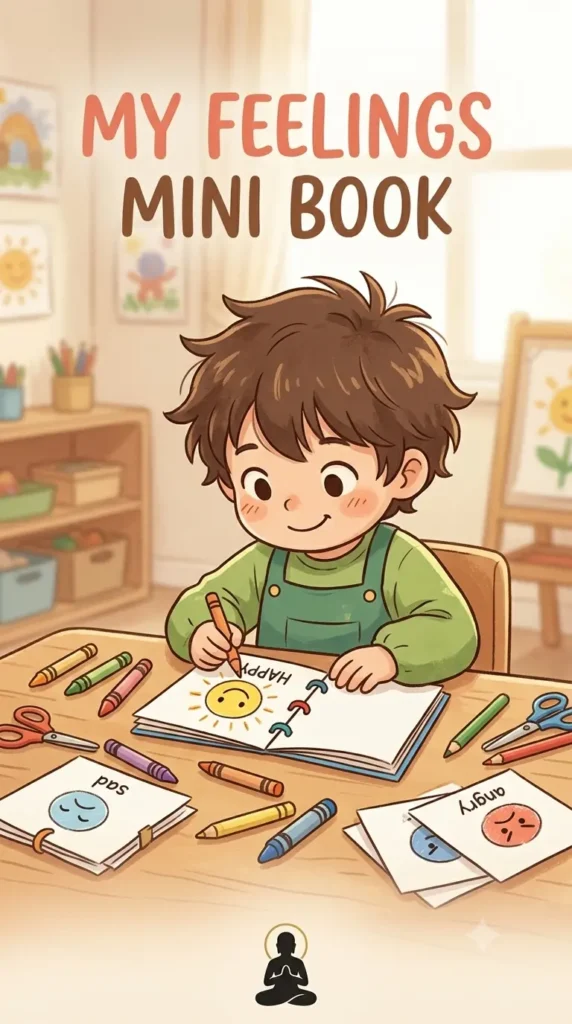
10. My Feelings Mini Book
Ten pages beat one. The My Feelings Mini Book pulls several skills into a single hands-on booklet instead of ending after one page.
Each spread covers one emotion. Color a face. Draw what triggers it. Point to where it lives in the body. Or dictate a sentence for an adult to write down.
Classrooms get real mileage out of this format. The finished booklet becomes something to revisit. A teacher might say, “You wrote about feeling worried yesterday. Do you remember what helped?”
At home, it works just as well. A quiet way to build emotion words without making every single conversation feel like a worksheet session.
Download the Complete 10 Preschool Emotions Worksheets
Want the full set instead of picking one at a time? Grab the complete 10 Preschool Emotions Worksheets bundle. Matching, coloring, cut-and-paste, drawing, body awareness, situation matching, and a first pass at regulation, all in one printable set.
More words on a page rarely helps a preschooler. What helps is a page they can actually finish and talk about with someone they trust. That’s the whole aim behind these ten.
If your family journals together as kids get older, the gratitude worksheets and journal prompts for mental health guides build on this same noticing habit from a different angle.
What Do Preschoolers Learn From Emotions Worksheets?
An emotions worksheet preschool page turns a fuzzy feeling into something small hands can actually point at. Kids this age can’t say “I’m overstimulated.” Not yet. But they can point to a face. That’s where every good preschool activity starts.
At ages 3 to 5, the goal isn’t perfect control. It never is. Preschoolers are stacking rough, early skills, the kind that later grow into real emotional awareness, honest communication, and steadier reactions.
Recognizing Facial Expressions
Kids spot an emotion long before they’ve got a word for it. A furrowed brow. A wobbly lip. They notice it in a parent’s face before they could ever explain what “worried” means. Matching a smiling face to happiness, or a scrunched-up one to fear, gives a child a solid visual anchor. Nothing abstract about it.
Facial expressions carry real emotional information. The APA Dictionary of Psychology treats them as a key form of nonverbal communication, one that reflects what a person is actually feeling inside.
So a simple emotions worksheet for kids doesn’t need writing at all. A child can point. Circle. Match one face to another. That’s enough.
Building Simple Emotion Vocabulary
Words come next. An emotions worksheet preschool activity might introduce happy, sad, angry, scared, and surprised, five words, kept small on purpose.
Once a child has a label, an adult finally has something to work with. “You look angry.” Then a follow-up: “Do you want to tell me what happened?” That’s the whole shift, from a meltdown with no shape to a feeling with a name attached.
Connecting Feelings to Situations
Feelings don’t come out of nowhere. Preschoolers slowly figure that out, usually through repetition, not explanation. A feelings worksheet preschool page might show a child losing a toy, or getting a hug, or trying something new for the first time, then ask what feeling might fit.
There’s no single correct answer here. That’s not the point. The point is starting a conversation, one where a kid gets to guess, and an adult gets to listen.
Noticing Body Signals
Emotions show up in the body first, sometimes before a child even knows why. Tears when sad. A tight tummy before something scary. A hot face right before the yelling starts. These physical clues give a preschooler a second way in, one that doesn’t depend on vocabulary at all.
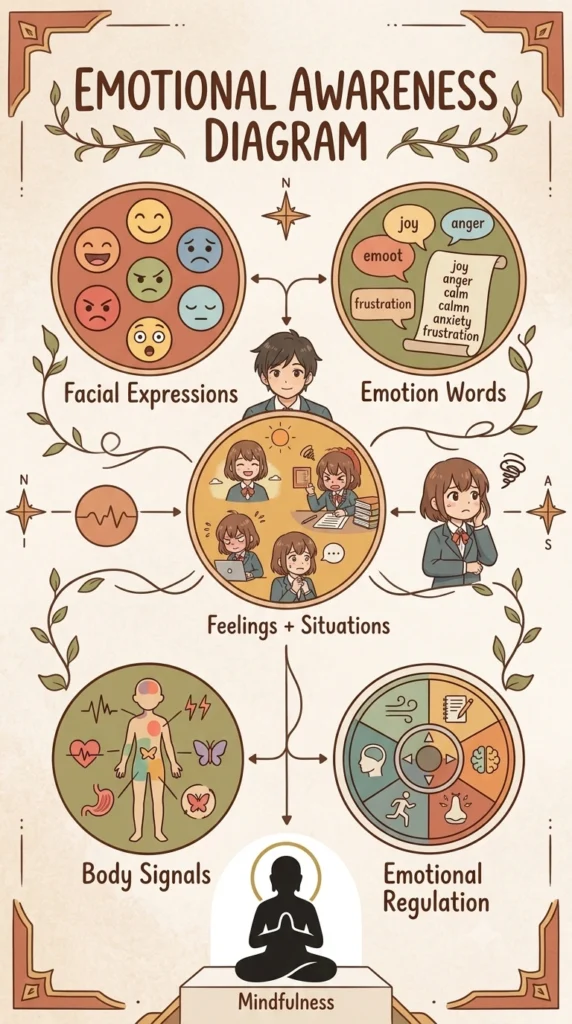
Noticing a body signal is really just an early form of body-based awareness, the same skill older kids and adults build through tools like a feelings exercise later on.
Beginning Emotional Regulation
A worksheet can introduce emotional regulation activities for kids. It can’t replace an adult in the room. Regulation isn’t something a 4-year-old figures out alone, on paper, in silence.
The APA Dictionary of Psychology is clear on this: the skill develops over time, and young children need caregivers who name feelings out loud, model coping strategies, and help a child choose what to do next.
For a preschooler, that might look small. Moving from “I’m angry” to “I’m angry, so I need help” is a real shift. A worksheet can plant that seed. It can’t grow it alone. That part still takes a grown-up, showing up, again and again, long after the page is put away.
If this kind of noticing-first approach feels useful, it pairs well with the broader ideas covered in our emotions worksheet guide, or with a running emotions journal for tracking patterns as kids get older.
How to Use an Emotions Worksheet Preschool Activity With a Preschooler
An emotions worksheet preschool activity works best as a conversation. Not a test.
Preschoolers learn through play. Through repeat and adult guidance. So keep the activity short. Keep it loose. The goal is recognizing feelings and saying them out loud, not getting every box “right.”
Sound too simple? It is. That’s exactly why it works with this age group.
Let the Child Point, Circle, Color, or Draw
Preschoolers don’t need full sentences to learn about emotions. A feelings worksheet for kids can ask a child to point to a face. Circle an emotion. Color a picture. Draw what a feeling looks like.
For a three-year-old, pointing is enough. Nothing more required. An older preschooler might circle “angry,” or draw a face bursting with excitement. Follow what the child can already do. Don’t turn an emotions worksheet preschool coloring page into a writing drill.
Cut-and-paste versions work well here too. A child matches a face to a feeling word, glues it down, and moves on. No pencil grip needed. No pressure to spell.
Ask One Simple Follow-Up Question
Once the child picks an emotion, ask one easy question. “When do you feel happy?” Or, “What happens when you feel angry?” Keep it concrete. Tie it to something from their actual day, not an abstract idea.
What if the child stays quiet? Don’t push. The worksheet already did its job. It named the emotion and put a word to it. That’s the whole win for a three-year-old.
Some emotions worksheet preschool activities include this step built in, right below the picture. Others leave blank space for the adult to ask their own question out loud instead of writing anything down.
Model the Skill Yourself
Kids pick up feeling words faster when an adult shows them first.
Try this: “I felt nervous when I couldn’t find my keys.” Then describe what that felt like in your body. Or what helped you calm down.
That one sentence does more than a whole worksheet on emotions for preschool ever could alone. It turns a printable page into something real. A live example, not paper theory.
This models exactly what emotional regulation activities for kids are meant to teach. Notice the feeling. Name it. Then choose what to do next. CDC’s early-childhood milestone guidance notes that social and emotional skills, like recognizing and naming feelings, are part of what young children are expected to build during these years, which is part of why the modeling step matters so much. CDC’s developmental milestones
Stop When the Activity Stops Being Helpful
An emotions worksheet preschool page should support learning. Not become one more task the child has to finish.
Restless? Frustrated? Overwhelmed? Put it away. Come back another day.
A five-minute conversation beats a completed page every time, at this age. There’s no prize for finishing. Ever.
If you want a similar habit that grows with the child later, a short five-minute journal prompt works the same muscle once they’re old enough to write a little. And if you’re building this into a regular routine at home, our full emotions worksheet guide covers how to turn one-off check-ins into a habit that sticks past the preschool years.
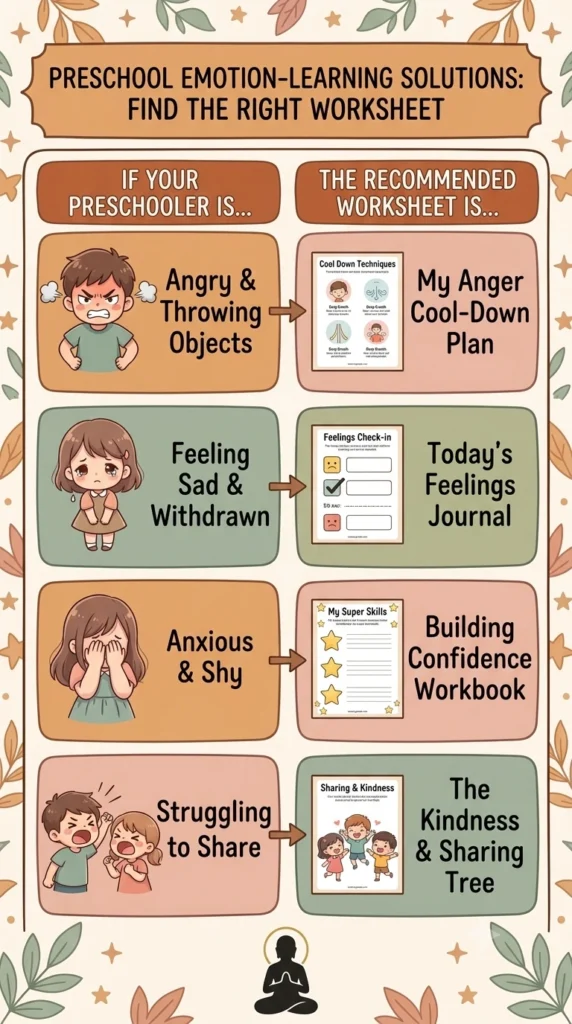
Which Preschool Emotions Worksheet Should You Start With?
Skip the guesswork. The right emotions worksheet preschool activity depends on one thing only: what the child can already do.
Not what worked for the kid next door. Not the cutest printable in your search results. Watch first.
Still pointing at faces without naming them? Start with matching. Already saying “happy” or “mad” out loud? Move toward situations, body cues, and small regulation choices. That’s the whole method.
Research on preschoolers backs this up. A study of preschool-aged children found their ability to recognize emotion from faces and body poses connects directly to broader social skills, which is exactly why starting at the right skill level matters more than starting at worksheet.
Decision Table
| If your child struggles with… | Start with… |
|---|---|
| Recognizing facial expressions | Match the Emotion Faces |
| Naming feelings | Feelings and Emotions Matching Worksheet |
| Saying how they feel | How Am I Feeling Today? |
| Understanding what causes a feeling | What Made Me Feel This Way? |
| Recognizing body cues | Where Do I Feel It in My Body? |
| Expressing emotions through drawing | Draw the Emotion |
| Connecting feelings with everyday situations | Feelings and Emotions Matching Worksheet |
| Handling big emotions | Big Feelings, Small Choices |
| Learning through hands-on activities | Cut and Paste the Feelings |
| Building a personal feelings vocabulary | My Feelings Mini Book |
The goal isn’t finishing every sheet in order. Pick the one that matches where the child is. Repeat it. Let it get boring.
A three-year-old who points confidently to a happy face but can’t say why doesn’t need a harder writing task yet. Not even close. What they need is more chances to link emotion words with faces, situations, and their own day. Give the vocabulary time to catch up to the recognition.
Once basic emotions feel familiar, sheets like What Made Me Feel This Way? or Big Feelings, Small Choices push things one step further. Keep an adult nearby while your child works through them, especially the parts that touch on upsetting moments.
Building this kind of routine at home pairs well with your own reflection habits, too. If you’re already using gratitude worksheets or a short round of mindfulness journal prompts to stay grounded, modeling that same noticing habit next to your child makes the worksheet land faster.
Kids copy regulation before they understand it. For the full range of feelings and emotions preschool worksheet options beyond this list, our complete emotions worksheet guide covers versions for every age, from Gen Alpha through adulthood.
Emotions Worksheet Preschool Activities Beyond the Printable
A worksheet alone won’t teach a three-year-old what anger feels like. Paper isn’t enough. Preschoolers learn feelings through repetition, not explanation. They need to see a face, hear a tone, move their bodies, and try it again tomorrow.
That’s why an emotions worksheet works best as a starting point, not the whole lesson. Pair the printable with games, stories, and everyday moments, and the words on the page actually start to mean something.
Act Out an Emotion
Show, don’t just tell. That’s the whole idea here. Pick one feeling. Happy, worried, angry, surprised. Ask the child to show it with their face and their whole body. Not just a word. A shape they can hold.
Go first. An adult modeling “worried” gives the child something real to copy, not a definition to memorize. Kids this age learn by mirroring people, not by hearing the word explained. Keep it short. One feeling at a time is plenty.
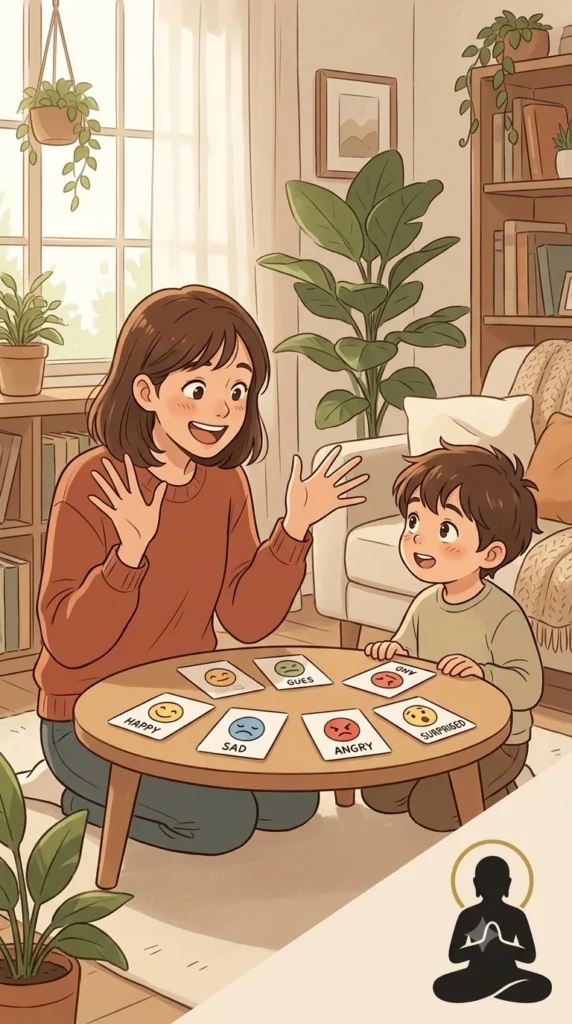
Emotion Charades
This turns feelings practice into a game, and games stick better than worksheets ever do. Write a few emotions on small cards. Draw a face if the child can’t read yet. Let the child pick one and act it out. No talking allowed.
The adult guesses. Then comes the real question: “What helped you know?” That single follow-up does more work than the whole game. It pulls the child’s attention toward eyebrows, shoulders, and voice, the actual clues behind an emotion, not just the label.
Mirror the Facial Expression
Stand at a mirror. Make faces together. Happy, sad, angry, surprised, one at a time. Ask what changes. The eyebrows. The mouth. The eyes. Small stuff, but it’s exactly what kids miss when they’re only shown a static drawing.
Keep it playful. This isn’t a quiz with one right answer. A face can look a little angry and a little hurt at once, and that’s fine. The goal is noticing, not scoring.
Read a Story and Find the Feelings
A familiar picture book works better than a worksheet on its own here. Pause at the moment something happens to a character. Ask, “How do you think they feel?” Then let the child point to a feeling face, or pick from a short list you offer out loud.
This is where a feelings worksheet for kids and a good story overlap. The book gives the emotion context. The child supplies the word. Together, they do what a blank worksheet can’t do by itself.
Pair a Worksheet With a Calm-Down Activity
Naming the feeling is only half the job. After finishing an emotions worksheet for kids, connect whatever feeling came up to something the child can actually do about it. Angry or overwhelmed? Try slow breathing. A quiet corner. Asking for help. Squeezing something soft.
The feeling doesn’t need to vanish. That’s not the goal, and it never was. The goal is practice. What can this child do while the feeling is still there? A short breathing pause here works a lot like the grounding habits in mindfulness journal prompts, just scaled down for a four-year-old’s attention span.
Can You Use Inside Out to Teach Preschool Emotions?
Yes. And here’s the honest version of why it works.
Preschoolers connect feelings to stories faster than they connect feelings to definitions. Inside Out hands a small child something concrete: a face, a color, a name for the loud thing happening inside them. That’s useful. Genuinely useful.
But here’s the catch. The movie is a way in, not the destination. Treat it like a warm-up for a proper emotions worksheet preschool routine, not a replacement for one.
Why Familiar Characters Can Help
A character does something a definition can’t. It gives the feeling a face.
“Anger” is abstract to a four-year-old. Red, stomping, and shouting is not. That gap is exactly where familiar characters earn their place.
A child who struggles to name fear or sadness can usually point at a character first and say what they see happening on screen. That’s the entry point. Not the finish line.
Turn that recognition into one short question: “How do you think they feel? Have you ever felt that way?” Simple line. Big shift. It moves the conversation off the screen and onto the child’s own memory, which is really the whole point of the exercise.
Turn Movie Emotions Into Real-Life Emotion Vocabulary
Start with the story. Then leave it behind.
Use the character’s face to introduce a word, then stretch past whatever the film actually showed. Preschoolers can hold more than five feelings, even if the label takes a beat longer to land. Try happy, sad, angry, scared, surprised, worried, frustrated, excited, and calm as a working set:
- Happy, sad, angry, scared
- Surprised, worried, frustrated
- Excited, calm
After naming one, ask the child to draw a face that matches it. Or match it to a situation on a simple feelings worksheet for kids. Neither task is about remembering which character felt what. It’s about building words the child can actually reach for at home, or mid-meltdown at preschool.
That reach matters more than the recall. A child who says “I’m frustrated” instead of screaming already has more room to work with.
Don’t Limit Preschoolers to Five “Movie Emotions”
Real feelings don’t sort themselves into five neat boxes. Never have.
A child can feel excited and nervous about the first day of school. Both at once. A child can feel angry and sad when playtime ends, and neither feeling cancels the other out.
One overview of how emotions unfold across the preschool years describes this directly: young children start with simple emotions and steadily layer on more complex ones as they grow. children enter the world with simple emotions and gradually add complex feelings to their repertoire of skills
So don’t stop at five. That’s the trap.
Inside Out works best as a doorway, not a curriculum. Pair the story-based chat with a proper set of Preschool Emotions Worksheets for Preschoolers that actually help a child recognize, name, express, and slowly respond to the wider mess of feelings a five-emotion movie was never built to cover.
If you’re also working on your own noticing habit while you guide theirs, a few mindfulness journal prompts can help you stay present for the conversation instead of rushing to fix the feeling.
Emotions Worksheet Preschool Tips for Parents and Teachers
Good preschool worksheets don’t feel like a test. They feel like a chat. Kids ages 3 to 5 are still figuring out how to spot a feeling, name it, and say it out loud. Your job isn’t to hand them the right answer. It’s to sit next to them while they find their own words.
CDC’s early-milestone checklists frame social-emotional growth this way too: most 3-year-olds are still building the basics of naming and expressing feelings, not mastering them.
Developmental milestones mark what most children can typically do by a given age, based on how they play, learn, speak, act, and move. That’s the whole reason an emotions worksheet preschool activity should stay loose and low-pressure. Nobody’s grading a four-year-old on vocabulary.
Keep the Vocabulary Simple
Start small. Happy, sad, angry, scared, excited. Words a preschooler already hears at home or on the playground.
Save the fancier words for later. “Frustrated” and “disappointed” can wait until the basics feel automatic.
A child doesn’t need a long feelings list memorized. If they point at an angry face and say “I’m mad,” that counts. That’s real progress, not a consolation prize.
This is also why a simple feelings worksheet for kids works better than a dense one. One picture. One word. One small win. Pair it with a coloring page and you’ve got an easy emotions worksheet preschool coloring activity that needs zero explanation.
Don’t Correct a Child’s Feeling
A child points to “sad.” You expected “angry.” Don’t mark it wrong.
Feelings aren’t multiple choice. The same picture can hit two kids two different ways.
Try this instead: “You think she’s sad. What makes her look sad to you?” That question does more work than any correction ever could. It gets the child explaining their own thinking, out loud, in their own words.
Avoid “You Shouldn’t Feel That Way”
Here’s an honest take on this one. A preschooler doesn’t need permission to feel the “correct” thing. They need help understanding what they’re already feeling.
“Don’t be angry” shuts the door fast. Say it enough times and a kid stops telling you the truth about hard feelings altogether.
Split the feeling from the behavior instead. “It’s okay to feel angry. We still keep our hands safe.” Two short sentences. Two different jobs. The feeling gets validated. The behavior still gets a boundary.
That split matters more than most emotional regulation activities for kids ever spell out directly, and it’s worth carrying into other calm-down routines you build with a child.
Use Worksheets for Conversation, Not Testing
A feelings worksheet preschool page works best with a grown-up sitting right there. Not rushing through boxes. Just talking.
Ask about the picture. Ask about the face. Ask what’s happening in the scene. Skip the box-checking pace entirely.
Younger preschoolers might just point, color, or pick between two feelings. That’s plenty. Writing can wait a year or two.
If you want a model for this kind of unhurried, judgment-free noticing, it’s close to what shows up in mindfulness journal prompts built for older kids and adults. Same instinct. Slower pace. No correct answer waiting at the end.
Repeat Favorite Activities Instead of Completing Everything Once
Kids don’t learn a feeling word once and keep it forever. Repetition is what makes it stick.
Found a format your child likes? Reuse it. Same layout, new feeling, new everyday situation. An emotions worksheet preschool activities set built around one template, swapped out weekly, beats twenty different one-off printables every time.
The goal was never to finish every printable in the stack. It’s to give a child repeated chances to notice a feeling, put a word to it, and practice saying what’s going on inside. Teachers who want to track how that vocabulary grows over weeks might find a simple emotions journal useful alongside the worksheets, since it holds the pattern a single sheet can’t.
For families who want to build this into something bigger than one printable, our full emotions worksheet guide covers versions for every age, from emotions worksheet preschool free printables through therapy-oriented sheets for older kids and adults. And if a child responds better to open-ended play than a worksheet format at all, a feelings exercise gives you that same goal without the page.
When an Emotions Worksheet Isn’t Enough
A worksheet can name a feeling. It can’t do everything else a young child needs.
An emotions worksheet preschool activity helps a three- or four-year-old point to an angry face, or circle a color that matches how they feel. That’s real value. It’s just not the whole picture.
Young kids don’t learn to handle big feelings from one page. They need it over and over. They need an adult standing next to them. They need real moments, not just paper ones, to actually practice.
Worksheets Teach Skills; They Don’t Replace Adult Support
This isn’t a knock on worksheets. It’s a limit worth naming.
A worksheet teaches a skill. It doesn’t replace a person. A preschooler might circle “angry” without any trouble, then completely lose it five minutes later when a sibling grabs their toy. That’s not a failed worksheet. Knowing a word and using it mid-meltdown are two different skills, and small kids are still building both.
So what actually helps in that moment? Usually not another worksheet. Usually you.
Get down to their level. Use short, plain words. Say what you see: “You’re mad because he took the truck.” Then help them pick what happens next. Do that enough times, and the ideas from the worksheet start showing up on their own, in the moments that actually count.
Here’s the part that gets skipped a lot: caregivers get overwhelmed too. If these moments are draining you, our journal prompts for mental health can give you a place to sort through your own reactions, separate from whatever your child is going through.
When a Child May Need More Individualized Support
A worksheet can’t tell you why a child is struggling. It was never built for that.
Don’t use it to diagnose anything. Not a developmental delay. Not a mental-health condition. That’s outside what a printable page can do.
So when should you look further? If the emotional or behavioral stuff sticks around. If it’s intense. If it gets in the way of daily life, school, sleep, friendships. If your gut tells you something’s off with how your child is developing. In any of those cases, talking to a pediatrician or a qualified child-development professional is a reasonable next move.
HealthyChildren.org, run by the American Academy of Pediatrics, is a solid place to start if you want parent-focused information on kids’ emotional and behavioral health.
One more thing worth saying clearly: asking a professional doesn’t mean something’s wrong. Sometimes it just gives a family a clearer way forward.
Conclusion
The best emotions worksheet preschool activities don’t ask young children to explain feelings they aren’t ready to put into words. They give them simple ways to point, color, match, draw, and talk about what is happening inside them.
Start with basic emotion recognition, then gradually introduce body cues, everyday situations, and simple regulation choices. If one worksheet becomes a favorite, repeat it rather than rushing through all ten.
For a broader collection of age-specific resources, explore our Emotions Worksheet pillar. When you’re ready, download the complete set of 10 free preschool emotions worksheets and use them as conversation starters, not tests.
Frequently Asked Questions
What emotions should a preschooler learn first?
Preschoolers can start with familiar emotions such as happy, sad, angry, scared, and surprised.
These feelings are easier to connect with facial expressions and everyday experiences. As children become comfortable naming them, introduce words such as frustrated, worried, excited, calm, or disappointed.
What is the best emotions worksheet for a 3-year-old?
For a three-year-old, the best emotions worksheet for kids is usually visual and requires little or no reading. Try emotion-face matching, coloring, pointing, circling, or simple cut-and-paste activities.
An adult can read the prompts aloud and turn the worksheet into a short conversation.
How can I use an emotions worksheet with a child who cannot read or write yet?
A preschool feelings worksheet for kids does not need to be a writing exercise. Read the instructions aloud, then let the child point, circle, color, match, or draw.
If the worksheet includes writing, the adult can write down the child’s exact words while the child focuses on identifying and expressing the feeling.
Do emotions worksheets help preschoolers with emotional regulation?
They can support the early skills behind regulation, especially recognizing and naming emotions, but a worksheet is only one part of the process.
Preschoolers also need adult modeling, co-regulation, practice, and simple coping strategies. A useful emotions worksheet can start the conversation rather than replace it.
What is the difference between a feelings worksheet and an emotions worksheet for kids?
The terms are often used interchangeably, and both can help children identify and express what they feel.
In practice, a feelings worksheet may focus more on personal experiences, while an emotions worksheet may teach specific emotion words, facial expressions, or situations. The distinction isn’t always strict.
How often should preschoolers use emotion worksheets?
There is no required schedule for using an emotions worksheet preschool free printable. Short, occasional activities usually work better than making worksheets a daily requirement.
Revisit a favorite worksheet when a child is calm, then connect its ideas to real situations during play, stories, or everyday conversations.

It’s Bhaskar!
Well, I am not a psychologist a monk, or a philosopher by training. I’m just an engineering graduate.
‘The Empty Self’ is where I write about that idea, and what it actually means for ordinary life, anxiety, identity, habits, the stories we tell ourselves about who we are. I don’t have a psychology degree, and I’m not offering therapy or clinical advice. What I do have is thought and clarity, and genuine curiosity about why we suffer the way we do and how much of it might loose once we shed this ‘fixed identity’.