
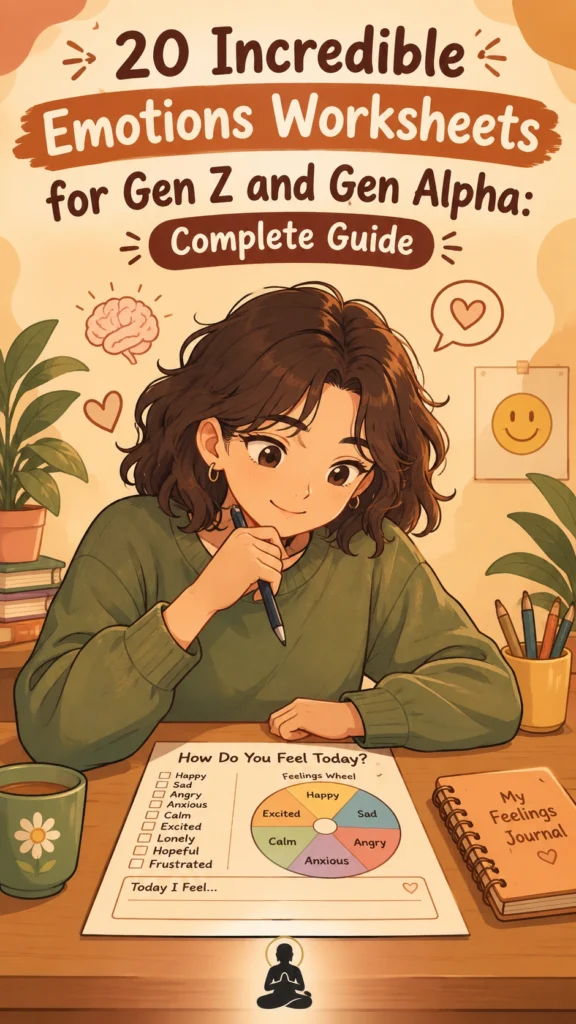
You don’t need a long journal entry to figure out what you’re feeling. Sometimes all you need is the right question on the page.
What am I feeling? Where do I feel it in my body? What set it off? What do I want to do next?
An emotions worksheet gives you that structure. No hunting for the perfect words first. Just one prompt, then the next.
This guide brings together practical Feelings Worksheets, Feelings and Emotions Worksheets, and other Printable Worksheets on Emotions, built for different needs, ages, and situations. Maybe you’re untangling a confusing mood after a hard conversation. Maybe it’s emotional overload after a rough day. There’s a worksheet for that.
Right now, this page holds 14 ready-to-use worksheets. Six more focused worksheet guides are on the way, and they’ll be linked here as each one publishes.
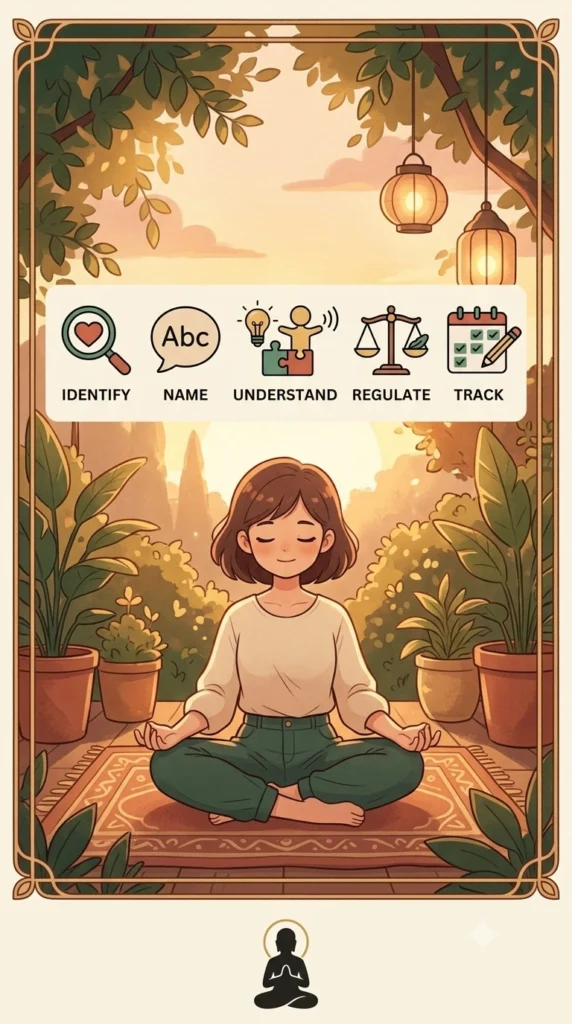
Quick overview: these worksheets help you identify, name, understand, express, track, and regulate emotions. Start with whichever one matches what you need today. You don’t have to complete every exercise. Some take two minutes. Others reward slower, deeper reflection, closer in spirit to these mindfulness journal prompts or these journal prompts for your mental health.
[IMAGE: Custom warm, non-clinical illustration showing a diverse Gen Z/Gen Alpha person using an emotions worksheet with simple checkboxes, emotion words, a feelings wheel, and a small journal beside them. Alt text: “emotions worksheet examples for teens and adults.”]
Table of Contents
Disclaimer
This blog is written and edited with the help of AI, then reviewed by me before publishing. As a result, the content is for general reflection only, not therapy or medical advice, and I’m not a licensed mental health professional. If you’re in crisis, please contact 988 if you’re in US or a local crisis service of your country instead of relying on this site.
What Is an Emotions Worksheet?
An emotions worksheet gives you a place to slow down. Instead of leaving a feeling as a vague “I feel bad,” it walks you through naming it, tracing where it came from, and figuring out what to do next.
That’s the whole point. Not vague. Specific.
What emotions worksheets help you do
A good worksheet asks more than “how do you feel?” It gives you room to spot an emotion, name it with real precision, and dig into what might have triggered it. Then it pushes further. How is this showing up in your body? Your thoughts? What you’re actually doing right now?
From there, you can work on expressing it. Or calming it down. Or just tracking the pattern over weeks.
That range is what makes an emotions worksheet worth using more than once. You might reach for one when a feeling won’t turn into words. Or after a fight, when you’re trying to untangle what actually happened.
Some people use one during a weekly check-in, just to catch patterns before they build up. If you’ve ever sat down to write out how you’re feeling and come up blank, a few journal prompts for mental health can work alongside a worksheet to get the words moving.
A printable version works the same way, as long as the prompts leave enough space to actually think, not just check a box.
Emotions vs. feelings vs. thoughts vs. moods vs. behaviors
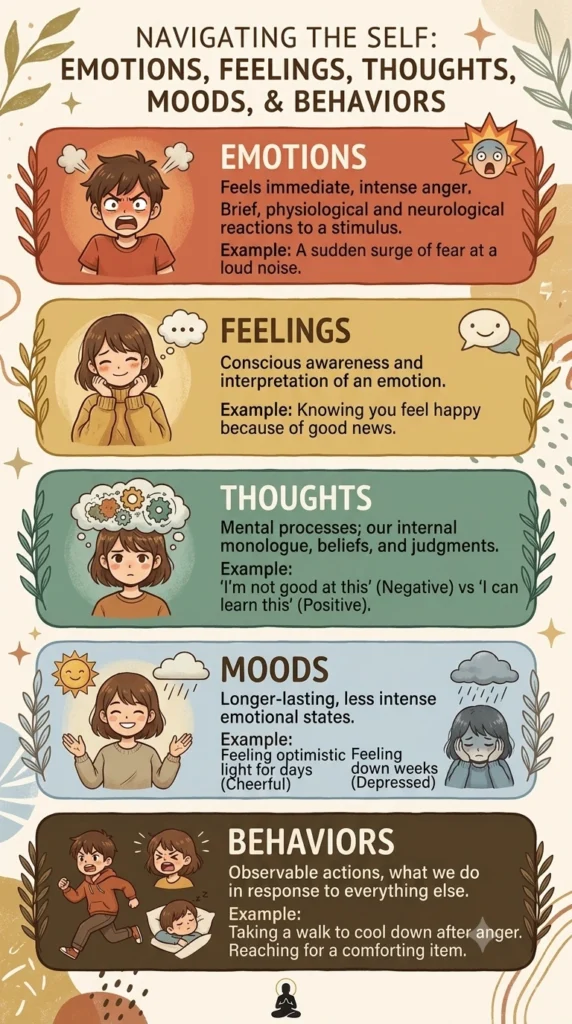
People use these words like they’re the same thing. They’re not, and mixing them up is exactly why worksheets confuse people at first.
Here’s the split. Emotions are the full response, body, behavior, and experience all tangled together. Feelings are just the part you notice, the subjective slice of that response. Thoughts are the interpretation layer, the story you tell about what’s happening. Moods run longer and looser. Sometimes there’s no clear trigger at all.
Behaviors come last. They’re what you do because of, or alongside, everything above.
The APA Dictionary of Psychology draws this same line, treating emotions and feelings as distinct and describing moods as states that can stick around without an obvious cause.
An example makes it click faster than a definition does. “My chest feels tight” is a body sensation. “I feel anxious” is the emotion itself. “They probably think I failed” is a thought, not a fact. “I’ve felt on edge all afternoon” is a mood. And “I avoid opening the message” is the behavior, the part everyone else actually sees.
How tHow to Choose the Right Emotions Worksheet
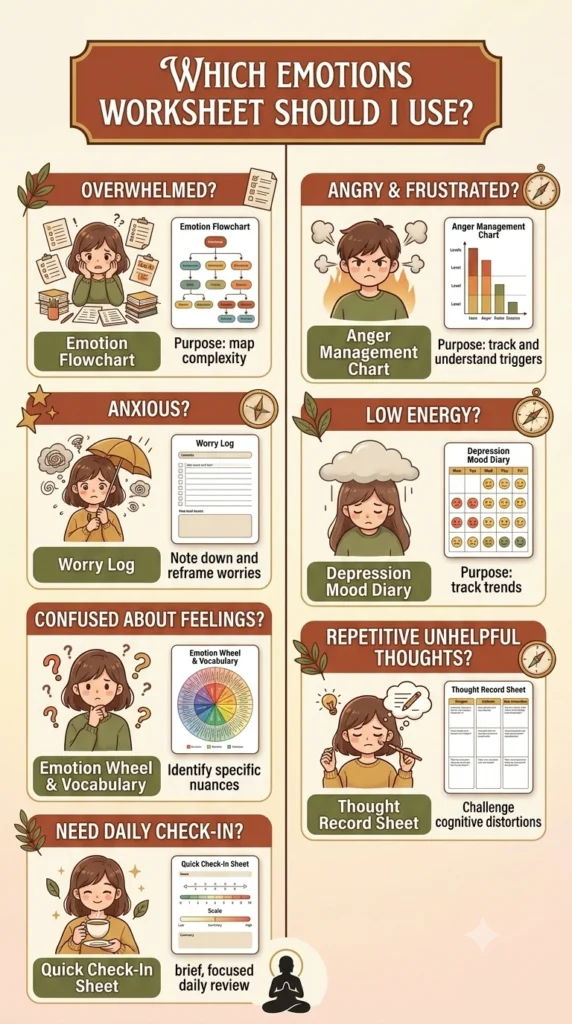
The right emotions worksheet depends on one thing. What you actually need right now.
Not what worked for someone else. Not the version with the prettiest layout. If you can’t name the feeling, start with identification. Stuck in a feeling you already recognize? Regulation does more for you than reflection ever will. Overthinking which one to pick? Don’t. Use the table below and move on.
| If you… | Start with… |
|---|---|
| Can’t name the feeling | Emotion identification worksheet |
| Feel something in your body | Body/emotion worksheet |
| Know the feeling but not the trigger | Trigger worksheet |
| Feel overwhelmed | Regulation worksheet |
| Need to talk to someone | Expression worksheet |
| Want to spot patterns | Emotion log |
| Need therapy homework | Therapy-oriented worksheet |
Can’t Name the Feeling? Start With an Emotion Identification Worksheet
Sometimes the honest answer is just “I don’t know.” That’s exactly where an emotion identification worksheet earns its place. It moves you from vague words like bad, weird, or stressed toward something sharper. Disappointed. Irritated. Lonely. Embarrassed. Overwhelmed.
You don’t need the perfect word on the first try. Closer is enough.
Feel Something in Your Body? Start With a Body/Emotion Worksheet
The mind doesn’t always speak first. Sometimes the body does. A tight chest. Tense shoulders. A heavy stomach. Shaky hands. A restless feeling with no name attached yet.
Start with a body-based worksheet when the sensation shows up before the emotion does. Physical cues are real information, even when the feeling behind them stays fuzzy. Pairing this with mindfulness journal prompts can help you catch these signals in the moment, not twenty minutes after they’ve already passed.
Know the Feeling but Not the Trigger? Start With a Trigger Worksheet
Knowing you’re angry, anxious, or hurt is only half the picture. What set it off? That part often hides.
A trigger worksheet works backward. The situation first. Then your read on it. Then the feeling it produced. Three steps. Nothing fancier than that.
Feel Overwhelmed? Start With a Regulation Worksheet
This isn’t the moment for deep analysis. Not when the feeling is already too loud.
Emotion regulation is generally understood as the ability to respond to emotional experience in a way that’s flexible enough for spontaneous reactions but still lets you delay a reaction when needed. An emotional regulation worksheet puts that into practice. Notice what’s happening. Pick one manageable next response. Wikipedia
It’s 9pm. Your chest is tight. Your thoughts won’t sit still. A regulation worksheet gives you one small next move instead of ten. Small enough to actually do.
Need to Talk to Someone? Start With an Expression Worksheet
You know what you’re feeling. Explaining it out loud is the hard part.
An expression worksheet organizes your thoughts before the conversation happens. That way the right words show up when you need them, not twenty minutes after you’ve already left the room.
Want to Spot Patterns? Start With an Emotion Log
Same reaction, different day? An emotion log is built for exactly that.
Record the situation. The feeling. The intensity. The response. Patterns hiding in the moment tend to surface once you look back over weeks instead of hours. A dedicated emotions journal can hold all of that in one place, situations, triggers, sensations, and responses, so nothing gets lost between entries.
Need Therapy Homework? Start With a Therapy-Oriented Worksheet
Therapy homework isn’t one-size-fits-all. Choose a worksheet that supports the specific skill you’re working through with your therapist.
A worksheet should back up the conversation. It was never meant to replace professional assessment or treatment. Some weeks, writing fits the work better than filling in boxes, and therapy journal prompts cover that side of it too.
14 Emotions Worksheets to Try Right Now (+ 6 More Coming Soon)
These emotions worksheets cover the full process of emotional awareness: naming what you feel, understanding its intensity and triggers, noticing body signals, and choosing how to respond. The first 14 are ready to use now, while six upcoming resources will expand the collection for different ages and needs.
1. Emotion Identification Worksheet
An emotion identification worksheet is useful when “I feel bad” is the best description you can come up with. Instead of stopping at a broad label, the worksheet helps you look closer: Are you disappointed, embarrassed, rejected, irritated, lonely, worried, or something else?
Start with a simple prompt:
What am I feeling right now?
Then ask:
- What happened just before I noticed this feeling?
- What words come close to describing it?
- Where do I feel it in my body?
- How strong is it?
- What might this emotion be trying to tell me?
The goal isn’t to find the one “correct” emotion. Sometimes two labels fit. Sometimes the closest word is still imperfect. That’s fine. Emotional awareness starts with getting more specific, not getting perfect.
For example, “stressed” might actually turn out to be a mix of overwhelmed + worried + frustrated. Those emotions may call for very different responses.
[Future cluster: Identifying Emotions Worksheet]
A dedicated identifying emotions worksheet can go much deeper into identifying feelings, recognizing emotional cues, building emotional vocabulary, and labeling emotions with greater precision. This future guide will also cover versions designed specifically for adults and therapy settings.
2. Feelings Vocabulary Worksheet
A Feelings Worksheet helps expand the words you have available for describing your inner experience. That matters because “good,” “bad,” “fine,” and “stressed” can describe dozens of very different emotional states.
Think of emotional vocabulary as a set of labels on a map. The more useful labels you have, the easier it becomes to describe where you actually are.
A simple worksheet can begin with a broad word and ask you to find more specific possibilities:
Bad → upset → disappointed → rejected → hurt
These words aren’t interchangeable. Being disappointed because a plan fell through isn’t necessarily the same experience as feeling rejected by someone you care about. The worksheet is there to help you notice that difference.
You can also work in the opposite direction. Start with a specific word such as resentful, then ask:
- What broader feeling does this connect to?
- What happened that brought it up?
- Is another emotion underneath it?
- What do I need right now?
This is where Feelings and Emotions Worksheets become more useful than a simple list of emotion words. You’re not memorizing vocabulary. You’re learning how to use it.
A good vocabulary worksheet should also leave room for words that aren’t on the page. Emotional language varies from person to person, and sometimes the most accurate description is one you find yourself.
3. Feelings Wheel Worksheet
A feelings wheel worksheet organizes emotions from broader categories into more specific words. It can help when you know something is happening emotionally but can’t quite find the language for it.
For example, you might begin with a broad category such as sadness and move toward words such as lonely, disappointed, hurt, or hopeless. The point isn’t to force every experience into a fixed category. It’s to give you more options than “sad.”
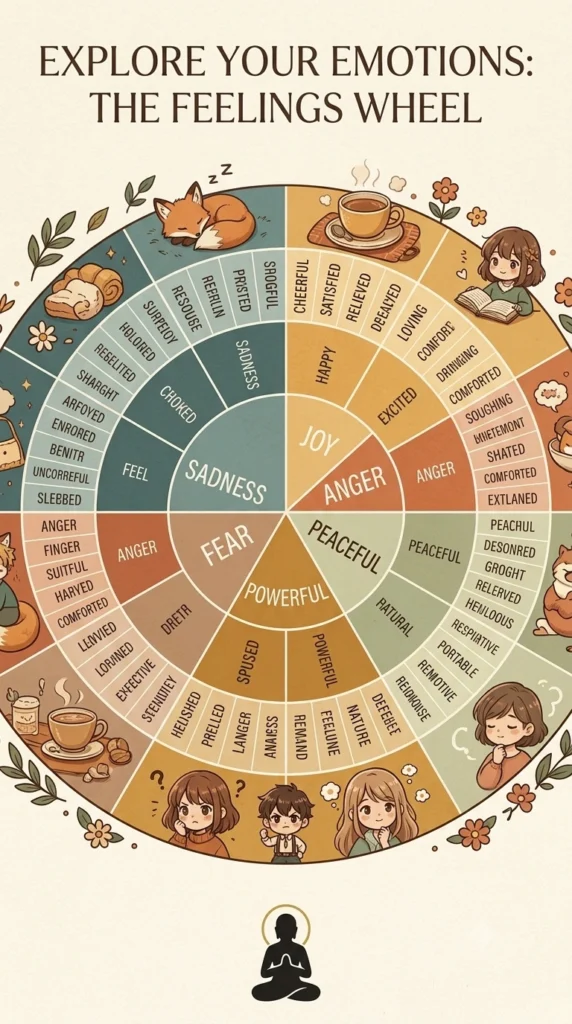
Try using a feelings wheel in three passes:
- Circle the broadest emotion that seems close.
- Move outward and choose a more specific word.
- Write one sentence explaining why that word fits.
That final step is worth keeping. Choosing “frustrated” from a wheel is useful; understanding why you’re frustrated is where the real reflection begins.
A feelings wheel can also work well as one of several Printable Worksheets on Emotions because it is quick enough for a daily check-in but flexible enough for deeper journaling.
One caution: emotion wheels aren’t universal dictionaries of human experience. Different wheels group and name emotions differently. If a word doesn’t fit, don’t force it just because it appears on the page.
4. Emotion Intensity Worksheet
An emotion intensity worksheet helps you describe how strongly you are experiencing an emotion, rather than simply naming it.
You might feel mildly irritated after a delayed reply and intensely angry after an argument. The emotion label can be similar while the intensity is completely different.
A simple scale can run from 1 to 10:
- 1–2: barely noticeable
- 3–4: present but manageable
- 5–6: clearly affecting your attention or behavior
- 7–8: difficult to ignore
- 9–10: extremely intense
These ranges are only a guide. There is no scientifically universal rule that says a particular number must correspond to a particular emotional state.
The more useful question is:
What does this emotion feel like at this intensity?
You can build the worksheet around a before-and-after comparison:
| Moment | Emotion | Intensity | What changed? |
|---|---|---|---|
| Before the conversation | Nervous | 7/10 | — |
| During the conversation | Nervous | 9/10 | Felt judged |
| 20 minutes later | Nervous | 4/10 | Had time to process |
This can be particularly helpful for emotional regulation because it shows that emotions can shift in intensity over time. Regulation doesn’t have to mean making an emotion disappear. Sometimes the goal is simply moving from an intensity that makes thoughtful action difficult to one that gives you more room to choose what happens next.
5. Where Do I Feel the Emotion in My Body?
Emotions aren’t experienced only as thoughts. You may notice a tight jaw when you’re angry, a heavy chest when you’re sad, restless energy when you’re anxious, or a sinking feeling in your stomach when something feels wrong.
A body-awareness worksheet gives you a place to record those signals without assuming that every physical sensation has one fixed emotional meaning.

Start with:
Where do I notice this emotion in my body?
Then record:
- What sensation do I notice?
- Is the area tight, heavy, warm, cold, restless, shaky, or numb?
- Does the sensation stay in one place or move?
- When did I first notice it?
- Did the sensation change after a few minutes?
For example, you might write:
“My shoulders feel tight. My stomach feels unsettled. I keep wanting to move around.”
That description may tell you more than simply writing “anxious.”
It’s also worth avoiding a common trap: body sensations are clues, not diagnostic tests. A tight chest doesn’t automatically mean anxiety, and a relaxed body doesn’t automatically mean you’re happy. Context still matters.
6. What Triggered This Emotion? Worksheet
A trigger worksheet helps you slow down the chain between what happened and how you responded.
A useful starting model is:
Event → Interpretation → Emotion → Response
The event is what happened. The interpretation is the meaning your mind gave it. The emotion is what you experienced. The response is what you did next.
Consider a friend leaving your message on read.
The event is simple: they didn’t reply.
Your interpretation might be: “They’re annoyed with me.”
That interpretation may bring up worry or rejection, which could lead to checking your phone repeatedly, sending another message, or pulling away.
But the interpretation isn’t necessarily a fact. Your friend might be busy, asleep, distracted, or dealing with something unrelated to you.
A worksheet can separate those pieces:
What happened?
What did I observe without adding meaning?
What did I tell myself it meant?
What assumption or story appeared?
What emotion followed?
What feeling did I notice?
How did I respond?
What did I say, do, avoid, or feel tempted to do?
What else could be true?
Are there other reasonable explanations?
This isn’t about talking yourself out of your feelings. The emotion is real even when the interpretation behind it turns out to be incomplete.
You can also check out How to Create an Emotions Journal for an in-depth knowledge regarding this.
7. Emotion, Thought, Urge, and Action Worksheet
An emotion can create an urge without requiring you to act on it.
That’s the key idea behind this worksheet.
Imagine receiving a harsh comment online. You might feel angry, think “They are deliberately trying to embarrass me,” feel an urge to respond immediately, and then type something you regret later.
The worksheet separates those stages so they don’t blur together:
| What to notice | Your response |
|---|---|
| Emotion | What am I feeling? |
| Thought | What is my mind saying about this? |
| Urge | What do I want to do right now? |
| Action | What did I actually choose to do? |
| Result | What happened afterward? |
The distinction between urge and action is especially useful. Feeling an urge to send an angry text doesn’t mean you have to send it. Feeling afraid doesn’t mean you have to avoid the situation. Feeling jealous doesn’t automatically tell you what action will help.
You can add one final prompt:
If I gave myself ten minutes before acting, what response would I be more likely to respect later?
Sometimes the answer is still to act. Sometimes it’s to wait. The worksheet simply creates enough space to make that choice deliberately.
8. Mixed Emotions Worksheet
Mixed emotions are normal. You can be excited about a new opportunity and nervous about what it will demand from you. You can miss someone and still know that distance from them is healthy. You can feel relieved about a breakup while grieving the relationship.
A mixed emotions worksheet gives those combinations a place on the page instead of forcing you to choose just one feeling.
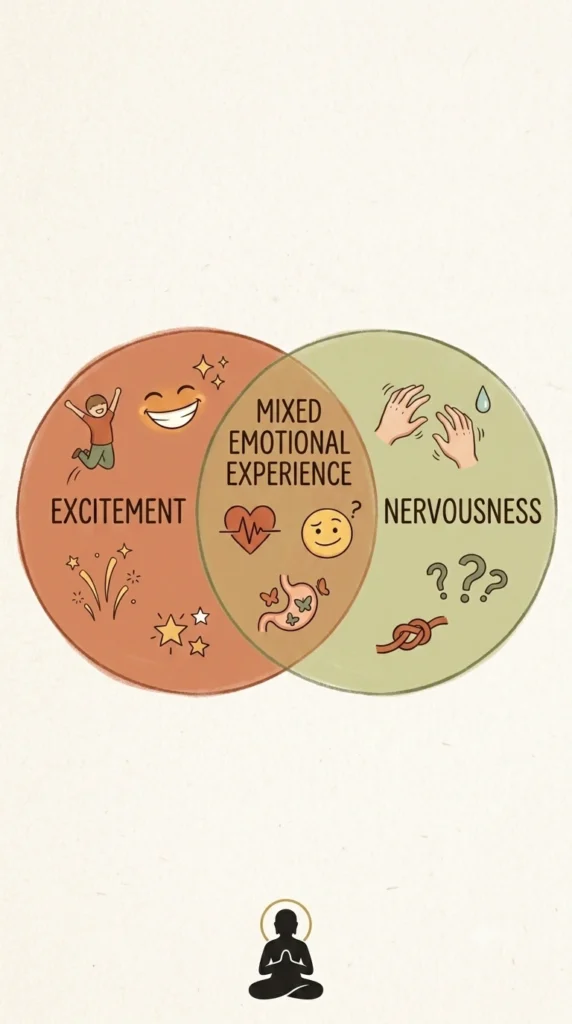
Try this structure:
Situation:
What is happening?
Emotion 1:
What is one feeling I notice?
Emotion 2:
What is another feeling that is also present?
What does each emotion seem connected to?
What part of the situation might explain each feeling?
What do I need to remember?
Can both emotions be valid at the same time?
For example:
Starting college: excited + nervous
Setting a boundary: relieved + guilty
Getting an opportunity: proud + scared
Seeing an old friend: happy + sad
This is particularly relevant for Gen Z and Gen Alpha because online conversations often flatten complicated experiences into a single label. Real emotional life is usually messier. A worksheet doesn’t need to tidy that mess up; sometimes it simply needs to help you describe it accurately.
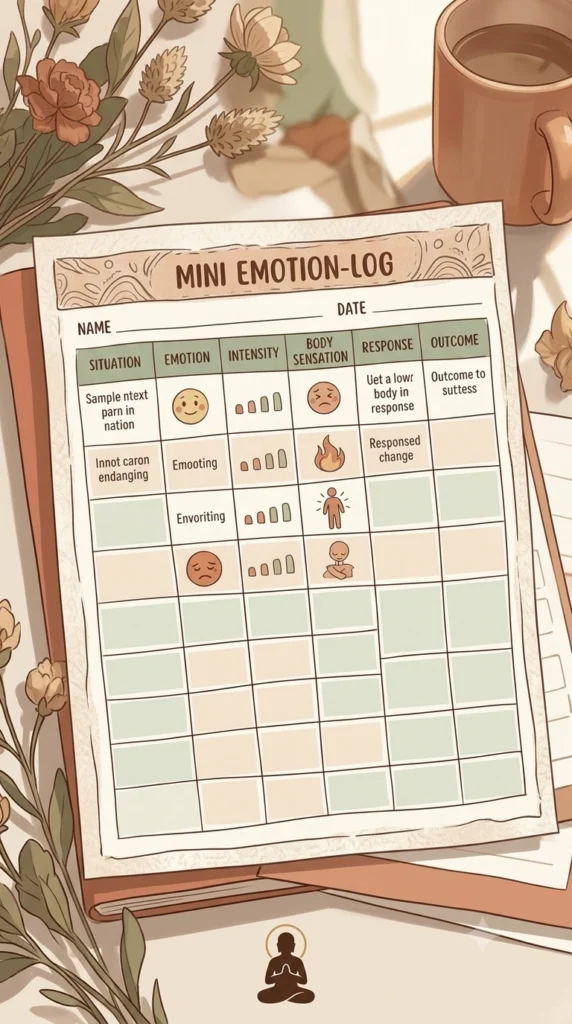
9. Emotion Log Worksheet
An emotion log is designed for patterns, not just one difficult moment. Instead of asking what you’re feeling once, it lets you record emotional experiences over several days or weeks.
A useful emotion log can include:
| Situation | Emotion | Intensity | Body signal | Response | Outcome |
|---|---|---|---|---|---|
| Group project message | Frustrated | 6/10 | Tight jaw | Waited before replying | Conversation went better |
| Family disagreement | Hurt | 8/10 | Heavy chest | Took a break | Felt calmer later |
| Unexpected compliment | Embarrassed | 4/10 | Warm face | Laughed it off | Felt good afterward |
The value comes from reviewing the entries later.
You may notice that your strongest reactions happen after poor sleep. Or that certain conversations repeatedly bring up the same emotion. Or that an action you use to cope helps for ten minutes but makes the situation worse afterward.
Don’t turn the log into a demand to record every emotional moment. That can become another chore. A few meaningful entries are often more useful than filling out a form mechanically every evening.
10. Emotional Awareness Check-In Worksheet
An emotional awareness check-in is a short worksheet for noticing what is happening internally right now, without turning every check-in into a long journaling session.
For adults, this can be especially useful during transitions: before work, after a difficult meeting, during a commute, before bed, or when you notice yourself becoming unusually irritable.
Try a five-minute version:
Right now, I feel:
Choose one or two words.
The intensity is:
0–10.
My body feels:
Name one physical sensation.
The strongest thought in my mind is:
Write it as honestly as you can.
What might I need right now?
Rest, space, food, connection, reassurance, movement, clarity, support, or something else.
One helpful next step:
Choose something realistic.
This can function as an emotion identification worksheet for adults without requiring a detailed emotional analysis. That’s the point. A check-in should be easy enough to use on an ordinary Tuesday, not only when life has already fallen apart.
If you notice the same emotion showing up repeatedly, that’s when a longer emotion log or journal may be more useful than another five-minute check-in.
11. Emotional Regulation Worksheet
Emotional regulation is not about getting rid of an emotion. An emotional regulation worksheet helps you notice what you’re feeling, understand what is driving it, and choose a response that fits the situation rather than reacting automatically.
A useful worksheet might begin with:
What am I feeling?
Name the emotion as specifically as you can.
How intense is it?
Rate it from 0–10.
What is happening right now?
Describe the situation without judging yourself.
What is this emotion pushing me to do?
Notice the urge before acting on it.
What would help me respond well?
Consider whether you need time, information, a boundary, movement, rest, connection, or a conversation.
For example, if you’re angry after receiving a critical message, regulation might mean waiting before replying, taking a short walk, and then deciding whether the message actually requires a response. It doesn’t mean convincing yourself that you’re not angry.
That’s an important distinction. An emotion can be valid without every action it urges being helpful.
You can also use the worksheet after the emotion has passed:
- What helped the intensity change?
- What made it worse?
- Did my response match what I actually needed?
- What would I try differently next time?
This turns emotional regulation into a skill you can observe and practice, rather than a vague instruction to “calm down.”
12. Anger and Emotional Triggers Worksheet
Anger often carries information about something that feels wrong, unfair, threatening, disrespectful, or out of control. An anger worksheet helps you examine that information before deciding what to do with it.
Start by describing the situation:
What happened?
Then move one layer deeper:
What did I think the situation meant?
Maybe the thought was, “They don’t respect my time,” or “Nobody is listening to me.” That interpretation can be more revealing than the event itself.
Next, explore:
What might my anger be connected to?
- A boundary being crossed
- A value being ignored
- Feeling dismissed
- Feeling powerless
- Feeling embarrassed
- Feeling hurt
- Feeling treated unfairly
Then notice the physical side. Did your jaw tighten? Did your heart race? Did you feel hot, restless, shaky, or ready to move?
Finally:
What is my strongest urge?
And: What response would protect what matters to me without creating a bigger problem?
That last question is where this worksheet earns its place. Anger doesn’t automatically mean “do nothing.” Sometimes it points toward a necessary boundary or conversation. The goal is to make the response intentional.
13. Difficult Emotions Worksheet
A difficult emotion is not necessarily a harmful emotion. Shame, guilt, grief, jealousy, embarrassment, and loneliness can be painful without being emotions that need to be eliminated.
A useful difficult-emotions worksheet should therefore avoid questions such as “How do I get rid of this feeling?” Instead, start with curiosity:
What am I feeling?
Then:
What happened before I felt this way?
What does this emotion seem connected to?
What story am I telling myself about the situation?
Is there another part of the story I may be overlooking?
What do I need right now?
The answer may not be “fix the problem.” You might need rest, reassurance, privacy, a conversation, time to grieve, or simply permission to acknowledge that something hurts.
Take shame as an example. Shame often comes with a harsh judgment about the self: I did something embarrassing, therefore something is wrong with me. A worksheet can help separate the event from the identity judgment.
Guilt can be different. It may point toward something you regret and want to repair. Jealousy may reveal insecurity, fear of losing something important, or an unmet need. Loneliness may tell you that connection matters to you.
The worksheet doesn’t have to decide which interpretation is correct. Its job is to slow the reaction down enough for you to investigate it.
14. Emotional Expression Worksheet
An emotional expression worksheet helps turn an internal experience into words that another person can actually understand. Identifying an emotion is one step; communicating it clearly is another.
A simple structure is:
I feel…
Name the emotion rather than leading with an accusation.
When…
Describe the situation as specifically as possible.
Because…
Explain what the situation means to you or what need, expectation, or value is involved.
What I would like is…
State a realistic request, boundary, or next step.
For example:
“I feel frustrated when plans change at the last minute because I rely on knowing what to expect. Could you let me know earlier when something changes?”
The “I feel…” framework can be useful, but it isn’t a magic formula for difficult conversations. Sometimes the other person won’t respond well. Sometimes the situation isn’t safe for direct communication. Sometimes you need time to understand your own emotion before bringing it to someone else.
That’s why the worksheet should include a final question:
Is this something I want to communicate, process privately, or discuss with someone I trust?
If you’re looking for Free Printable Feelings Worksheets PDF resources, this type of communication worksheet is particularly useful because it gives you space to prepare before an emotionally charged conversation rather than trying to find the right words in the moment.
Coming Soon: 6 More Emotions Worksheets
The next six resources will expand this collection into dedicated guides for communication, age-specific needs, therapy, and broader emotional-awareness activities. They are intentionally kept as short teasers here so each future article can go much deeper into its own search intent.
15. Talking About Feelings Worksheet
[Future cluster: Talking About Feelings Worksheets]
A talking-about-feelings worksheet can help you organize an emotion before bringing it into a conversation. It can be especially useful when you know something is bothering you but keep losing your words once the conversation starts.
Emotional expression activities work best when they help you communicate what you actually mean rather than giving you a script you have to follow.
16. Emotions Worksheet for Teens
[Future cluster: Emotions Worksheet for Teens]
An emotions worksheet for teens needs to feel relevant to real teenage experiences, not like a worksheet written for much younger children.
Future resources will explore school pressure, friendships, family conflict, social media, identity, embarrassment, anger, and the sometimes confusing experience of having several emotions at once.
This will include practical formats for a worksheet emotions teens can complete without needing a long explanation first.
17. Emotions Worksheet for Adults
[Future cluster: Emotions Worksheet for Adults]
An emotions worksheet for adults can focus on situations that become harder to name once everyday responsibilities pile up: work stress, relationships, boundaries, decision-making, uncertainty, and emotional overload.
A future guide will go deeper into emotions worksheet adults can use for regular check-ins, reflection, and pattern tracking, including options for people looking for an identifying emotions worksheet for adults.
18. Therapy Identifying Emotions Worksheet
[Future cluster: Identifying Emotions Worksheet]
A therapy identifying emotions worksheet can be useful as a structured way to reflect between sessions, build emotional vocabulary, or bring a difficult experience into a therapy conversation.
It shouldn’t replace assessment or treatment from a qualified mental-health professional, but it can give both the client and therapist clearer language to work with.
The future Identifying Emotions Worksheet guide will cover emotion recognition, feelings identification, labeling emotions, and therapy-oriented applications in greater depth.
19. Emotions Worksheet for Kids
[Future cluster: Emotions Worksheet for Kids]
An emotions worksheet for kids should use simpler language and more concrete cues than an adult resource. Faces, basic emotion words, body sensations, short scenarios, and a Feelings Worksheet for Kids can help children connect what happens around them with what they feel inside.
The future guide will focus on age-appropriate ways to build that emotional vocabulary without turning every feeling into a lesson.
20. Emotions Worksheet for Preschoolers
[Future cluster: Emotions Worksheet Preschool]
Preschool Emotions Worksheets for Preschoolers need to be simple enough for children who are still developing the language to describe internal experiences.
Matching faces, identifying colors or expressions, choosing between basic emotion words, and answering “How do you feel?” can make emotional learning concrete and interactive.
The future preschool guide will focus on activities that adults can use alongside young children rather than expecting preschoolers to complete lengthy written exercises independently.
How to Use an Emotions Worksheet
An emotions worksheet only works if you slow down first. Rush it, and it turns into another task on your list. Name what you notice. Connect it to your body. Then pick one small step forward.
Start with the easiest question
You don’t need to finish every box on an emotions worksheet. Not every time. If you’re overwhelmed, start with one line: What am I feeling right now? Still stuck? Pick from a short list instead: angry, sad, worried, calm, frustrated, confused. A half-finished check-in still counts. Small answers still open the door.
Name the emotion without judging it
This isn’t about deciding whether the feeling makes sense. Not yet. Describe it first. “I feel jealous” gives you something to work with. “I shouldn’t feel jealous” shuts the door before it opens.
Observation comes before interpretation, and you can ask why later, once the feeling actually has a name. This kind of noticing, without rushing to fix or judge it, is close to what mindfulness journal prompts are built for too.
Look for the body signal
Emotions live in the body as much as the mind. A tight jaw usually means anger. A heavy chest often means sadness. Restless hands, a flutter in the stomach, legs that won’t sit still; that’s anxiety showing up before you’ve found the word for it.
A quick body scan can name a feeling faster than language sometimes can, especially when you’re too tired to think it through.
Separate the emotion from the action
Feeling something doesn’t mean you have to act on it. An emotion is information, not a command. You can feel angry and still delete the message you drafted in the heat of it. This distinction matters most when the feeling runs hot, and it’s the whole point of most emotional regulation worksheets in the first place.
End with one useful next step
An emotions worksheet shouldn’t turn into an endless self-audit. Pick one honest move instead. Take a break. Call someone. Set a boundary. Drink some water.
Go back to the situation later, once things have cooled off. Or write it out, even a quick five-minute journal prompt counts if that’s all the time you’ve got. Awareness only matters if it leads somewhere.
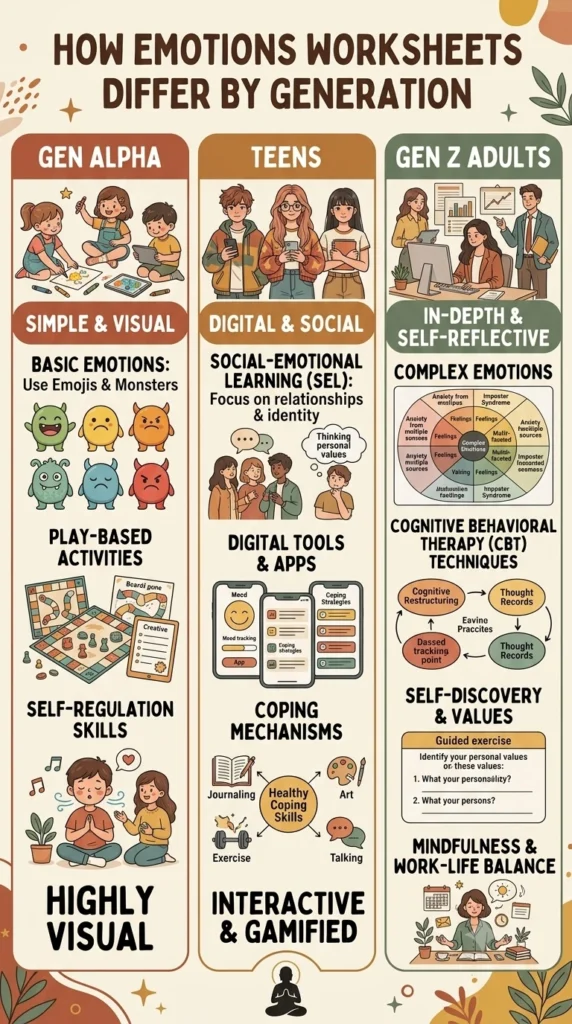
Emotions Worksheets for Different Ages
An emotions worksheet only works if the words on it match the person holding the pencil. Give a five-year-old the same page a teenager gets, and it falls flat. Give a teenager the same page an adult gets, and it feels forced too.
Age doesn’t change the goal. Notice the feeling. Name it. Understand where it came from. Respond to it. What changes is the language, the examples, and how deep the reflection goes.
Gen Alpha
For younger kids, an emotions worksheet should feel like play. Not homework.
Faces work. Colors work. Matching games and short scenarios work. A long explanation of emotional awareness does not. Kids this age think in pictures, not paragraphs.
Picture a worksheet where a child matches a worried face to a scene like walking into a new classroom. Then they point to where that feeling sits in their body. That’s it. That’s the whole exercise.
Body cues matter more here than almost anything else. “My tummy feels tight” lands. “My hands feel shaky” lands too. A definition of emotional awareness doesn’t. Keep the instructions short. Stick to emotion words the child already knows. Leave room to draw or circle an answer instead of writing one.
Teens
Teenagers need more than a face chart. They need nuance.
A good emotions worksheet for teens digs into identity, friendships, school pressure, social media, conflict, embarrassment, anger, anxiety. Without treating any of it like a problem to fix. Most teenage emotions aren’t broken. They’re just loud.
One useful format asks a teen to split what happened from what they thought it meant. Then name the actual emotion. Then name what they wanted to do next. That extra step matters. “I’m angry” is rarely the full story. It might be rejection underneath. Or embarrassment. Or just feeling misunderstood.
Gen Z Adults
For Gen Z adults, the worksheet shifts again. Relationships, work, boundaries, uncertainty, self-worth, feeling stretched too thin. The language gets more reflective here. There’s room to sit with patterns instead of just picking a word off a list.
Take that same body-awareness worksheet from earlier. For an adult, it might ask something different. Where do you feel a recurring boundary issue in your body? What tightens up before a hard conversation at work? Same tool. Different question.
If body-based reflection like this feels useful, it pairs well with other grounding practices, like the ones covered in journal prompts for mental health or a regular gratitude worksheets practice, which builds a similar noticing habit from a different angle.
When an Emotions Worksheet Is Useful (and When It Isn’t)
An emotions worksheet helps when a feeling won’t hold still long enough to name. You know something is off. You just can’t say what yet. That gap is exactly what the worksheet closes.
It turns “something feels wrong” into a few concrete lines you can sit with. No rushing to fix it. Some people call this an identifying emotions worksheet instead, or just a plain feelings worksheet. Same idea, different label.
Good times to use one
An emotions worksheet works best right after something stirs you up. An argument. A disappointing text. A stressful class, a hard meeting, plans that changed without warning. Write down what happened while the details are still sharp. That’s how you separate the event from your read on it.
Quieter moments matter too. A short check-in at the end of the day can surface patterns. Patterns you’d miss while sprinting from one task to the next. For journaling, an emotions worksheet gives a blank page some direction. No staring at nothing, wondering where to start.
Working with a therapist or counselor? A worksheet can double as therapy homework. Or something concrete to bring into a session. Sometimes all you’ve got is “I’m stressed” or “I feel weird.” An emotion identification worksheet helps you hunt for something sharper.
When to stop the exercise
This isn’t about finishing what you started. An emotions worksheet should support reflection, not add to the pile. Stop if writing leaves you more overwhelmed, destabilized, frightened, or emotionally flooded than when you started. You don’t owe the page a finished worksheet just because you began one.
Some material is better explored with a qualified mental-health professional. Especially when reflection pulls up memories too heavy to hold alone. A worksheet is a tool. Not a test. Leaving a question blank counts as an answer. So does taking a break. So does asking for support. All valid. is a perfectly valid response.
Emotions Worksheet vs. Emotion Journal vs. Feelings Exercise
An emotions worksheet, an emotion journal, and a feelings exercise all aim at the same thing. Figuring out what you actually feel. But they don’t work the same way.
A worksheet hands you structure. A journal shows you patterns over weeks and months. A feelings exercise just lets you sit with the emotion and see what’s there.
Emotions worksheet
Structure is the whole point here. You get fixed prompts. Name the emotion. What set it off. How strong it hit. What you wanted to do next.
That rigidity helps on the days your head feels like static. No blank page staring back at you. Just boxes to fill. An emotion identification worksheet turns “I feel awful” into something specific. Disappointed. Embarrassed. Lonely. Frustrated.
Emotion journal
An emotion journal drops the fixed format. Open-ended, no set questions to answer. You write what happened, what you felt, what you needed, what you noticed once it passed.
This is where patterns show up. Maybe the same three situations keep dragging you into irritation, or self-doubt, or wanting to disappear. One entry won’t tell you that. A month of them will. Want a place to start? This guide to journal prompts for mental health walks through how to build the habit.
Feelings exercise
This one has no fixed shape at all. It might be writing. Might be talking it out loud with someone. Might be movement, or picturing the feeling, or matching an emotion to a word or a face. Sometimes it’s just sitting still and naming where in your body the feeling lives.
Filling a page was never the goal. Sometimes the most useful thing you can do is say the feeling out loud. Or notice the tightness in your chest. Or land on the one word that actually fits.
How to Turn an Emotions Worksheet Into a Regular Practice
A one-off emotions worksheet doesn’t teach you much. The real value shows up when you use it again and again, and start noticing patterns instead of just filling in blanks once.
A few minutes of regular reflection is what makes emotional awareness stick. It gets sharper. More specific. Easier to use when life actually gets messy.
Try a 2-minute emotional check-in
You don’t need a full worksheet every single day. Two minutes is enough. Ask yourself three things: What am I feeling right now? Where do I feel it in my body? What might have set it off? Jot down a few words. Rate the intensity from 1 to 10.
That’s it.
The goal here isn’t a perfect breakdown of your emotional state. It’s just noticing. Most people skip this step entirely and wonder why their feelings catch them off guard later in the day.
Keep a weekly emotion log
Daily check-ins are useful, but they’re easy to forget by Friday. A weekly emotion log catches what slips through. Write down the situation, the emotion, the intensity, and how you responded.
Do this for a few weeks and something interesting happens. Certain conversations keep showing up. Certain rooms, routines, or people start repeating in your notes. That’s not a coincidence.
Keep the format dead simple. If it takes more than five minutes, you won’t keep doing it.
Review recurring emotions and triggers
Once a week, sit down with what you’ve written. Which emotions kept showing up? Did the same trigger appear more than once? Look for the pattern without turning it into a verdict on your character.
Feeling irritated three times this week doesn’t mean you’re failing at something. It usually means something else. An unmet need. A boundary nobody respected. A situation that’s actually worth a second look, not just a quick eye-roll and move on.
Pair emotional awareness with journaling
A worksheet gives you the frame. Journaling is what you do inside it. One holds the structure, the other lets you actually dig into what the structure turns up.
Start moving from what happened to what you felt. Then the story you told yourself about it. Then the need or value sitting underneath. Then the response you actually chose.
Want the full breakdown of that event-to-response chain? Our guide on journaling for emotional intelligence walks through each step, and it pairs well with any emotions worksheet you’re already using.
Related Emotional Awareness Activities
An emotions worksheet works best with structure. Emotional awareness doesn’t always need one. Not every day.
Short activities cover the gap. Notice what you feel. Put a word to it. Ask what’s actually driving it. Then choose how you respond. Different moods call for different tools. No single format fits every one.
Feelings Exercise
A feelings exercise is broader. It’s built to help you notice, name, express, or work through an emotion, whatever way actually fits.
It might involve writing, talking, body awareness, visualization, or matching an emotion to a situation. Sometimes it’s just sitting with a recent moment. Then asking what was really going on underneath it.
Unlike an emotions worksheet, a feelings exercise skips the fixed format. That’s the whole point. No boxes to fill in. Nothing printed required. Just something that bends to your age, your mood, and whatever’s actually happening that day.
We’re building a full guide on feelings exercises next. It’ll cover practical ways to notice, identify, and express what you feel. Until then, an emotions journal offers a similar structured starting point. Prefer writing? Journal prompts for mental health is a solid place to start.
Free Printable Emotions Worksheets PDF: What to Look For
A useful Feelings and Emotions Worksheets PDF should be easy to read, simple enough to finish without extra help, and spacious enough to actually write on. A crowded page may look thorough, but it can make emotional reflection feel like homework.
When choosing Free Printable Feelings Worksheets PDF resources, look for:
- Clear instructions: You should know what to do within a few seconds.
- Age-appropriate vocabulary: A teen worksheet shouldn’t read like a preschool activity, and an adult worksheet shouldn’t feel childish.
- Enough writing space: Small boxes rarely work for meaningful reflection.
- Realistic completion time: A five-minute check-in and a deeper reflection worksheet serve different needs.
- Privacy: Avoid including sensitive details if the worksheet will be stored, shared, or used in a classroom or therapy setting.
The same standards apply to an Identifying Emotions Worksheet PDF, Identifying Emotions Worksheet for Adults PDF, or Understanding Emotions Worksheet PDF. The best worksheet is one you’ll actually use, not the one with the most boxes on the page.
Conclusion
An emotions worksheet is most useful when it helps you understand what you feel without judging yourself for feeling it. You might use one to name a difficult emotion, spot a trigger, notice a body signal, or decide what to do next.
You don’t need to complete a worksheet perfectly, either. Start with one honest answer and follow where it leads. Over time, these small check-ins can make emotional patterns easier to recognize and talk about.
Whether you’re a teen figuring out changing feelings or an adult dealing with stress and relationships, the goal isn’t to control every emotion. It’s to understand yourself a little better.
Frequently Asked Questions
What is an emotions worksheet?
An emotions worksheet is a structured activity that helps you identify, name, understand, express, or regulate emotions. It may include prompts, emotion lists, feelings wheels, body maps, rating scales, or reflection questions that make emotional awareness easier.
What is the difference between an emotions worksheet and a feelings worksheet?
An emotions worksheet and a Feelings Worksheet usually serve the same purpose: helping you recognize and explore what you feel.
“Emotion” and “feeling” are often used interchangeably in everyday language, although psychology can distinguish them based on how each term is defined.
How can an emotion identification worksheet help you name your feelings?
An emotion identification worksheet gives you a structured way to move from a vague feeling to a more specific label.
Instead of writing “I feel bad,” you might identify disappointment, loneliness, embarrassment, frustration, or another emotion that better describes your experience.
What should I include in an emotions worksheet for adults?
An emotions worksheet for adults should include space to identify the emotion, intensity, trigger, body sensations, thoughts, needs, and response.
An identifying emotions worksheet for adults can also include reflection prompts that connect recurring emotions with relationships, work, boundaries, or daily stress.
Are there emotions worksheets specifically for teens?
Yes. An emotions worksheet for teens can use situations that feel relevant to adolescence, such as friendship problems, school pressure, family conflict, identity, social media, or changing moods.
A worksheet on emotions for teens should use clear language without talking down to teenagers.
Can emotions worksheets be used in therapy?
Yes, an emotions worksheet can be used as a reflection or discussion tool in therapy. A therapy identifying emotions worksheet may help someone name feelings, notice patterns, prepare for a session, or complete agreed-upon therapy homework, but it does not replace professional assessment or treatment.
What is the difference between an emotions worksheet and an emotional regulation worksheet?
An emotions worksheet can focus on identifying, naming, understanding, expressing, or tracking emotions. Emotional regulation worksheets go a step further by helping you examine what happens after an emotion appears and consider ways to respond without automatically acting on the first impulse.
Where can I find free printable feelings and emotions worksheets in PDF format?
You can find Free Printable Feelings Worksheets PDF resources through mental-health, education, and self-help websites, although quality varies.
When choosing Feelings and Emotions Worksheets PDF resources, look for clear instructions, age-appropriate language, useful writing space, and prompts that encourage reflection rather than judgment.

It’s Bhaskar!
Well, I am not a psychologist a monk, or a philosopher by training. I’m just an engineering graduate.
‘The Empty Self’ is where I write about that idea, and what it actually means for ordinary life, anxiety, identity, habits, the stories we tell ourselves about who we are. I don’t have a psychology degree, and I’m not offering therapy or clinical advice. What I do have is thought and clarity, and genuine curiosity about why we suffer the way we do and how much of it might loose once we shed this ‘fixed identity’.
Pingback: Identifying Emotions Worksheet: 8 Simple Worksheets for Gen Z and Gen Alpha | The Empty Self
Pingback: Emotions Worksheet Preschool: 10 Free Worksheets for Little Gen Alphas | The Empty Self
Pingback: Emotions Worksheet for Kids: 10 Free Worksheets for Little Champs | The Empty Self