
Most people treat mindfulness and gratitude as separate habits. One lives in meditation apps. The other lives in journals with lined pages and prompts you forget to answer.
That split misses something.
Mindfulness and gratitude run on the same fuel: attention. Slow down enough to notice your thoughts, your surroundings, or one small act of kindness, and thanks stops feeling forced. It starts happening on its own. That’s the hidden link most guides skip past. Once you see it, both practices click into place.
Quick answer: Mindfulness and gratitude aren’t the same thing. But they work best as a pair. Mindfulness means paying attention to right now, without rushing to judge it or fix it. Gratitude means noticing the value already sitting in your life, your people, your ordinary days. Mindfulness usually comes first. You can’t be thankful for what you never noticed. Together they build a loop: mindfulness sharpens your awareness, gratitude gives that awareness a reason to matter. Neither one feels like a chore once the loop starts turning.
You don’t need an hour of meditation for this. You don’t need a spotless journaling streak either. Most people find it in something smaller. A quiet cup of coffee. A conversation you’d normally rush through. Five minutes outside that somehow holds your full attention.
Sound too easy? It is. That’s exactly why it works.
The rest of this guide breaks down why that happens, what the research actually shows, and how to fold both habits into a normal week. No forced positivity. No pretending every day feels good, because it won’t.
Table of Contents
Disclaimer
This blog is written and edited with the help of AI, then reviewed by me before publishing. As a result, the content is for general reflection only, not therapy or medical advice, and I’m not a licensed mental health professional. If you’re in crisis, please contact 988 if you’re in US or a local crisis service of your country instead of relying on this site.
What Is Mindfulness?
Mindfulness means paying attention on purpose. Not later. Right now. You notice what’s already happening in your mind and body instead of judging it or rushing to fix it. That’s it.
It’s less about clearing your head and more about noticing what’s sitting there already. Here’s why that matters for mindfulness and gratitude working so well together: you can’t actually appreciate something you never slowed down enough to see.
Definition
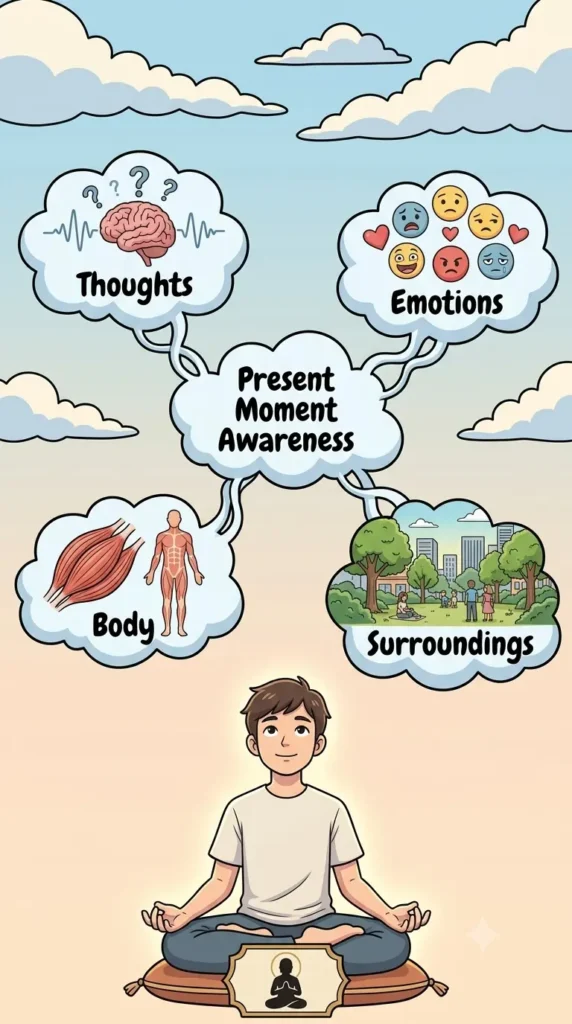
At its core, mindfulness means being fully aware of what’s happening right now. Your thoughts. Your emotions. The tightness in your shoulders. The sound outside your window. You watch it all with curiosity instead of criticism.
Sound too passive to matter? It isn’t. Choosing to pay attention takes real effort, especially when your mind keeps replaying yesterday or rehearsing tomorrow’s meeting.
Here’s a simple way to hold it: attention is the skill, awareness is what you get back. The more on purpose your attention gets, the more of your actual life you experience instead of sleepwalking through it.
Core Principles
Different teachers frame mindfulness differently. Most agree on a few basics underneath it all.
- Paying attention to what’s happening right now.
- Watching thoughts and feelings without reacting on impulse.
- Accepting the moment as it is before deciding what to do next.
- Bringing your focus back gently every time it wanders off.
Notice what’s missing from that list. Forcing yourself to feel happy isn’t on it. Mindfulness isn’t about manufacturing good moods. It’s about seeing clearly, whether the moment feels good, uncomfortable, or somewhere forgettable in between.
Mindfulness vs. Meditation
People swap these words constantly. They’re not the same thing.
Meditation is a practice. Mindfulness is a way of paying attention.
Think of meditation like lifting weights. It builds the muscle. But you don’t need twenty minutes on a cushion every morning to get there. You can practice thankfulness mindfulness while you drink your coffee, wash a dish, walk the dog, or actually listen to a friend instead of planning your next sentence.
Common Misconceptions
The biggest myth? That mindfulness means emptying your mind. That’s not how minds work. Thoughts keep showing up. Always will. The practice is noticing them without getting dragged along by every single one.
Here’s another one worth clearing up: mindfulness isn’t just for meditators or people following a spiritual path. Its roots go back centuries, sure. But schools use it now. So do workplaces, sports teams, and mental health programs. Why? Because paying attention on purpose is useful for absolutely everyone, no robe required.
What Is Gratitude?
Thank you is not gratitude. Not really. Real gratitude means noticing what matters, whether it comes from someone else, your own effort, or a plain Tuesday you’d usually roll right past. Mix mindfulness and gratitude together and something shifts. It stops being forced positivity. It becomes paying attention.
That’s the whole difference.
Gratitude vs. Appreciation vs. Thankfulness
People mix up gratitude, appreciation, and thankfulness all the time. Not surprising. They overlap. But the differences matter more than most people think.
Gratitude runs deeper. It’s the awareness that something added real value to your life, a person, an experience, a chance you almost missed, even a hard lesson that reshaped you. Psychologist Robert Emmons frames gratitude as a two-part response. You spot a benefit. Then you recognize where it came from.
Appreciation is looser. Wider. You can appreciate a sunset, a song stuck in your head, a skill you’re still clumsy at, a quiet morning with nowhere to be. No debt attached. No giver required.
Thankfulness is usually gratitude with a voice. It’s the feeling that turns into words or action. Telling someone they matter. Writing a note nobody asked for. Just pausing long enough to notice what’s already yours.
Here’s why this distinction actually matters. Thankfulness mindfulness isn’t about reciting positive lines until they lose meaning. It’s slowing down enough to notice what’s already sitting right in front of you.
Want to build this from scratch? Start with how to practice gratitude, a full guide on making the habit stick long term. A steady gratitude practice gives your mindfulness something worth noticing. Mindfulness returns the favor. It sharpens your eye for what’s actually worth appreciating.
Why Gratitude Matters in a Mindfulness Practice
Mindfulness trains attention. Gratitude points that attention toward value. Simple as that.
Strip out mindfulness and gratitude turns into a checklist. Three things you’re thankful for, scribbled down half-asleep, no real feeling behind any of it. Strip out gratitude and mindfulness can go flat too, just watching things happen with no warmth attached.
Sound too simple to matter? It isn’t.
Put mindfulness and gratitude back together and the practice gets sharper. More intentional. You start catching the small stuff, a conversation that helped more than you admitted, sunlight landing across your desk, progress you’d normally wave off. Not because your problems vanished. Because you’re finally letting the whole picture in, not just the loud parts.
The Hidden Relationship Between Mindfulness and Gratitude
Mindfulness and gratitude aren’t the same practice. But they train two sides of one skill. Noticing what’s happening. Recognizing its worth.
Mindfulness pulls your attention into the present moment. Gratitude decides what to do once it’s there.
Why mindful awareness naturally creates gratitude
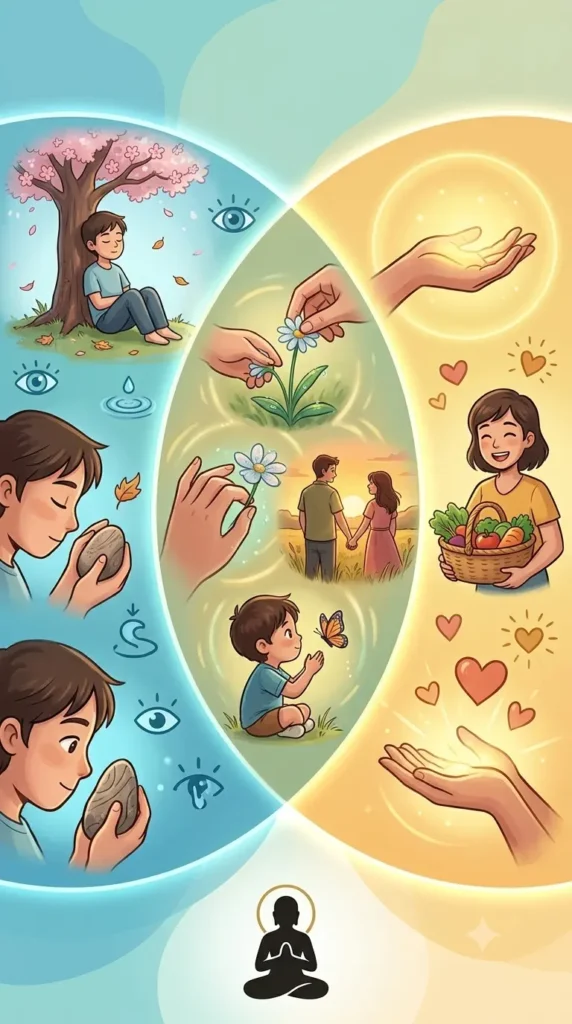
You can’t feel thankful for something you never noticed in the first place. That’s the whole mechanism behind mindfulness and gratitude working together.
Most days run on autopilot. You drink coffee while scrolling messages. You walk outside while your head is stuck on tomorrow’s meeting. You sit across from someone you love while your mind is three rooms away.
Mindfulness breaks that loop. It drags your attention back to what’s already in front of you.
That matters more than it sounds. Gratitude usually starts with plain observation, not effort. Sunlight through a window. A routine that still feels comfortable. A stranger’s small kindness. None of it is new. It was always there. Mindfulness just uncovers it.
Psychologists Robert Emmons and Michael McCullough have studied this connection directly. Their research on gratitude shows that intentionally noticing positive aspects of life can strengthen feelings of appreciation and well-being. Not a vague mood boost. A trainable habit of attention. You can read more through the Greater Good Science Center’s gratitude research overview.
Sound too simple to matter? It is. That’s exactly why it works.
How gratitude strengthens mindful living
Gratitude does more than make you feel good for a minute. It reshapes what your attention goes looking for.
Practice it regularly and something shifts. You start scanning for meaningful details instead of letting your brain default to problems, gaps, and what’s missing. This isn’t about ignoring hard things. It’s about widening the frame around them.
Picture someone deep in a brutal week at work. They can still admit the week is rough. Nothing forces them to pretend otherwise. But they can also notice one friend who checked in, one quiet morning, one thing that actually went right. Gratitude doesn’t erase the hard week. It just adds another layer on top of it.
This is where thankfulness mindfulness starts to earn its name. Mindfulness teaches presence with whatever is happening, good or bad. Gratitude teaches a response to the good parts specifically. Together, they build a more balanced way of paying attention.
Neither one alone gets you there.
Why one practice becomes stronger with the other
Mindfulness and gratitude solve the same root problem. Living on autopilot.
Mindfulness slows you down enough to notice. Gratitude holds you there long enough to actually value what you found. Skip one, and the other wobbles.
Practice mindfulness by itself, and awareness grows without direction. You notice more, but noticing doesn’t automatically turn into appreciation. Practice gratitude by itself, and it can flatten into a checklist. Three things I’m “supposed” to be thankful for today. Forced. Hollow.
Combine them and the forcing disappears.
You’re not manufacturing positivity out of thin air. You’re becoming more aware of your surroundings, your relationships, your actual daily experience, and appreciation grows out of that awareness on its own. No script required.
The relationship between mindfulness and gratitude was never about stacking one more habit onto an already full day. It’s about changing the quality of attention you bring to the life you’re already living.
That’s the real shift.
Benefits of Practicing Mindfulness and Gratitude Together
Mindfulness and gratitude aren’t the same skill wearing two names. They’re different muscles. One teaches you to notice what’s happening. The other teaches you to notice what matters. Practiced together, mindfulness and gratitude build something most people never get from either alone: a mind that pays attention and knows what to do with what it finds.
That combination shows up in small, specific ways. Steadier moods. Relationships that feel less transactional. Days that don’t blur into each other. Here’s how each piece actually works.
Lower Stress
Stress doesn’t ask permission. It just shows up, usually at the worst moment.
Mindfulness buys you a beat between the trigger and your reaction. Gratitude uses that beat differently. It points your attention at whatever is still working, even when plenty isn’t.
This isn’t about faking calm. A brutal day at work stays brutal. Nobody’s pretending otherwise. But a kind text from a friend, ten quiet minutes on a walk, a meal that actually tasted good: these things are real too. Mindfulness and gratitude just make sure your brain doesn’t skip past them on its way to the next problem.
Emotional Resilience
Emotional resilience means bouncing back when things get hard. Not avoiding the hard part. Bouncing back from it.
Mindfulness makes that possible by letting you watch a thought without becoming it. You feel the anger. You don’t have to act on it. Gratitude adds the second piece: it reminds you what’s still standing when everything else feels shaky.
Psychologist Barbara Fredrickson studied this directly. Her Broaden-and-Build theory proposes that positive emotions widen an individual’s perspective, opening the door to a wider range of thoughts and actions than usual. In plain terms, feeling good isn’t just pleasant. It stretches what you’re capable of noticing and doing. Gratitude, practiced consistently, feeds that stretch.
Better Relationships
Gratitude changes who you see standing in front of you.
Notice someone’s effort enough times and the relationship shifts. It stops being about what they owe you. It starts being about what they’re actually doing.
A short gratitude note. Ten seconds thinking about how someone showed up for you last week. These aren’t grand gestures. They’re small enough to actually do, and that’s the point. If you want to see what this looks like in practice, this collection of gratitude statements and expressions breaks it down with real examples.
Improved Sleep
Bedtime is where unfinished thoughts go to multiply.
You lie down. The mind keeps working. A short mindfulness practice, even two minutes of watching your breath, gives that noise somewhere to land besides your chest. Gratitude journaling does something slightly different. It redirects the spotlight away from tomorrow’s worries and onto today’s good moments.
Try this. One line about something you appreciated. Sixty seconds of noticing your breathing. That’s the whole habit. Nothing complicated about it. This kind of thankfulness mindfulness pairing works precisely because it’s boring enough to actually stick.
Greater Life Satisfaction
Most days run on autopilot. You eat, you commute, you scroll. None of it registers.
Mindfulness pulls you out of that fog long enough to actually experience the moment. Gratitude tells you why the moment was worth experiencing in the first place. Together, ordinary stops feeling automatic.
Why does writing down three small positives each day work better than most people expect? Because it forces a pause that autopilot never allows. For more ways to build that habit, this list of daily gratitude ideas and prompts is a solid place to start.
Reduced Rumination
Rumination is the mind on a loop. Same worry, different hour, no new information.
Mindfulness interrupts the loop without fighting it. You notice the thought circling. You don’t chase it. Gratitude does the rest by widening what else gets your attention, so the worry isn’t the only tenant in your head.
Neither practice erases hard thoughts. That was never the promise. The goal is smaller and more useful: a relationship with your own mind where one bad thought doesn’t get to run the whole show.
Mindfulness vs Gratitude: What’s the Difference?
Mindfulness and gratitude get lumped together constantly. They’re not the same thing.
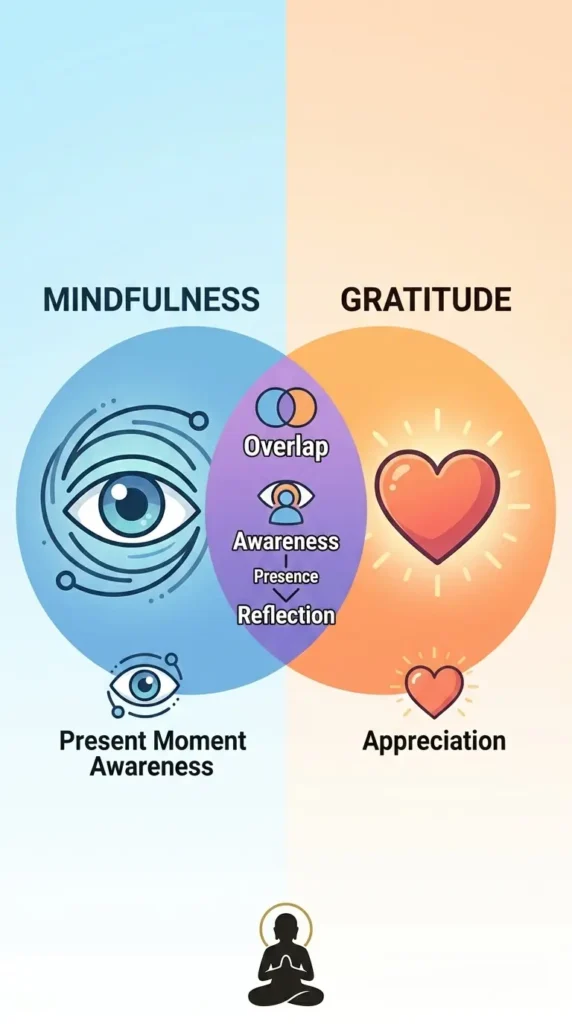
Mindfulness trains you to notice what’s happening right now. Gratitude trains you to spot what actually matters and sit with it. One builds attention. The other builds appreciation. That’s the real split between mindfulness and gratitude, and most people skip right past it.
Here’s the mistake almost everyone makes. They treat mindfulness and gratitude as one practice wearing two names. They’re not. They start from different places entirely.
You can be fully present in a hard moment and feel zero thanks for it. That’s mindfulness without gratitude. You can also feel grateful for something and barely notice it’s happening. That’s gratitude without mindfulness. Both are real. Both happen daily.
Want to see how they actually work? Line them up side by side.
Comparison Table: Mindfulness vs Gratitude
| Factors | Mindfulness | Gratitude |
|---|---|---|
| Purpose | To build awareness of your thoughts, feelings, body sensations, and surroundings without reacting right away | To notice and value the people, moments, and qualities that add real worth to your life |
| Focus | The present moment, plain and simple | The good stuff, the support, the meaning hiding in your day |
| Techniques | Meditation, mindful breathing, body scans, mindful walking, watching your thoughts pass | Gratitude journaling, thank-you notes, gratitude reflections, catching small good moments |
| Benefits | Sharper attention, better emotional awareness, lower stress, fewer knee-jerk reactions | Deeper appreciation, stronger bonds with people, more positive moments, tougher resilience |
| When to practice | Ordinary moments. Stressful ones too. Transitions, quiet stretches, whenever you need to reset | Daily check-ins, morning routines, evening journaling, or anytime you want to name what matters |
| Can they exist independently? | Yes. Mindfulness doesn’t need gratitude to work. But it opens the door to it | Yes. Gratitude can stand alone. Mindful awareness just makes it land deeper and feel more real |
Here’s the simplest way to hold this. Mindfulness helps you notice. Gratitude helps you appreciate what you noticed.
That’s it. Nothing more complicated.
Run both practices together and something shifts. You stop rushing past the good stuff. You’re actually there for it. Present enough to catch it before it slips by.
This is exactly why thankfulness mindfulness work tends to blend reflection with real-time awareness instead of turning thanks into a checklist. Nobody’s forcing positive thoughts here. The goal is smaller than that. Just notice what’s already sitting right in front of you.
How to Practice Mindfulness and Gratitude Every Day
Mindfulness and gratitude don’t need a perfect routine. Small moments, repeated often, train your attention faster than any big ritual. That’s it. You notice what’s already happening instead of chasing what comes next. Nothing more complicated than that.
Morning routine
Waking up decides more than you think. The first few minutes after waking set your attention for hours. Most people skip this window. They reach for the phone before their feet even touch the floor. Try something else first. Notice one thing you can feel, hear, or appreciate before the rush starts.
It could be the blanket’s warmth, morning light, or one quiet breath before the day starts. Pair that mindful notice with a quick thought of thanks. That’s the whole pause you need before the rush begins.
Five-minute sensory gratitude
This isn’t about writing a long list every day. A five-minute sensory practice works just as well. Notice something you can see, hear, touch, smell, or taste. That’s the whole practice.
Why does something this small actually work? This is thankfulness mindfulness in its simplest form. You feel it in the moment instead of just thinking about it later.
Mindful gratitude journaling
Journaling slows your thoughts down faster than almost anything else. A mindful gratitude journal isn’t about forcing positivity on a hard day. It’s not that simple. It’s about paying closer attention to what’s already there.
Write about a conversation that mattered, or a small comfort you usually ignore. Maybe it’s one thing you like about yourself.
Try this printable gratitude journal template if a blank page feels too open-ended, or work through these guided gratitude worksheets instead.
Walking meditation
Most people treat walking as only a way to get somewhere. That’s the whole problem. Notice your footsteps, your breathing, the sounds around you, and how the light changes as you move. Nothing fancy needed.
Add gratitude and an ordinary walk turns into something worth noticing. Your body, the street, even the weather can become worth appreciating.

Mindful eating
Most meals disappear without a single thought. A mindful meal slows that whole process down. That’s the goal. Notice the flavours, the textures, and the effort behind the food on your plate. A routine bite becomes a small moment of thanks.
Evening reflection
Before sleep, spend a few minutes reviewing your day without judging it. Ask yourself two questions. What did I notice today? What moment do I want to remember?
A short review like this links noticing with thanks. Over time, they merge. Mindfulness and gratitude stop feeling like separate habits. They become one way of paying attention to your life.
See this everyday gratitude list for more ideas on what to notice and appreciate daily.
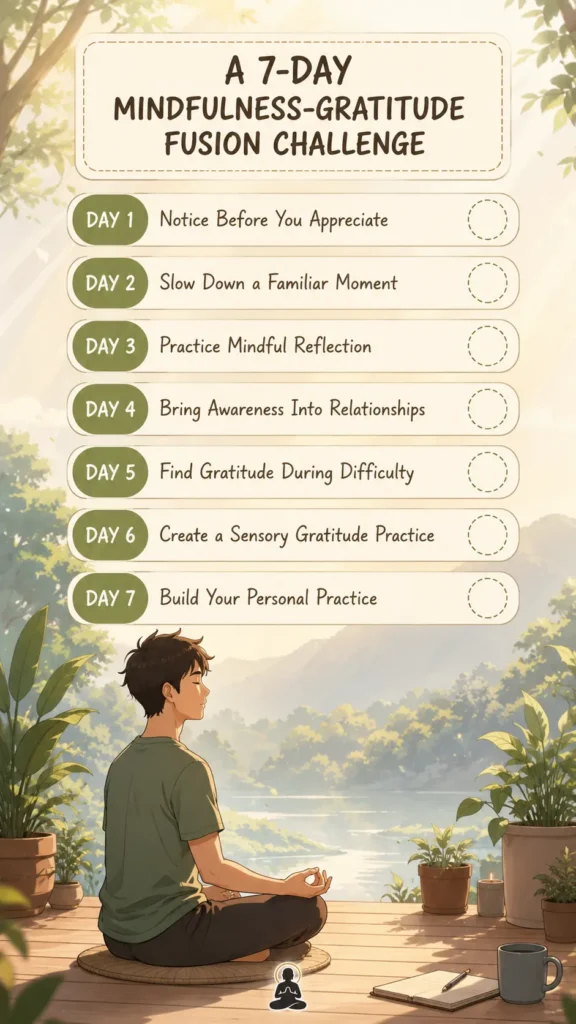
A 7-Day Mindfulness-Gratitude Fusion Challenge
This isn’t a beginner gratitude list. It’s the next step. If you’ve already tried a basic gratitude practice, this mindfulness and gratitude challenge takes things further. It teaches you to combine awareness with appreciation, so being thankful stops feeling like a chore and starts feeling like how you naturally see your life.
The idea is simple. Each day pairs one mindfulness exercise with one gratitude exercise. Not a checklist. Not forced positivity. Just training your attention to notice what’s already happening around you.
Sound too simple? It is. That’s exactly why it works.
Day 1: Notice Before You Appreciate
Mindfulness practice: Spend five minutes watching your surroundings. Don’t judge anything. Just notice sounds, colors, textures, the feel of the chair under you.
Gratitude practice: Write down one ordinary thing you usually skip past. Clean water. A comfortable chair. Morning sun through the window. A text from someone who matters.
Here’s the real connection between mindfulness and gratitude. It starts with attention. You can’t thank something you never stopped to see.
That’s the whole point of day one.
Day 2: Slow Down a Familiar Moment
Mindfulness practice: Pick one routine thing. Drinking tea. Brushing your teeth. Do it without your phone nearby. No distractions.
Gratitude practice: Afterward, write why that small moment mattered.
Most people rush through these moments daily. Slowing down even once changes what you notice.
Day 3: Practice Mindful Reflection
Mindfulness practice: Sit quietly for five minutes. Thoughts will show up. Let them pass without chasing them down.
Gratitude practice: Record one thing that helped you recently. It doesn’t need to be big.
This is where thankfulness and mindfulness start blending together. You’re not manufacturing gratitude. You’re just watching closely enough to catch it.
Day 4: Bring Awareness Into Relationships
Mindfulness practice: During one conversation today, listen fully. No planning your next sentence while the other person talks.
Gratitude practice: Write about something you appreciate in that person.
Real listening is rare. Most conversations are two people waiting for their turn.
Day 5: Find Gratitude During Difficulty
Mindfulness practice: Notice your emotions without rushing to fix them. Let the discomfort sit there for a minute.
Gratitude practice: Name one source of support, learning, or strength hiding inside a hard situation.
This isn’t about pretending the hard thing is good. It’s about finding what’s still standing while everything else feels shaky.
Why does this work when nothing else did? Because you’re not skipping the difficulty. You’re looking past it for a second.
Day 6: Create a Sensory Gratitude Practice
Mindfulness practice: Use all five senses to experience one moment fully. What do you see, hear, smell, touch, taste right now?
Gratitude practice: Write five things you noticed. Then write why each one added something to your day.
Small detail. Big shift in how the day feels afterward.
Day 7: Build Your Personal Practice
Mindfulness practice: Spend ten minutes combining breathing awareness with noticing what’s around you.
Gratitude practice: Look back over your notes from the week. Pick one habit worth keeping.
What changes on day seven that didn’t show up on day one? Mostly this: noticing stops feeling like effort. It starts feeling automatic.
That’s the shift the whole challenge is built around.
Common Mistakes That Prevent Both Practices from Working
Mindfulness and gratitude look simple. They aren’t always easy. Most people don’t fail because the practice is wrong. They fail because they turn it into a performance. Something to force. Something to measure. Something to hide behind when a feeling gets uncomfortable.
Real change comes from paying attention. Honestly. Not from chasing a better mood on command.
For a deeper breakdown of where gratitude goes wrong, see How to Practice Gratitude.
Forcing gratitude
Gratitude turns hollow fast when it becomes a checklist. Writing “I am grateful for my life” does nothing if you feel nothing while writing it. It just breeds frustration.
Try something smaller instead. The heat of your tea mug. A text from a friend. Five quiet minutes before the day starts. That’s where thankfulness mindfulness actually begins, not in the grand statements.
Specific beats sweeping. Every time.
Expecting instant happiness
Here’s the part nobody tells you. Mindfulness and gratitude help your wellbeing. They are not a light switch. Some days you’ll sit down, practice fully, and still feel flat. Still feel tired. Still feel like nothing worked.
That’s not failure. The point was never nonstop happiness. The point is noticing more. And responding with a clearer head, even on the dull days.
Using gratitude to suppress emotions
Gratitude isn’t a lid you put on hard feelings. Telling yourself “others have it worse” while you’re struggling doesn’t build thanks. It builds guilt.
Two things can be true at once. That’s healthy gratitude. Something like this: “This hurts right now, and there’s still a moment of care in here somewhere.”
Hold both. Don’t pick one and force the other out.
Confusing mindfulness with relaxation
Mindfulness is not a spa treatment. Sound relaxing? Sometimes it’s the opposite. Paying close attention often surfaces thoughts you’d rather skip. Feelings you usually dodge. Sensations you tend to push down.
Calm might follow. But awareness has to come first, and awareness isn’t always comfortable.
Skipping consistency
One journal entry rarely rewires anything. One meditation session won’t either. The real shift comes from returning. Again and again. Even when it feels ordinary. Even when nothing seems to be happening.
Five minutes, done daily, beats an hour done only when you’re inspired. Inspiration is unreliable. Showing up isn’t.
Can You Practice Gratitude Without Mindfulness?
Yes. You can feel thankful without ever sitting still or paying close attention to the moment. Gratitude and mindfulness are not the same skill. Gratitude means noticing something good and valuing it. Mindfulness means paying attention to what’s happening right now, without judging it. Two different habits. Run them together, though, and gratitude tends to feel less scripted and easier to keep up.
Gratitude can exist without mindfulness
You don’t need a meditation cushion first. No quiet room required. No breathing exercise before you’re allowed to feel thankful.
A friend texts to check on you after a rough day. You catch a memory from childhood out of nowhere. You notice a small comfort you usually walk right past. That’s gratitude. It showed up without any mindfulness practice attached to it.
Take a gratitude list. It works fine on its own. Writing down what you appreciate pulls your focus toward what actually matters to you. If you’re short on ideas, this list of everyday things to be grateful for is a good place to start.
But here’s the catch. Gratitude without mindfulness can turn into autopilot. You write “my family,” “my health,” “my home.” Same words, every day. Not because you feel it, but because that’s what goes on the list.
That’s where mindfulness earns its place. It slows you down long enough to actually feel the thing you’re writing about. For a deeper breakdown of how to build that habit properly, see this guide on how to practice gratitude.
Mindfulness makes gratitude more intentional
Mindfulness doesn’t manufacture gratitude out of nowhere. It just helps you notice what was already sitting there.
Picture your morning tea. Without attention, it’s just another task between waking up and rushing out the door. Add mindfulness, and suddenly there’s warmth in the cup. A smell. A quiet minute before the day’s demands start piling on. That noticing is what opens the door to appreciation.
This is the real link between mindfulness and gratitude. Mindfulness trains where your attention goes. Gratitude gives that attention something worth landing on.
It runs both directions, too. Plenty of people practice mindfulness with zero interest in gratitude. Still works. But most who pay closer attention start noticing more things worth being thankful for, whether they planned to or not. This pairing is sometimes called thankfulness mindfulness, attention and appreciation feeding each other on repeat.
Sound too simple? It is. That’s exactly why it works.
The goal was never to force a smile onto every moment. It’s to notice more of your own life. Even the boring parts. The ones you’d normally scroll past without a second glance. That’s usually where the deeper gratitude starts.
When Mindfulness and Gratitude Feel Difficult
Mindfulness and gratitude get sold as easy. Practice them, and life feels lighter. That’s the pitch.
But some seasons don’t feel light at all.
When anxiety, depression, burnout, or grief take over, noticing what’s good can feel impossible. Force gratitude in that state and things often get worse, not better. That’s not a personal failure. It’s just how a stressed nervous system works.
Mindfulness and gratitude were never meant to erase pain. They’re meant to help you meet your experience honestly, even the hard parts.
When anxiety makes gratitude feel impossible
Anxiety pulls your attention toward what might go wrong next. Your mind scans for threats. Unfinished tasks. Problems that haven’t even happened yet.
Told to “just be grateful” in that state? It feels disconnected from reality. Almost insulting.
Here’s what actually helps. Mindfulness lets you notice anxious thoughts without getting pulled under by them. Once you can do that, gratitude changes shape. It stops being about convincing yourself everything’s fine. It becomes about spotting small pockets of support sitting right next to the difficulty.
What does that look like in practice? Appreciating a quiet morning. A friend who checked in on you. The fact that you took one small step today, even while feeling overwhelmed.
Small counts. It’s supposed to.
Curious how these two feelings sit together without one canceling the other? Can Gratitude and Anxiety Exist at the Same Time? walks through exactly that, without asking you to dismiss the hard emotions to get there.
When depression, burnout, or grief changes your relationship with gratitude
Some days, gratitude comes easy. Other days, it feels like homework you can’t finish.
That doesn’t mean you’re doing it wrong.
Burnout drains your ability to notice anything positive, because your attention is already spent elsewhere. Grief works differently. Gratitude doesn’t replace sadness during grief. It sits beside it. You can miss someone every single day and still feel thankful for the years you had with them. Both things are true at once.
This is where mindfulness earns its keep. It offers a gentler entry point. No demand that the moment be different than it is. Just notice what’s actually happening right now.
From there, a thankfulness mindfulness practice can shrink down to almost nothing and still count. “I had one peaceful minute today.” “Someone was kind to me.” That’s enough. Small observations aren’t a lesser version of gratitude. They’re still gratitude.
If mindfulness and gratitude stir up emotions you didn’t expect, slow down. Go gently. Be patient with yourself here.
Note: One more thing worth saying plainly. None of this is medical advice, and it’s not a substitute for professional support when you need it. Mindfulness and gratitude are tools for reflection and awareness. They were never meant to be a requirement to feel positive all the time.
How This Fits Into a Long-Term Gratitude Practice
Mindfulness and gratitude work best as ongoing habits. Not quick fixes you reach for on a bad day.
A gratitude list points you to what matters. Mindfulness is what lets you catch those moments as they happen, not after. Skip one and the other loses most of its power.
Here’s why the pairing works. Gratitude tells you where to look. Mindfulness gives you the attention to actually see it. Practice both long enough and something shifts. You start noticing small things worth appreciating before you even try. Thankfulness stops being a task and turns into a lens.
Some days won’t feel that way. Some will feel flat. Some will feel heavy, and forcing gratitude on a heavy day usually backfires. A real practice makes room for both. Not just the easy days.
This is where the beginner-to-advanced guide on how to practice gratitude comes in. It walks through building a routine that holds up over time, one that feels genuine instead of scripted.
Keep going, and something changes. Mindfulness stops being a separate task on your list. It becomes the way you notice the life already in front of you.
Conclusion
Mindfulness and gratitude are not rivals. They are not two separate habits fighting for space in your day. That’s the pairing. Mindfulness notices what’s already happening. Gratitude picks up from there and thanks you for what you found.
Some people call this thankfulness mindfulness. Same idea. Different label.
You don’t need a spotless routine to start. Not a perfect morning ritual. Not a nonstop positive outlook. A few minutes of real attention, done on purpose, can change what you catch in an ordinary day. Nothing more complicated than that.
The goal isn’t to skip over hard moments. It’s to stay present with the whole picture, including the plain parts that are easy to miss. Why does that ordinary stuff matter? Because most of life happens right there.
Frequently Asked Questions
How does gratitude relate to mindfulness?
They work as a pair. Mindfulness notices the moment. Gratitude decides what’s worth keeping from it. One trains attention. The other points that attention toward what actually matters.
Think of it like a camera and a filter. Mindfulness is the lens, wide open, taking in everything. Gratitude is the filter that picks out the shot worth keeping. Without mindfulness, you’d miss the good moment entirely. Without gratitude, you’d notice it and shrug past it anyway.
Put them together and something shifts. You stop drifting through your day on autopilot. You start catching the good stuff before it passes you by.
What are the 4 elements of gratitude?
Four things, in order: noticing, thinking, feeling, expressing.
First you spot something worth valuing. A quiet ride home. A friend who showed up early. Then you sit with why it matters. That’s the thinking part, and most people skip it.
Feeling comes next. This is the actual appreciation, not just the acknowledgment of it. Last is expressing it out loud, in writing, or through some small action.
Skip step four and gratitude stays private. It never becomes a habit that sticks. Say it, write it, show it. That’s what turns a fleeting thought into something real.
What is the highest form of gratitude?
Not a feeling. Not a single practice you do once a day. It’s a way of living.
The highest form shows up on the hard days too, not just the easy ones. It doesn’t wait for things to line up first. Someone practicing this kind of thankfulness mindfulness can sit in a rough week and still find one thing worth noticing.
That takes awareness. It takes acceptance too, the willingness to sit with what’s actually happening instead of what you wish were happening. Most people only reach for gratitude when life is already good. The deeper version doesn’t need permission.
What is the root of gratitude?
Awareness. Plain and simple.
You can’t feel grateful for something you never noticed in the first place. That’s the whole problem with rushing through your day. The good stuff was there. You just weren’t looking.
This is exactly where mindfulness earns its keep. It slows your attention down enough to catch what you’d normally blow past. A small kindness. A quiet moment before the day gets loud. Support you didn’t ask for but got anyway.
Miss the noticing, and gratitude never gets a chance to start.
Can mindfulness and gratitude help with anxiety or stress?
Yes, and the research backs it up. Mindfulness sharpens your awareness of your own thoughts and emotions as they happen, not after they’ve already run the show.
A meta-analysis by Goldberg and colleagues looked across dozens of studies and examined how well mindfulness-based interventions work for clinical populations dealing with specific symptoms. The findings pointed toward real, measurable improvements in emotional well-being. Gratitude practices show up in the research too, tied to stronger resilience and better psychological outcomes over time.
None of this replaces a therapist or a doctor. It’s not meant to. But as everyday tools, mindfulness and gratitude hold up. Small, repeatable, and backed by more than just good intentions.
It’s Bhaskar!
Well, I am not a psychologist a monk, or a philosopher by training. I’m just an engineering graduate.
‘The Empty Self’ is where I write about that idea, and what it actually means for ordinary life, anxiety, identity, habits, the stories we tell ourselves about who we are. I don’t have a psychology degree, and I’m not offering therapy or clinical advice. What I do have is thought and clarity, and genuine curiosity about why we suffer the way we do and how much of it might loose once we shed this ‘fixed identity’.