

You’ve written family, friends, and health five days straight. Nothing new comes out. That’s not a personal failing.
Those blessings still matter. But we’ve probably already covered them in our big-picture guide to being thankful.
This list works differently. It’s built around things to be grateful for daily, the small stuff you’d normally skip past. Warm sun on the walk to school. A text that made you smile. Finally getting a concept that confused you yesterday.
Why does small stuff matter more than it looks? Because it repeats. A once-a-year moment doesn’t build a habit. A daily one does.
The research agrees. One study on gratitude and teen well-being found that students who practiced gratitude regularly felt more supported by teachers and peers, and reported higher day-to-day satisfaction at school. The benefit showed up most when gratitude turned into routine, not a once-in-a-while journal entry.
That’s the whole point here. Forty things to be grateful for everyday, small enough to notice, real enough to actually repeat.
Table of Contents
Why “Things to Be Grateful for Daily” Works Differently Than a One-Time Gratitude List
The best things to be grateful for daily aren’t the biggest ones. They’re not the ones you’d put on a life resume either.
They’re smaller than that.
A good laugh in third period. A cool breeze on the walk home. Finally getting a concept that made zero sense yesterday. These moments show up once. Then they’re gone.
If you want the full range of what counts, the complete list of things to be thankful for is worth bookmarking. This piece zooms into the daily habit part specifically.
Daily Gratitude Is About Repetition, Not Completeness
This isn’t about building a perfect list. Not even close.
A one-time gratitude list turns into an inventory fast. Family, friends, health, home. Those things matter. Nobody’s arguing that.
But a daily practice does something different. It trains your attention. It doesn’t test your memory.
That’s the whole distinction. Miss it, and the habit backfires before it even starts. You start hunting for something impressive enough to write down, and the pressure kills the habit inside a week.
Here’s what actually works instead: one or two small things, noticed and named. That’s it. Nothing more complicated than that.
On the days it feels forced, some gratitude journaling for anxiety techniques can help when your brain refuses to cooperate. And if you’re wondering whether it’s normal to feel both thankful and anxious at once, it is. Gratitude and anxiety can exist together, so don’t force a mood that isn’t there yet.

Today’s Sunlight, Not “Sunlight” as a Category
Specific beats broad. Every time.
Write “I’m grateful for music,” and the sentence means nothing tomorrow. It’s a placeholder, not a memory. Write “I’m grateful that one song came on while I was getting ready,” and suddenly it’s real. It happened. You can picture it.
Same goes for nature. Skip “I’m grateful for nature.” Notice the actual sky on the actual walk home. The color it turned. The one cloud shaped like something dumb.
Need a running list of prompts to pull specific moments from? 365 journal prompts for mental health breaks this down one day at a time, so you’re never starting from a blank page.
Think of it like a photo instead of a map. A map shows everything, all at once, flattened out. A photo captures one moment that will never happen twice.
That’s the shift. The more you hunt for those moments, the easier they get to find. And your gratitude practice stops feeling like homework you’re repeating for the tenth time.
Running low on ideas some mornings? Skimming unique things to be thankful for or deep things to be thankful for tends to jog something specific loose fast.
40 Precious Things to Be Grateful for Daily for Teenagers
The biggest moments in life rarely teach you gratitude. Small ones do that instead. A warm shower. A text at the right time. Five quiet minutes between classes. These are the things to be grateful for daily, and once you start noticing them, ordinary days stop feeling so ordinary. If you want a fuller foundation on this idea, our guide to things to be thankful for is a good place to start.
This list breaks the day into pieces. Morning. School. Evening. Even the parts of yourself you don’t usually stop to thank. Forty things to be grateful for everyday, all pulled from the actual shape of a teenager’s day.
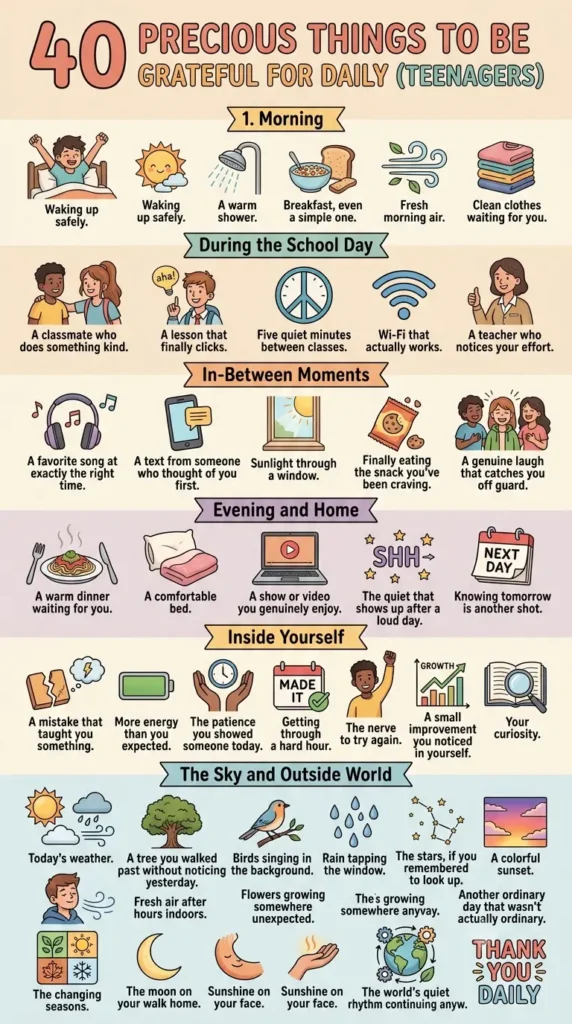
Morning
Mornings move fast. Half of it happens on autopilot before your brain even wakes up. But some small comforts sit right there, waiting to be noticed.
- Waking up safely. Another day means another shot at learning, laughing, messing up, and trying again. Don’t skip past that.
- A warm shower. It feels invisible until the water turns cold. Reliable comforts disappear the moment they stop being reliable.
- Breakfast, even a simple one. Toast. Cereal. Yesterday’s leftovers. It still fuels the thinking and moving you’ll do for the next six hours.
- Fresh morning air. Walking to school or waiting for the bus, a few real breaths wake you up faster than another scroll ever could.
- Clean clothes waiting for you. Small routine. Real impact. Starting the day comfortable matters more than people admit.

During the School Day
School isn’t always kind. Some days drag. Some feel pointless by third period. Even then, small things show up if you’re paying attention.
- A classmate who does something kind. They save you a seat. Lend a pen. Make you laugh right before a test. Tiny gestures land bigger than people think.
- A lesson that finally clicks. Yesterday it made no sense. Today it does. That’s what progress actually looks like, most of the time.
- Five quiet minutes between classes. Your brain needs the reset. Everything speeds back up the second the bell rings.
- Wi-Fi that actually works. Sounds small. Isn’t. Finishing homework or messaging a classmate depends on it more than most students admit.
- A teacher who notices your effort. Not your grade. Your effort. One honest comment can stick with you longer than the test score ever will.

In-Between Moments
Some of the best parts of the day arrive while you’re waiting on something else entirely.
- A favorite song at exactly the right time. Music shifts your mood in under three minutes. Especially on the rough days.
- A text from someone who thought of you first. Doesn’t need to be long. “How’s your day?” is enough to remind you someone’s paying attention.
- Sunlight through a window. You won’t remember it tomorrow. It still quietly improves today.
- Finally eating the snack you’ve been craving. Small pleasure. Still counts. Gratitude isn’t reserved for milestones.
- A genuine laugh that catches you off guard. The unplanned ones usually turn into the best memories.
Evening and Home
Home is where the day slows down. Even after a rough one at school, small comforts show up here to help you recharge.
- A warm dinner waiting for you. Homemade or thrown together fast, having enough to eat is worth noticing.
- A comfortable bed. Few things beat knowing there’s a safe place to rest after a long day.
- A show or video you genuinely enjoy. It isn’t just a distraction. It lets your mind loosen up after hours of concentrating.
- The quiet that shows up after a loud day. Once the noise fades, your thoughts finally get room to settle.
- Knowing tomorrow is another shot. Bad days end. Good ones do too. Every evening is proof another beginning isn’t far off.

Inside Yourself
Not every reason for gratitude comes from outside. Some of it happens quietly, inside you, without anyone noticing.
- A mistake that taught you something. Embarrassing in the moment. Useful for years after. That’s usually how it works.
- More energy than you expected. Some mornings start at zero and somehow everything still gets done by night.
- The patience you showed someone today. Maybe you listened instead of cutting in. Maybe you stayed calm mid-argument. That says something about who you’re becoming.
- Getting through a hard hour. You don’t have to love the day. Making it through still counts as something.
- The nerve to try again. Answering in class. Sending the application. Speaking up when it would’ve been easier not to.
- A small improvement you noticed in yourself. Growth is quiet, usually. It’s picking a better response than you would’ve six months ago.
- Your curiosity. Wanting to understand something new keeps life interesting long after the school bell stops ringing for good.
If school stress is part of what’s weighing on you lately, it might help to look at how gratitude and anxiety can coexist, since one doesn’t have to cancel out the other.
The Sky and Outside World
Nature doesn’t ask for your attention. It’s just there. Waiting to be noticed, whether you look or not.
- Today’s weather. Bright sun, a cool breeze, dramatic clouds. Any of it can shift the whole feel of a day.
- A tree you walked past without noticing yesterday. Familiar places get more interesting the second you actually look.
- Birds singing in the background. Easy to tune out. Impossible to ignore the second they go quiet.
- Rain tapping the window. Not everyone loves rainy days. There’s still something calming about hearing it from indoors.
- The stars, if you remembered to look up. They have a way of shrinking today’s problems down to size.
- A colorful sunset. No two are exactly alike. That alone makes each one worth a second look.
- Fresh air after hours indoors. Even a short walk outside can reset your whole perspective.
- Flowers growing somewhere unexpected. A crack in the sidewalk. The edge of a parking lot. Beauty shows up in odd places.
- The changing seasons. Each one brings different sounds, colors, and routines that quietly shape your memories without you noticing.
- The moon on your walk home. Five seconds of looking up is sometimes enough to interrupt a stressful thought loop.
- Sunshine on your face. Small experience. Easy to miss. Still enough to lift your mood on contact.
- The world’s quiet rhythm continuing anyway. Trees grow. Birds migrate. Rain falls. Mornings return, whether your day was good or brutal. That consistency is its own kind of comfort.
- Another ordinary day that wasn’t actually ordinary. Most memories worth keeping aren’t built from huge events. They’re built from dozens of small moments nobody thought to notice at the time.

Things to Be Grateful for Everyday When You’re Having a Bad Day
A bad day doesn’t erase your ability to feel thankful. It just changes what that feeling looks like. On rough days, the goal isn’t some big, sweeping realization. It’s noticing one small comfort, one tiny win, or one moment that proves the whole day wasn’t ruined.
That’s really what things to be grateful for daily looks like when nothing’s going right. Small. Specific. Easy to miss if you’re not looking.
Tiny Wins Still Count
Your brain is wired to notice stress faster than it notices good. That’s not a flaw. It’s just how attention works when things feel hard.
But even rough days have small wins hiding in them. You got out of bed when you didn’t want to. You answered that text you’d been avoiding for a week. You made yourself a sandwich instead of skipping dinner again.
None of that fixes the day. It’s not supposed to. What it does is prove you kept moving. Some days, that’s the whole job.
Basic Comforts Are Easy to Overlook
Gratitude gets practical on hard days. A warm shower after school. Clean socks. Your favorite hoodie, the one that’s basically worn through by now. A dog curled up next to you while you scroll your phone.
None of this counts as small because it doesn’t matter. It counts as small because you usually stop noticing it. Life has to get hard first. Then suddenly a quiet room for ten minutes feels like something worth naming.
Emotional Honesty Comes First
You don’t need to fake feeling okay to practice things to be grateful for everyday. Gratitude and hard feelings live in the same room just fine.
You can be disappointed in a friend. Anxious about a test tomorrow. Overwhelmed by whatever’s happening at home. And still notice the person who checked in on you, or the dinner that was waiting when you walked through the door.
APA research on emotion backs this up directly: acknowledging hard feelings instead of pushing them down tends to support better coping than forcing a fake-positive front. Want to go deeper on this specific tension? Read Can Gratitude and Anxiety Exist at the Same Time? for the full breakdown.
Try a One-Minute Gratitude Practice
If today feels heavy, don’t reach for a list of twenty things. That’s setting yourself up to fail before you start.
Set a one-minute timer instead. Answer just one question for each of these:
- What made today slightly easier?
- Who or what actually helped, even a little?
- What comfort would I miss if it vanished tomorrow?
Some days, that’s the entire practice. Sixty seconds. Three answers. And honestly? It’s the version you’re most likely to keep showing up for.
How to Build a Daily Gratitude Habit That Actually Sticks
This isn’t about writing pages every night. A habit built on daily things to be grateful for works best when it feels almost effortless. Skip the perfect routine. Make gratitude small enough to repeat on rushed school mornings and after the kind of day that wipes you out. Showing up daily beats one long, thoughtful list written once a month.
Keep a Simple Gratitude Journal
You don’t need a fancy notebook. Or a full page of reflection every night. One or two honest sentences about your day are enough. That’s it. Do that consistently and those small entries turn into a record of moments you’d have otherwise forgotten by next week.
Not sure what to write? Guided prompts make the habit far easier to keep. The 365 Journal Prompts for Mental Health list is built for exactly this, one prompt a day, no blank page staring back at you. And if gratitude and anxious thoughts tend to show up together on the page, gratitude journaling for anxiety walks through how the two can actually coexist.
Notice One New Thing Instead of Repeating the Same Three
Family and friends deserve daily thanks. Nobody’s arguing that. But naming the same three things every night stops training your brain after a while. Challenge yourself to spot one fresh detail each time instead, things to be grateful for everyday don’t have to be big. The smell of rain before school. A joke that landed at lunch. Finally getting a math problem that beat you yesterday.
Hunting for something new forces your brain to actually pay attention. Autopilot doesn’t get a vote. If the usual list feels stale, unique things to be thankful for and deep things to be thankful for both offer angles you probably haven’t tried yet.
Pair Gratitude With an Existing Habit
Pair gratitude with something you already do without thinking. Brushing your teeth. Packing your bag. Plugging your phone in at night. Pause for a few seconds during any of those and name one thing from that day you’re grateful for.
Behavior scientist B.J. Fogg calls this habit stacking, tying a new behavior to a routine that’s already automatic. Sound too simple to work? It is, and that’s exactly why it works. The old habit becomes the reminder for the new one, so you’re not relying on memory or motivation to make it happen. Fogg’s own research through the Behavior Design Lab at Stanford University breaks down why stacking habits this way outperforms willpower alone.
Small, repeatable, attached to something you already do. That’s the whole formula. Nothing more complicated than that. For a broader look at where this fits into gratitude practice overall, the full guide on things to be thankful for is worth a read too.
Common Mistakes People Make With Daily Gratitude
A daily practice around things to be grateful for daily works best when it feels honest, not forced. Many teens quit. They turn thanks into another task they can fail at. Skip a few common mistakes, and noticing real moments gets easier. No pressure, no faking it.
Forcing positivity
Gratitude isn’t the same as pretending everything is fine. Had a rough day? Telling yourself you “should” feel thankful for everything usually backfires. You end up burying real feelings instead of working through them.
A better approach lets both things sit side by side. Admit today was stressful. Still notice one small comfort. A friend who checked in. A warm meal. Just making it through. That’s real thanks, not forced cheer.
Difficult emotions and gratitude aren’t opposites. If you want a deeper look at how gratitude and anxiety can coexist, that piece breaks down why both can show up at once.
For more on why burying negative emotions backfires, the American Psychological Association discusses the value of naming feelings instead of brushing them off.
Comparing your gratitude to someone else’s
There’s no prize for the “best” gratitude list. None.
One teen might feel grateful for a college acceptance letter. Another might just be glad they found five quiet minutes between classes on a rough morning. Both count. Gratitude isn’t a contest.
Start measuring your list against someone else’s online, and your focus drifts. Away from your own life. That’s the one place this practice is meant to grow.
Only counting big wins
Plenty of people assume gratitude has to orbit big milestones. Winning a competition. Acing a test. Hitting some long-term goal.
Those moments are rare, though. Daily thanks sticks when you notice the ordinary stuff instead. A hot shower before school. Your favorite song playing out of nowhere. Clean sheets after a long day. Laughing at a joke in class. Small things. But they happen constantly, which is exactly the point.
Treating gratitude as ignoring hard feelings
One of the biggest mix-ups here: thinking gratitude leaves no room for sadness or anxiety. It doesn’t work that way.
Gratitude notices what’s good without denying what’s hard. That distinction matters. You don’t need a perfect day to earn thanks. You don’t need to hide your struggles to feel it either.
Let yourself feel disappointed. Still clock the one thing that brought comfort. That’s what makes the habit last. Over time, that honesty is what keeps a daily gratitude practice worth showing up for.
Reflection Questions for Today’s Gratitude Practice
A good gratitude practice isn’t about collecting impressive answers. It’s about noticing today. That’s it.
These questions slow you down. They pull you back into the ordinary moments you lived through but never actually saw. People, comforts, quiet wins. Stuff that slipped past while you were busy just getting through the day. If you’re hunting for things to be grateful for daily, this is where the real list starts, not with big life events, but with today.
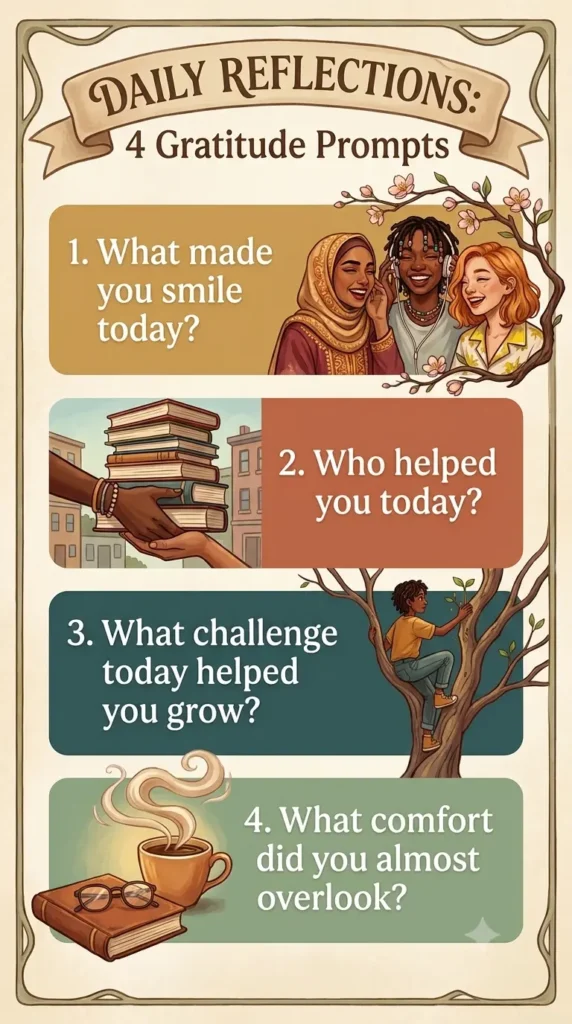
What made you smile today?
Skip the obvious answer. Dig a little deeper. Maybe a friend sent a meme that actually landed. Your dog lost it at the door like you’d been gone a year. Or something clicked in class that had confused you for a week straight. Small win, right?
Even a half-second smile counts. It’s proof that good moments show up quietly, not with a spotlight.
Who helped you today?
Help rarely looks dramatic. A teacher re-explaining a problem for the third time. A sibling who made you laugh mid-argument. A friend who saved you a seat at lunch. Someone who just listened, no advice, no fixing.
Notice this enough, and something shifts. You start seeing you’re rarely doing this alone.
What comfort did you almost overlook today?
A warm meal. Clean clothes. A phone charger that actually worked. A breeze after being stuck inside all day. The quiet of your room after a loud one.
These get ignored because they’re familiar. That’s the trap. Gratitude grows the moment you notice what’s turned into background noise. This is one of those things to be grateful for everyday that never makes anyone’s list, until they actually sit and think.
What’s one thing today you’d have missed if you weren’t paying attention?
Sunlight hitting your desk at a weird angle. A song you love playing out of nowhere. A stranger holding a door two seconds longer than they needed to.
None of that makes it into memory on its own. Not unless you choose to notice it. Nobody’s brain flags “stranger held door” as important. You have to catch it yourself.
What challenge today helped you grow, even a little?
Not every hard moment means something right away. Some just teach patience. Others build nerve you didn’t know you had. Maybe you spoke up in class even though your voice shook a little. Maybe you finally finished the assignment you’d been avoiding for three days.
Growth rarely feels good in the moment. Usually it feels like discomfort first, meaning later. If you’re working through heavier emotions alongside this practice, gratitude and anxiety can exist at the same time, and that’s worth understanding before you assume something’s wrong with you.
What would you miss tomorrow if it disappeared tonight?
This one flips the whole exercise. Instead of taking things for granted, you start appreciating them while they’re still here. Your morning routine. Your best friend’s voice on the phone. Your usual walking route. A safe place to land at the end of the day.
The answer usually lands somewhere close to home. The most valuable parts of your life are also the easiest to stop seeing. For more prompts that dig into this kind of reflection, the 365 journal prompts for mental health list is worth a look, especially on days when nothing comes to mind right away.
Conclusion
Gratitude doesn’t need a huge win. It doesn’t need a life-changing moment either. Most days, the good stuff hides in small things you almost miss. A kind text from a friend. A walk that clears your head. A meal you actually enjoyed. Or just the fact that you got through a rough day without falling apart.
That’s it. That’s the whole point.
Finding things to be grateful for daily isn’t about forcing happy thoughts on a bad day. It’s about training your brain to notice what’s already sitting right in front of you. Most teens scroll past these moments without a second thought. The message. The walk. The meal. Gone before they even register.
So how do you actually build this? You don’t need a perfect day to find something worth noticing. You just need one thing. Start there. Then let that awareness grow, one day at a time.
Here’s the list. Forty small things worth noticing today, and probably tomorrow too.
Frequently Asked Questions
What’s a quick way to think of something to be grateful for today?
Start small. Not your whole life, just today.
Think about one thing. A conversation that made you smile. A meal you actually enjoyed. A quiet ten minutes on your bed with nothing to do. That’s it.
The smallest moments work best. They’re easy to spot and even easier to appreciate, and they don’t need a big backstory to count. If you’re building a longer list, 365 journal prompts for mental health can give you fresh angles when today feels flat.
How is a daily gratitude habit different from writing a big gratitude list?
A big list is a highlight reel. It’s the important stuff, the people, the milestones, the things you’d list if someone asked you to sum up your life.
A daily habit is different. It’s not about summing anything up.
It’s about noticing what’s happening right now. Today’s small win. Today’s decent meal. You’re not repeating yesterday’s answers. You’re hunting for one or two fresh things that made today a little better than it could’ve been.
That hunt is the whole point. Miss it, and the habit turns into a copy-paste exercise. Do it right, and it stays alive.
What are some daily gratitudes?
Most days hand you more material than you’d think. You just have to look.
Here’s what that usually looks like in practice:
A good night’s sleep
Clean water from the tap
A song that hits right
A kind text from a friend
Warm sunlight through a window
A teacher who actually helped
A quiet moment alone
A meal that filled you up
Getting through a hard day with a bit more strength than you expected
None of these are dramatic. That’s exactly why they work. Need more ideas that go past the obvious? Unique things to be thankful for and deep things to be thankful for both dig into angles most lists skip.
Can you feel stressed and grateful about the same day?
Yes. Both, at once, no contradiction.
Stress and thankfulness aren’t opposites. They’re not even measuring the same thing. One tracks what’s weighing on you. The other tracks what’s still working, even under that weight.
You can be buried in schoolwork and still notice a friend showed up for you. You can dread tomorrow and still enjoy a peaceful walk tonight. The hard stuff doesn’t cancel out the good stuff. They just sit next to each other. For a closer look at how these two feelings coexist, gratitude and anxiety existing on the same day breaks down exactly why that happens.
What are 5 benefits of being grateful?
Practicing thankfulness does more than feel nice in the moment. It changes how your brain scans the day.
Here’s what tends to shift:
Your mood lifts, even on average days
You start spotting good moments faster, without trying as hard
Relationships get stronger, since appreciation tends to go both ways
You bounce back quicker when things get rough
Everyday stuff feels more meaningful instead of blurring past you
Small shift. Real payoff. If anxiety is part of your daily picture, gratitude journaling for anxiety shows how the two work together.
How many things should I include in a daily gratitude practice?
There’s no magic number here.
Don’t overthink it. For most teens, one to three things a day is plenty to build something that lasts.
Trying to hit ten every night usually backfires. You start padding the list with stuff you don’t actually feel. Three specific, real moments beat ten forced ones every time.

It’s Bhaskar!
Well, I am not a psychologist a monk, or a philosopher by training. I’m just an engineering graduate.
‘The Empty Self’ is where I write about that idea, and what it actually means for ordinary life, anxiety, identity, habits, the stories we tell ourselves about who we are. I don’t have a psychology degree, and I’m not offering therapy or clinical advice. What I do have is thought and clarity, and genuine curiosity about why we suffer the way we do and how much of it might loose once we shed this ‘fixed identity’.