

You already know you’re capable. Then a bad grade lands. Or an awkward conversation, a career setback, an endless scroll through someone else’s highlight reel. The way you see yourself shifts, quietly, without asking permission first.
Self esteem journal prompts give you a place to slow that process down. A place to check what you actually believe about yourself, instead of just reacting to it.
This guide brings together 50+ prompts for building self-worth, questioning harsh self-talk, practicing self-acceptance, and noticing progress you’d normally brush past. Some of these questions overlap with the wider work covered in our journal prompts for self love guide, especially if your inner critic tends to run louder than it should.
You don’t need to feel confident before you open the notebook. Not even close. Some of the most useful entries happen on the days you feel the least sure of yourself.
Quick Overview: Self esteem journal prompts are targeted questions that help you examine how you actually value yourself, not just how you feel in the moment. They dig into what you believe about your worth, your capability, your right to take up space, separate from a grade, a compliment, or a bad day. This guide holds 50+ of them, sorted by real struggles, plus daily prompts, a 30-day challenge, and self-worth exercises you can turn into an actual practice.
Table of Contents
What Are Self-Esteem Journal Prompts and How Can They Help?
Self-esteem journal prompts are focused questions. They ask how you see yourself. Where that view came from. And whether it actually holds up against the evidence.
Good self esteem journal prompts don’t ask you to “feel positive” on command. That’s not the job. They help you spot patterns, push back on unfair self-judgments, and build something steadier underneath.
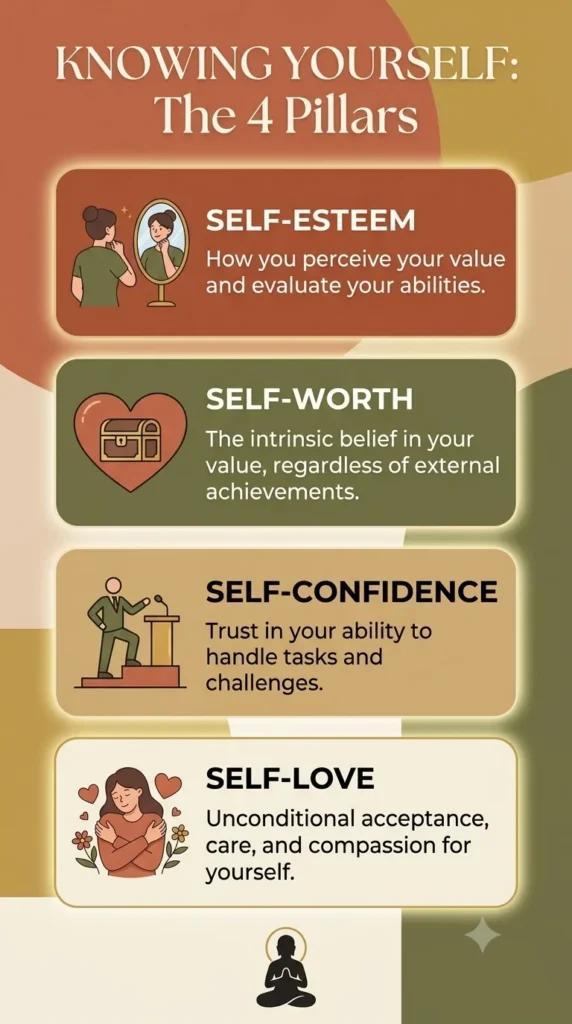
Self-esteem vs. self-worth vs. self-confidence vs. self-love
These words get used like synonyms. They’re not.
According to American Psychological Association’s Dictionary, Self-esteem is how positively or negatively you rate yourself, your qualities, your accomplishments, your abilities, your life as a whole.
Self-worth sits deeper. It’s the sense that you have value even on the days you’re not achieving anything worth bragging about. Self-confidence is narrower still. It’s the belief that you can handle one particular task, one particular room.
Self-love is different again. It’s how you treat yourself, especially when you’re disappointed in how something went.
That distinction matters when you’re picking a self worth journal or working through self worth journal prompts. Low confidence at work? You need questions about competence, about what you’ve actually pulled off before. Self-worth tied to grades, looks, money, or approval? The questions need to dig further down than that.
For a wider look at how self-love and self-acceptance connect to all of this, our journal prompts for self-love guide covers the broader framework.
What makes a journal prompt useful for self-esteem?
A useful prompt gives you something to actually dig into. Not a command to think positive. Big difference.
Good journaling prompts ask you to find evidence of a strength. Notice a thought that’s unfair. Answer yourself with some compassion. Decide what you’d do differently next time.
The Rosenberg Self-Esteem Scale, one of the most widely used measures of global self-esteem, works the same way. It looks at how people evaluate their overall worth and how they feel about themselves. It’s not testing whether you can churn out positive statements on demand.
That’s the bar worth aiming for. A strong prompt should leave you holding something real: a belief, a memory, a pattern, a piece of evidence, one small action you could take.
A quick note before you start journaling
You don’t have to close the notebook feeling confident. Some days the most honest answer is, “I don’t believe this about myself yet.” That still counts. That’s still information.
These self esteem journal prompts are for reflection and personal growth. Not a replacement for therapy or professional mental-health support. If journaling keeps bringing up more distress than it clears, pause. Consider talking to someone qualified instead of pushing through alone.
50+ Self Esteem Journal Prompts for Gen Z Adults
Self esteem journal prompts help you examine how you see yourself. They question harsh beliefs. They point out evidence of your strengths you’ve been ignoring. For Gen Z adults specifically, the prompts that actually work go further. They deal with comparison, achievement pressure, appearance, relationships, self-trust, and that constant sense of falling behind. No forced positivity required.
The goal isn’t convincing yourself that everything about you is wonderful. That falls flat on a day when you’re struggling. Sound too obvious to say? Maybe. But most self-esteem content skips it anyway.
A better prompt gives you something specific to dig into. Where did this belief come from? Is it actually true? What evidence have I overlooked? What would change if I stopped measuring my worth by one outcome?
Pick the category that matches what you’re dealing with right now. You don’t need all 60 prompts in order. Start wherever it hurts today.
Prompts to Recognize Your Strengths and Good Qualities
Strong self-esteem isn’t just about feeling attractive, successful, or confident. It also grows out of ordinary qualities: patience, curiosity, honesty, creativity, persistence, humor, empathy. Even the plain ability to keep going when something’s hard counts.
Character strengths are positive traits that shape how you think, feel, and act. The VIA Institute on Character lists 24 of them. It notes that everyone expresses these strengths in a different mix and degree.
Try these self esteem building journal prompts when you have trouble identifying what is good about you:
- What is something about my personality that I genuinely like, even if I rarely talk about it?
- Which personal strength has helped me through a difficult situation recently? What did I actually do that showed this strength?
- What is a skill I have developed that I once struggled with?
- What do people close to me tend to appreciate about me that I sometimes overlook?
- When have I made someone else’s day, even in a small or unnoticed way?
- Which quality of mine has nothing to do with my appearance, grades, career, money, popularity, or achievements—and why does it matter to me?
Stuck? Don’t limit yourself to the traditionally “impressive” traits. Being the friend who remembers an important date counts. So does asking a thoughtful question, staying calm during chaos, or making people feel included. The VIA framework makes that point well. Character runs wider than talent or achievement ever could.
Prompts to Build Self-Worth Beyond Achievement
Achievement isn’t the problem. Turning it into your only measuring stick is. You land the grade, the internship, the promotion, the relationship, and suddenly you feel good about yourself. Then something goes wrong. That feeling vanishes just as fast. A self worth journal can help you catch that pattern before it becomes your whole identity.
Psychologists call this contingent self-worth. Your self-esteem gets tied to succeeding in specific areas, or hitting specific standards. That distinction actually matters. Working toward something is healthy. Believing you have to succeed just to deserve basic respect is a completely different weight to carry.
- If I achieved nothing today, what would still make me worthy of care and respect?
- Which achievements have I started using as evidence that I am “good enough”? What happens emotionally when I don’t meet that standard?
- Who would I be if nobody could see my grades, job title, income, follower count, appearance, or relationship status?
- What qualities would I want someone to remember about me if my résumé disappeared tomorrow?
- When have I felt proud of myself for something that nobody else noticed or rewarded?
- What is one area where I can pursue improvement without turning the outcome into a judgment about my worth?
This is one of the journal prompts for building self esteem worth coming back to again and again: What remains true about me when I’m not performing well? Your answer probably won’t sound as clean as an affirmation. That’s exactly why it works.
Prompts for When Your Inner Critic Gets Loud
This isn’t about telling your inner critic to just “think positive.” When it takes over, the better move is slowing the criticism down enough to actually look at it. A thought can feel intense and still be wrong.
Try these prompts:
- What am I saying to myself about this situation that I would never say to someone I care about?
- What mistake, flaw, or awkward moment am I treating as evidence of a much bigger personal failure?
- What would I say to a close friend if they came to me with exactly the problem I’m criticizing myself for?
- Which part of my self-criticism is based on a realistic lesson, and which part is simply punishment?
- What standard am I holding myself to right now, and would I consider that standard reasonable if someone else were in my position?
- Rewrite one harsh thought in language that is honest, compassionate, and still accountable.
Self-compassion doesn’t mean pretending you did nothing wrong. Self-compassion means responding to difficulty without adding unnecessary cruelty to it. Kristin Neff’s self-compassion framework is a good next stop if you want to explore that distinction further.
A useful test is simple. After writing your response, ask whether it helps you understand what happened and decide what to do next. Or whether it just hands your inner critic more material to work with.
Prompts for Self-Acceptance and Being Okay With Imperfection
Self-acceptance isn’t the same as deciding you never need to change. Not even close. Journaling for self acceptance means learning to acknowledge who you are right now. It doesn’t mean treating your imperfections as proof that something’s fundamentally broken in you.
- What part of myself do I keep trying to hide, fix, or apologize for?
- Which mistake from my past am I still using to define who I am today?
- What insecurity takes up far more space in my mind than it probably does in other people’s minds?
- What would accepting this part of myself look like without giving up on personal growth?
- Which expectation about who I “should” be is making it harder to appreciate who I actually am?
- If I stopped trying to become a more acceptable version of myself for one day, how would I treat myself differently?
If this section stirs up the difference between self-acceptance and self-love, that’s worth exploring further. Our guide to journal prompts for self-love goes deeper into that territory.
Self-esteem, self-love, and self-acceptance overlap. They aren’t identical, though. Keeping those distinctions clear is what makes the journaling actually useful.
Prompts for Comparison, Social Media, and Feeling “Behind”
Comparison is where self-esteem journaling has to catch up with actual Gen Z adulthood. It’s hard to feel good about your own timeline some mornings. Your phone can show you someone else’s engagement, promotion, apartment, or body change before breakfast. Add a business launch, a holiday, or someone’s version of a dream life, and it stacks fast.
Social comparison isn’t new. What’s new is the constant stream of it: an endless feed of how other people appear to live. That’s worth examining: what you’re comparing, what you’re seeing, and the story behind the gap.
- Whose life do I compare mine with most often, and what specific quality or milestone am I actually comparing?
- When I scroll through social media and feel behind, what conclusion do I immediately make about myself?
- What parts of someone else’s life am I seeing online, and what parts could I never know from a post?
- Which timeline have I decided I am supposed to be following for career, money, relationships, appearance, or adulthood? Where did that timeline come from?
- What is something I genuinely want for myself that I only started wanting after repeatedly seeing other people have it?
- If I stopped measuring my progress against other people’s visible milestones for the next month, what would I use instead to decide whether I’m growing?
Prompt five stands out the most here. Sometimes comparison doesn’t uncover a goal you secretly want. It uncovers a goal you were taught to want.
Your honest answer might be, “I don’t actually want that life. I want what I imagine it would make me feel.” That’s a very different problem to solve.
Prompts for Confidence, Courage, and Self-Trust
Confidence rarely shows up before you act. More often it builds afterward. You acted, survived the awkwardness, and found out you could actually handle what happened. These journal prompts for self esteem focus on that less glamorous, more durable version of confidence. Call it self-trust.
- When did I do something difficult even though I was nervous or unsure?
- What decision have I made recently that I can trust myself for, regardless of whether it turned out perfectly?
- What opinion, need, or boundary have I been afraid to express because someone might not approve?
- What is one small thing I would try if I knew I didn’t have to impress anyone?
- When have I handled a situation better than the version of myself from a year ago might have expected?
- What evidence do I already have that I can cope when plans change, people disagree with me, or something doesn’t work out?
Notice the word doing the work here: evidence. Confidence built only on reassurance is fragile. It needs renewing every time something goes wrong. Confidence backed by memories of your own decisions has something sturdier holding it up.
Prompts for Failure, Rejection, and Setbacks
Most setback advice assumes the problem is the setback itself. It usually isn’t. Your self-esteem takes the real hit when you turn an event into an identity statement. I failed quietly becomes I’m a failure. These prompts separate the two, without pretending the disappointment didn’t matter.
- What happened, in plain factual language, without adding judgments about what it supposedly says about me?
- What did this failure, rejection, or awkward experience teach me that I couldn’t have learned beforehand?
- What part of this situation was actually within my control, and what part wasn’t?
- What would I tell myself if I viewed this setback as one event in a much longer story?
- When have I recovered from something that once felt devastating or embarrassing?
- What evidence from my past shows that I can adapt, learn, or try again after disappointment?
Separating an outcome from your identity doesn’t mean dodging responsibility. If you handled something poorly, own it. Repair what you can. Change the behavior next time. The point stands regardless: one result is information about a situation, not a complete description of a person.
That fits a growth-minded way of handling setbacks too. What happened becomes feedback for the next attempt. Not a permanent verdict on your ability.
Gratitude Journal Prompts for Self-Esteem
Here’s an honest take on gratitude lists: the generic kind gets boring fast. A gratitude journal for self esteem works better when it turns personal. Not just naming whatever’s good around you right now. Use these prompts to notice the people, qualities, experiences, and choices that actually shaped who you are.
- Who is someone who has believed in me during a period when I struggled to believe in myself, and what did they see in me?
- What is one quality about myself that I am grateful I developed through experience?
- What difficult experience am I grateful to have survived, even though I would never choose to repeat it?
- What opportunity, relationship, lesson, or ordinary part of my current life would my younger self have appreciated?
- What is something about my life right now that I usually overlook because it feels ordinary?
- What is something my past self did that I feel genuinely grateful for today?
Want something more structured than a blank page? Gratitude worksheets give you a printable starting point, and how to practice gratitude walks through the fuller technique. One distinction matters here. Gratitude isn’t supposed to turn into another performance, one where you pressure yourself to feel positive on command.
Prompts for Body Image and Appearance-Related Self-Doubt
For most people, the real goal was never feeling beautiful every single day. Body-image journaling that chases that ends up backfiring on the days you simply don’t feel attractive. Body neutrality offers another route. Notice what your body does. Respect it. Let your identity stay bigger than your appearance.
- What does my body allow me to experience, create, enjoy, learn, or participate in?
- When do I become most critical of my appearance, and what usually happens immediately before those thoughts begin?
- Which beauty standard have I internalized that I would like to question rather than automatically obey?
- How would I treat my body today if appearance were not something I needed to earn approval for?
- What parts of my identity, personality, relationships, or values have nothing to do with how I look?
- What would respecting my body look like on a day when I don’t particularly like how it looks?
If appearance-related thoughts start consuming you, journaling alone probably isn’t enough. Same goes if they get tangled up with eating or exercise behaviors.
The National Alliance for Eating Disorders offers education and referrals. Support is there for anyone affected by eating disorders or related concerns. This can be a heavy topic to sit with alone. If it feels personal, a professional or a helpline can help more than another page of writing.
Prompts for Values, Goals, and Your Future Self
Goals strengthen self-esteem when they give you a direction to walk toward. They damage it when every missed milestone turns into proof you’re falling behind. The real difference is simple: does the goal express what matters to you? Or decide what you believe you’re worth?
- What values do I want my everyday decisions to reflect, even when nobody notices?
- What kind of person do I want to become over the next year, separate from titles, income, appearance, or status?
- Which goal genuinely matters to me, and which goal am I pursuing mainly because I think it will make other people respect me?
- What would my future self thank me for starting, stopping, or protecting now?
- What quality do I want to practice more often, and what would that look like in an ordinary Tuesday rather than an idealized future?
- What is one small action I can take this week that would make me trust myself a little more?
A useful goal doesn’t need to look impressive from the outside. Sometimes the best self-esteem-building goal is small. A boundary you’ve been avoiding. A conversation you keep postponing. A habit that makes your life feel more like your own.
That’s the thread running through every one of these self esteem journal prompts. You’re not trying to manufacture a perfect opinion of yourself. You’re collecting a more accurate one.
Daily Journal Prompts for Self-Esteem When You Only Have 5 Minutes
A full journaling session sounds nice. Most mornings don’t allow one.
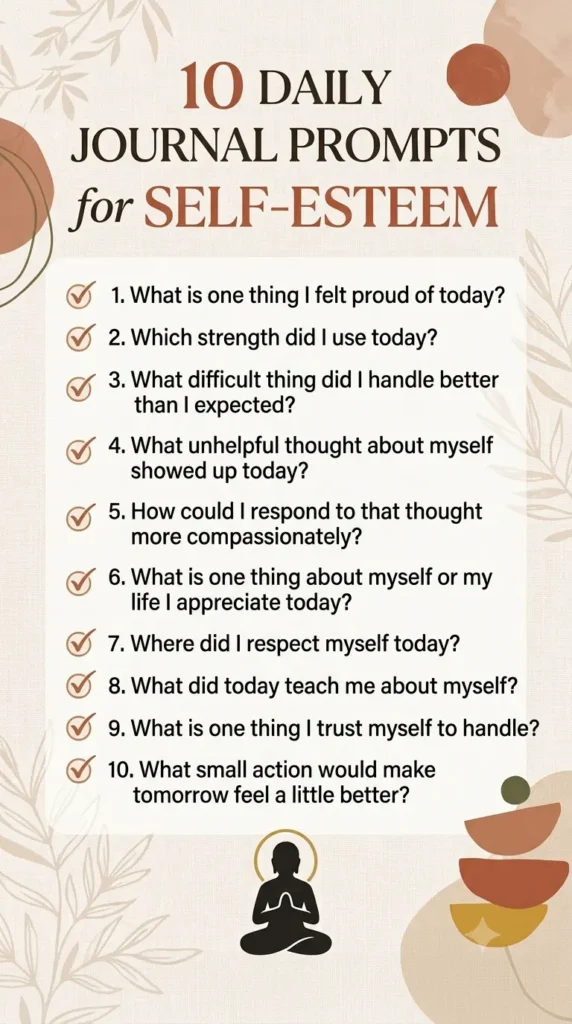
That’s fine. These self esteem journal prompts were built for the five minutes you actually have, a lunch break, the last quiet stretch before bed, the gap between the alarm and getting out of bed. Pick one. Or work through all ten when the day gives you room. Either way counts.
1. What is one thing I felt proud of today?
Pick something specific. Small is fine.
Maybe you spoke up in a meeting. Maybe you finished the task you’d been avoiding for a week. Maybe you just got out of bed when the day felt heavy. That one counts too.
Self-esteem builds when you notice your own effort. Not when someone else notices it for you.
2. Which strength did I use today?
Skip the obvious ones for a second. Intelligence, confidence, that whole category.
Patience counts. So does honesty, creativity, persistence, curiosity, kindness. What did you do today that put one of these on display, even quietly?
3. What difficult thing did I handle better than I expected?
Write down what happened. Then write how you responded.
That response tells you something. Usually more than you’d guess sitting down to write it.
4. What unhelpful thought about myself showed up today?
Name it. Don’t sign off on it as fact.
“I’m behind everyone else” is a thought. Not a verdict. This is one of the harder self esteem questions on this list, because naming the thought means you have to actually look at it instead of letting it run in the background all day.
5. How could I respond to that thought more compassionately?
Write the reply you’d give someone you actually care about. Not a hype speech. Something you’d believe if a friend said it to you.
Kristin Neff’s research on self-compassion frames this as meeting your own struggle with the same kindness you’d offer someone else, not with harsher standards just because it’s you. That’s the whole exercise here. Keep the response believable. An overdone affirmation does less than one honest, fair sentence.
6. What is one thing about myself or my life I appreciate today?
This is where a gratitude journal for self esteem earns its place. Choose something personal, not a generic line you could copy into anyone’s notebook.
Your sense of humor. The way you kept going on a rough week. A friend who actually shows up. If this angle resonates, how to practice gratitude walks through building it into a habit, and gratitude worksheets give you a printable starting point if a blank page feels like too much some days.
7. Where did I respect myself today?
Maybe you said no. Maybe you asked for what you actually needed. Maybe you took a break without justifying it to anyone.
Self-respect rarely announces itself. It shows up in ordinary decisions, the kind you almost don’t notice making.
8. What did today teach me about myself?
Look for a lesson about your limits, your preferences, your values, how you react under pressure.
You don’t need a big realization. A small, accurate one is worth more anyway.
9. What is one thing I trust myself to handle?
Keep it real-sized. Nothing has to be huge here.
Pick one situation you can actually face. Then remind yourself, in writing, why you can handle it. That’s the whole prompt.
10. What small action would make tomorrow feel a little better?
Get concrete. Send the email. Take the walk. Pack your bag tonight instead of tomorrow morning. Finish the one task that’s been sitting there.
That’s it. Ten questions, five minutes, no pressure to finish all of them today.
These daily journal prompts for self esteem work best as a repeatable habit, not a one-time exercise. Come back tomorrow. Then the day after. If you want to build these into a longer practice, the 30 journal prompts for self esteem later in this guide pick up right where these ten leave off.
Our full journal prompts for self love guide covers the wider territory around self-worth, boundaries, and self-acceptance if you want somewhere to go next. For prompts built specifically around a harsh inner critic, journal prompts for mental health goes deeper into that pattern.
How to Turn These Prompts Into a Self-Esteem Journal
A self esteem journal works best as a record. Not a task list. It tracks how you think, respond, grow, and get through hard moments. Pick prompts that match your day. Write when you can. Keep the proof of your progress in one place. It works a lot like a self love journal, just aimed at a narrower target: how much value you feel you have, not how kindly you treat yourself.
Choose prompts based on what you’re struggling with
You don’t need to work through these in order. Sound too flexible to actually work? It isn’t. The better move is picking the question that matches whatever’s loud in your head that day.
If you’re comparing yourself to friends or people online, choose a prompt about comparison, identity, or feeling behind. Stuck in harsh self-talk? Reach for one that examines the thought instead of your inner critic running the show, not one that papers over it with forced positivity. Feeling proud of yourself? Choose a strengths or accomplishments prompt, and stay with that feeling a while.
Treat the prompt collection like a menu. Not homework.
Try a 5–10 minute journaling routine
A short routine works. Set a timer for 5 to 10 minutes. Choose one prompt. Write without worrying about how polished it sounds.
A simple structure looks like this:
- What am I feeling right now?
- What is this feeling telling me about myself?
- What evidence supports or challenges that belief?
- What would I like to remember or do differently?
You don’t have to answer every question every time. One honest paragraph beats two pages you forced out of yourself. If naming a feeling on command feels unfamiliar, mindfulness journal prompts are a gentler place to build that muscle first.
Don’t force yourself to complete every prompt
More journaling isn’t automatically better journaling. If a question feels repetitive, pointless, or too far from what you’re actually dealing with, skip it.
This kind of self esteem work should leave room for answers that aren’t comfortable. You don’t need to convince yourself everything’s wonderful. Sometimes the more useful line is smaller. “I handled that better than I would have six months ago.” That’s it. That’s the whole entry, and it’s enough.
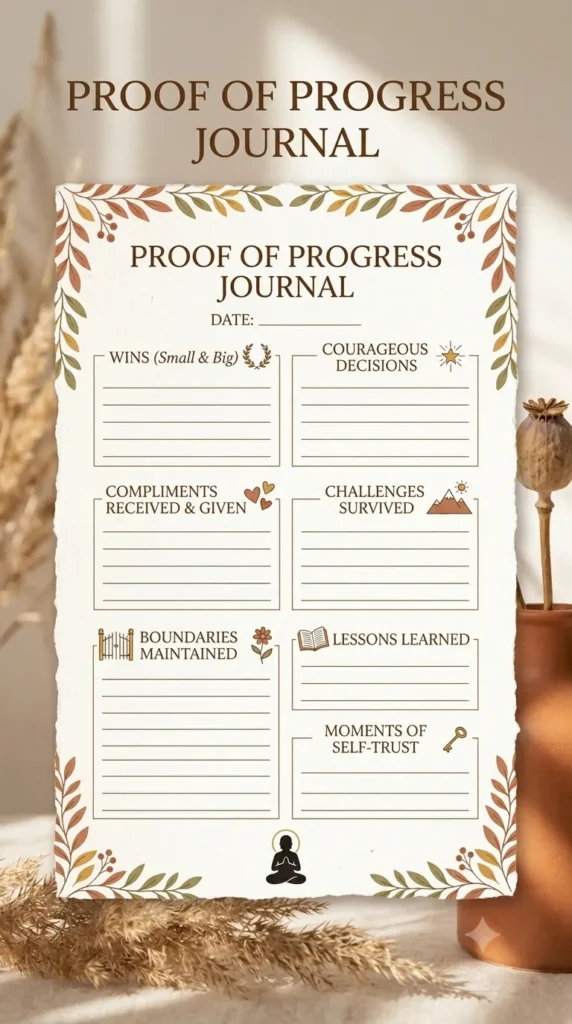
Keep a “proof of progress” page
One of the most useful additions to a self esteem journal is a running proof of progress page. Use it to log real evidence that you’re building self-trust, even on days your confidence feels thin.
Add things like:
- A win you nearly dismissed
- A brave decision you made
- A compliment you actually believed
- A hard situation you survived
- A boundary you held
- Something you learned from a mistake
- A moment you trusted your own judgment
Read this page when your inner critic gets loud. Specific evidence beats a generic reminder that you’re doing great. Pairing it with a habit of practicing gratitude makes that evidence easier to spot in the first place, since you’re already in the habit of noticing what’s going right. Over time, the page turns into a record you can return to when your memory is being unfair to you.
30 Journal Prompts for Self-Esteem: A Simple 30-Day Challenge
Thirty days. One page. That’s the whole deal.
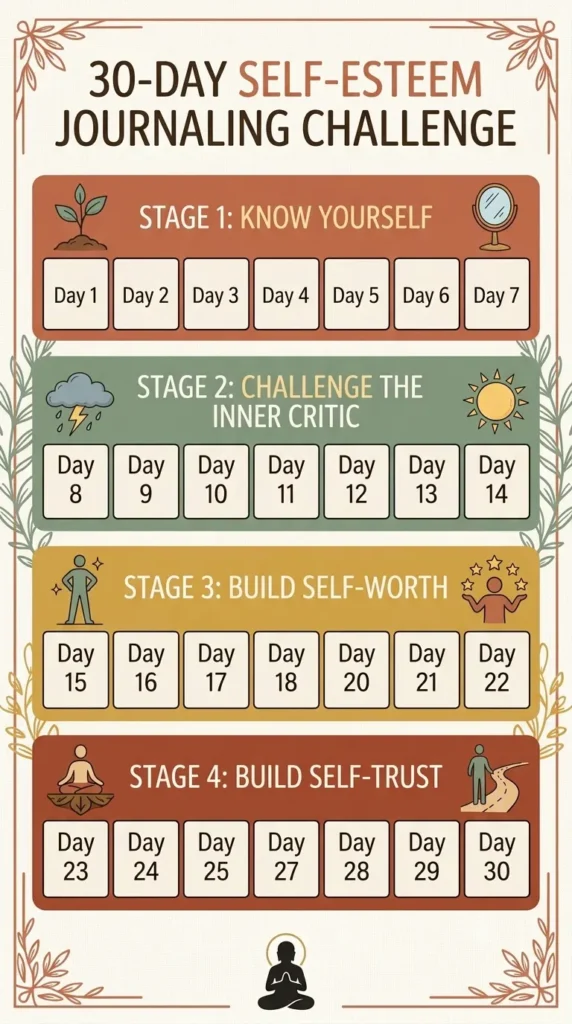
A 30-day challenge works because it doesn’t ask you to fix everything by Friday. You answer one question, close the notebook, and come back tomorrow. These self esteem journal prompts move through four stages: know yourself, question the inner critic, build self-worth, then build self-trust. Each week sets up the next one. Miss a day? Don’t restart. Just pick up where you left off.
Want a wider set of journaling prompts to draw from once the month ends? Our journal prompts for self love guide covers similar ground at whatever pace fits you.
Days 1–7: Know Yourself
You can’t build self-worth on a version of yourself you barely know. So week one stays simple. Notice what’s already there before trying to change anything. These early self esteem questions work whether you’re new to journaling or just rusty.
Day 1: What are five qualities you genuinely appreciate about yourself, including qualities that have nothing to do with your appearance, achievements, or productivity?
Day 2: What is something about your personality that makes you uniquely you?
Day 3: What are three skills or abilities you sometimes forget you have? Where have those strengths helped you recently?
Day 4: What is one thing you have handled in the past that you once thought you couldn’t handle?
Day 5: What do people who know you well seem to appreciate about you?
Day 6: When do you feel most comfortable being completely yourself? What is different about those situations?
Day 7: If you had to describe yourself without mentioning your job, grades, relationship status, appearance, or social status, what would you say?
Days 8–14: Challenge the Inner Critic
Most people would never talk to a friend the way they talk to themselves at 1am over one bad decision. That gap is the whole target this week. Not silencing the inner critic.
Just holding it to the same standard you’d hold anyone else to. If this pattern runs deeper than a week can hold, our journal prompts for mental health guide goes further into it.
Day 8: What is one negative thing you regularly tell yourself that you would never say to someone you care about?
Day 9: Think of a recent mistake you made. What happened, and what would you say to yourself if you responded with fairness instead of criticism?
Day 10: What does your inner critic usually say when you compare yourself with someone else? Is that judgment actually supported by the facts?
Day 11: What is one unrealistic expectation you regularly place on yourself? Where did you learn that you had to meet it?
Day 12: Think of a time you felt like a failure. What did that experience teach you that the outcome itself doesn’t show?
Day 13: What is one harsh belief you have about yourself that you would like to question rather than automatically accept?
Day 14: Rewrite one recent self-critical thought as if you were speaking to a close friend who was going through the same situation.
Days 15–21: Build Self-Worth
Worth built entirely on output collapses the second output slows down. That’s the problem with tying self-esteem to grades, a job title, or a number on a scale. This stretch works like a self worth journal, on purpose.
It asks what’s still true about you on a slow, unproductive Tuesday. Day 21 leans into gratitude specifically, so if that angle resonates, how to practice gratitude is worth pairing with it.
Day 15: Who would you still be if you couldn’t prove your worth through productivity, grades, money, appearance, or achievements?
Day 16: What makes you valuable that has nothing to do with what you accomplish?
Day 17: Which accomplishments are you proud of because of the person you had to become to achieve them, rather than the achievement itself?
Day 18: What qualities do you value in other people that you also recognize somewhere in yourself?
Day 19: Who has made you feel accepted for who you are? What does that relationship teach you about being worthy without performing for approval?
Day 20: What is one part of yourself you have been trying to “fix” that might deserve more acceptance instead?
Day 21: What are five things about your current life or yourself that you feel genuinely grateful for? Why do each of them matter to you?
Prefer something more structured than a blank page for that last one? Gratitude worksheets give you a printable starting point built for exactly this kind of prompt.
Days 22–30: Build Self-Trust
Confidence without self-trust doesn’t hold up under pressure. This final stretch looks backward on purpose, at the decisions, boundaries, and hard moments you already survived, and asks what they prove about you now. Sound too small to matter? It isn’t. Evidence from your own past is harder to argue with than any pep talk.
Day 22: When have you made a difficult decision that turned out to be right for you? What helped you trust your judgment?
Day 23: What is something you have been afraid to do because you were worried about what other people would think?
Day 24: Think of a time you spoke up, set a boundary, or said no. What did that moment teach you about yourself?
Day 25: What is one promise you can realistically make to yourself this week, and what small action will prove that you kept it?
Day 26: When was the last time you did something outside your comfort zone? How did you feel before, during, and after?
Day 27: What challenge are you facing right now that your past experiences suggest you are capable of handling?
Day 28: If you trusted yourself a little more, what decision would you make differently?
Day 29: What evidence from your past shows that you can recover when things don’t go according to plan?
Day 30: What have the past 30 days taught you about who you are, what you need, and what you can trust yourself to handle next?
That last question is the real point of the whole month. Not thirty tidy answers. Just a little more evidence that you can trust yourself with the next thirty days too.
Self-Esteem Journal Prompts for Women and Teens
Self-esteem doesn’t build the same way twice. Women often wrestle with appearance pressure, people-pleasing, or confidence at work. Teens carry a different weight. Friendship, school, identity, the ache of fitting in. One list won’t fit both. These self esteem journal prompts bend to whoever’s holding the pen. Not one approach forced on everyone.
Self-Esteem Journal Prompts for Women
Women’s worth often gets measured on a hidden scale, appearance, productivity, other people’s approval. Good self esteem journal prompts for women pull that scale into the open. Where am I measuring my worth against how I look, what I finish, or who approves of me? Sit with that question before writing anything else. Then push further.
Write about a boundary you’re proud of holding. Or a decision you made without asking permission first. Or one quality you value in yourself. Nothing to do with how you look. Nothing to do with what you finish today.
If that inner scorekeeping doesn’t quiet down after the page, the journal prompts for mental health guide goes further into breaking that pattern.
Self-Esteem Journal Prompts for Teens
Popularity isn’t the test here. For teens, self esteem journal prompts for teens can focus on identity and belonging instead. Not on who’s popular. When do I feel most comfortable being myself? Start there.
Other prompts can dig further. Friendship pressure, comparison at school, or the curated version of everyone else’s life online. Something hard you handled recently deserves a page too. So does a part of yourself you’re still learning to accept.
Scrolling usually makes that comparison worse before it gets better. The journal prompts for self love guide has a whole section built around exactly that pull.ndship pressure, comparison at school or online, something difficult you’ve handled recently, or a part of yourself you’re still learning to accept.
How Self-Esteem Journaling Fits With Self-Love and Self-Acceptance
Self-esteem, self-love, and self-acceptance sound like the same idea wearing three different outfits. They’re not. Self-esteem is about how you rate your own worth and skills. Self-love is how you actually treat yourself, day to day. Self-acceptance means staying imperfect without treating that as proof you’re not enough.
Three different jobs. One shared toolbox: the page in front of you.
Self-Esteem Asks, “How Do I See Myself?”
Self-esteem runs on evidence, not vibes. Write about a strength, a boundary you held, or a hard moment you handled. You’re weighing evidence for your own self-image.
That’s why self esteem journal prompts work best when your inner story has turned harsh. Skip the flat affirmation. “I’m confident” doesn’t hold up under pressure. Ask something sharper instead. What is something difficult I handled better than I would have a year ago? Now you’ve got a real answer, not a slogan.
Want the full picture on how self-worth, confidence, acceptance, and self-love connect? Our journal prompts for self love guide covers that ground in depth.
Self-Love Is About How You Treat Yourself
This isn’t about how you rate yourself. It’s about what you do next. Confidence goes missing some days. You rest anyway. You still set the boundary. You still swap the harsh sentence for a kinder one, even mid-mistake.
Self-esteem asks how you see yourself. Self-love asks how you respond to yourself. That’s the whole split.
This is where the two practices meet. A self worth journal built only on self-esteem prompts can turn into a scoreboard. Pair it with self-love questions, and the scoreboard becomes a conversation instead.
Self-Acceptance Makes Room for Imperfection
Self-acceptance doesn’t ask you to love every part of yourself. Not even close. It just asks you to stop treating your flaws as a reason to withhold respect.
A workable sequence: notice the belief, question it, respond with acceptance, then decide what to change. Four steps. Nothing fancier than that.
That four-step flow lives in our journal prompts for self love guide, and it’s worth borrowing here too. This piece stays focused on the self-esteem side of that same work, journaling for self acceptance included.ange. The existing self-love pillar’s four-step flow can help visualize this process; this article goes deeper specifically into the self-esteem side of that work.
Conclusion
Self-esteem rarely changes because you found the perfect affirmation or wrote one unusually positive journal entry. It tends to grow through repeated moments of noticing yourself more honestly, challenging unfair self-judgments, and keeping track of evidence that you’re capable, valuable, and still growing.
Use these self esteem journal prompts when you need a place to slow down and hear your own thoughts without turning every reflection into another test to pass. You don’t need to complete all 50+ prompts. Start with the one that feels relevant today, write honestly, and let your answers change as you do.
Frequently Asked Questions
What are the 10 things to boost your self-esteem?
Ten practical ways to support self-esteem are recognizing your strengths, tracking small wins, challenging harsh self-talk, setting realistic goals, practicing self-compassion, accepting imperfections, protecting healthy boundaries, spending time with supportive people, reducing unhelpful comparison, and keeping promises you make to yourself. Consistent small actions usually matter more than forced positivity.
Can journaling improve self-esteem?
Yes, journaling can support self-esteem by helping you notice negative self-beliefs, recognize your strengths, process setbacks, and collect evidence of your progress.
It isn’t a guaranteed fix, and writing can sometimes become rumination if used unhelpfully. The most useful approach is reflective: notice a thought, question it, and consider a more balanced perspective.
What are 5 ways to improve self-esteem?
Five useful approaches are practicing kinder self-talk, recognizing your accomplishments, setting boundaries, building competence through achievable goals, and separating your worth from other people’s approval.
You can also use self-esteem journal prompts to examine recurring beliefs about yourself. The goal isn’t to feel confident constantly; it’s to develop a more balanced and reliable view of yourself.
What are some good journal prompts to explore self-esteem?
Good self-esteem journal prompts ask you to examine your strengths, accomplishments, insecurities, self-talk, values, relationships, and reactions to failure.
Try asking:
“What am I proud of that I rarely give myself credit for?” or “Would I judge a friend as harshly as I judge myself?”
Specific questions tend to produce more useful reflection than generic affirmations.
What are 6 pillars of self-esteem?
The six pillars of self-esteem described by Nathaniel Branden are living consciously, self-acceptance, self-responsibility, self-assertiveness, living purposefully, and personal integrity.
Together, they focus on how you relate to reality, take responsibility for your choices, express your needs, pursue meaningful goals, and act according to your values.

It’s Bhaskar!
Well, I am not a psychologist a monk, or a philosopher by training. I’m just an engineering graduate.
‘The Empty Self’ is where I write about that idea, and what it actually means for ordinary life, anxiety, identity, habits, the stories we tell ourselves about who we are. I don’t have a psychology degree, and I’m not offering therapy or clinical advice. What I do have is thought and clarity, and genuine curiosity about why we suffer the way we do and how much of it might loose once we shed this ‘fixed identity’.
Pingback: Journal Prompts for Self Growth: 80+ Powerful Prompts for Gen Z | The Empty Self
Pingback: 100+ Great Journal Prompts for Self Love: The Complete Gen Z Guide | The Empty Self