

Meditation is supposed to quiet your mind.
Sometimes it does the opposite.
A few minutes of sitting still can surface thoughts, tension, or emotions you were too busy to notice before. Old worries creep in. Distractions you’d normally scroll past suddenly get loud. That’s exactly where meditation journal prompts step in.
Want the wider view first? Start with mindfulness journal prompts, our full library built for present-moment reflection. Meditation journaling narrows that idea down. You meditate first. Then you write down what you actually noticed.
Small difference. Big impact on what ends up on the page.
Some people call it meditation and journaling. Others say journaling meditation. Same idea, different label.
That gap matters more than it used to. Notifications never stop. Short-form videos, group chats, six open tabs, all pulling your attention sideways before you’ve even sat down. Neuroscientist Amishi Jha’s research has found mindfulness training can strengthen how attention holds up under stress. A study led by Fadel Zeidan backs that up. Just four days of brief meditation training improved working memory, mood, and focus in people who had never meditated before.
Four days. Not four months.
Sound too fast to matter? It isn’t. That’s the whole appeal of meditation journal prompts and journaling meditation as a pair. Small input, real return.
Quick answer: Meditation journaling means writing about what you noticed during or after meditation, your breath, body sensations, thoughts, emotions, or wherever your attention drifted. Nobody needs a profound entry every time. A useful meditation journal just helps you spot patterns, without rushing to judge or fix them.
You don’t need a perfect journal. You don’t need a 30-minute sit or a mind gone totally still either. You need a few honest minutes. And the right question.
Table of Contents
Disclaimer
This blog is written and edited with the help of AI, then reviewed by me before publishing. As a result, the content is for general reflection only, not therapy or medical advice, and I’m not a licensed mental health professional. If you’re in crisis, please contact 988 if you’re in US or a local crisis service of your country instead of relying on this site.
What Are Meditation Journal Prompts?
Meditation journal prompts give you words for what you noticed while meditating. They’re not there to force a big insight. Good meditation prompts do one job: catch sensations, thoughts, emotions, and shifts in attention before they fade.
What Is Meditation Journaling?
Not every sit deserves analysis. Some just deserve a few honest lines.
Meditation journaling means writing about what you notice before, during, or after you sit. You might record how your breath felt. Where your attention wandered. What emotion showed up. What shifted once you stopped trying to control the experience.
That last part matters most.
You don’t need a breakthrough every time you meditate. Sometimes you sit for ten minutes and your jaw stays tight the whole time. Sometimes the same conversation replays on loop. Sometimes you feel calmer. Sometimes nothing changes at all.
Write it down anyway.
Meditation journaling gives you room to notice without judging on the spot. String a few entries together, and patterns start showing up, patterns you’d never spot from inside a single session.
Here’s the simple version: meditation hands you the observation. Journaling gives it somewhere to land.
This is also where meditation and journaling part ways from a regular diary. You’re not logging what happened during your day. You’re logging what happened inside your attention.
Meditation Journaling vs. Mindfulness Journaling
Meditation journaling and mindfulness journaling overlap. They’re not the same thing though. Meditation journaling usually reflects on one specific sit, while mindfulness journaling can track awareness during any part of your day.
That distinction makes the choice easier.
Sit down for a breathing meditation, then write about your wandering thoughts afterward? That’s meditation journaling. Notice the taste of your coffee instead. Your impatience waiting for a text back. The feel of walking to class. Write about any of that later, and it’s mindfulness journaling.
Your meditation journal can stay narrow because of this. You don’t need to document your whole life in it.
Want a broader set of prompts for everyday awareness? Our 300+ mindfulness journal prompts guide covers exactly that. Keep this page focused on what happens around your sit.
Why Write After Meditation?
You’d think meditating already covers the reflecting part. Not quite.
Writing right after meditation captures what you noticed while it’s still fresh, instead of losing it to whatever your mind moves on to next.
That matters most on ordinary sessions. A thought you barely register while sitting can look oddly repetitive once you’ve written it down across a few entries.
Why does this work? Because the observation fades fast. Your mind moves to lunch, to a text you forgot, to whatever’s next on the list. A few lines written right after your sit hold onto the detail before it’s gone for good.
This lines up with how Jon Kabat-Zinn describes mindfulness. He founded the Center for Mindfulness at UMass Medical School. His definition: paying attention on purpose, in the present, without judgment.
Your journal doesn’t need to judge the sit either.
Skip writing “I was terrible at meditating because I kept getting distracted.” Try this instead: “My attention returned to an unfinished assignment five times.” The second version gives you something you can actually work with.
That’s the real value of journaling meditation. Not manufacturing meaning. Making the experience visible enough to notice. If self-criticism creeps into your reflections, a gratitude journaling for anxiety approach can help soften that voice too.
How to Use Meditation Journal Prompts (Before, During, After)
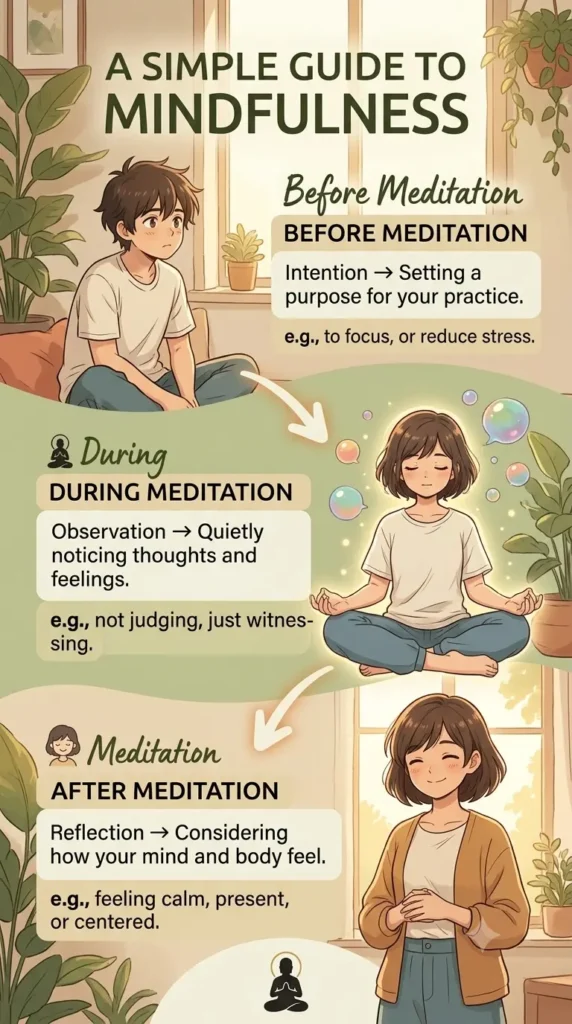
Meditation journal prompts work best when meditation and journaling stay separate acts, not one tangled moment. Use them to set an intention, notice what actually happened, then capture the details before they fade. You don’t need to turn every session into deep self-analysis. Not even close.
Before Meditation: Set an Intention
Choose one thing to notice before you sit down. Your breathing. Physical tension. Distraction. How restless you feel right now. A few meditation prompts work better than others for this step, and the observational ones win almost every time.
Keep the intention observational. “Notice when my attention wanders” beats “I need to clear my mind” almost every time. The second one hands you a result to chase. That’s the trap.
A goal like that gives you something to track. Not something to fail at.
If restlessness usually means anxiety sitting underneath it, gratitude journaling for anxiety pairs well with this kind of before-sit intention.
During Meditation: Notice, Don’t Analyze
This isn’t the time to investigate anything. Meditation asks you to notice, nothing more.
A thought shows up. You recognize it. You return to your chosen point of attention. That’s the whole cycle, repeated for the length of the sit.
Why does this matter so much? Because mind-wandering is normal inside focused meditation, not a sign you’re doing it wrong. Hasenkamp and colleagues mapped this out in a study on breath-focused practice. Their research described a simple loop. Attention wanders. Awareness notices. Focus returns. Then it happens again.
Nobody meditates without some version of that loop. It’s not failure. It’s just what focused attention looks like in a human brain.
After Meditation: Write Before the Feeling Fades
Write soon. Before your mind jumps back into messages, work, class, or a scroll session waiting on your phone.
The timer chimes. Your phone lights up on the side table. That’s the moment the noticing either gets written down or gets lost to the next notification.
Keep it concrete. “My shoulders stayed tense for most of the session.” Or: “I kept returning to tomorrow’s deadline.” Record the experience first. Explain it later, if at all.
Schroevers and Brandsma studied meditation diaries kept during an MBSR program. Over time, participant entries grew more detailed and more observational, not more analytical. The noticing sharpened. The habit did the work.
Gratitude sometimes shows up in what you notice. A look at things to be thankful for can help you name it more precisely. That beats a vague “I feel good” every time.
The 5-Minute Version (Minute-by-Minute)
Journaling meditation doesn’t need to be complicated. Five minutes covers it.
- Minute 1 — Check in: Write one sentence about how you feel.
- Minutes 2–4 — Meditate: Follow your breath or another chosen anchor.
- Minute 5 — Capture: Write what you noticed without judging it.
- Revisit patterns: Review older entries occasionally and look for recurring observations.
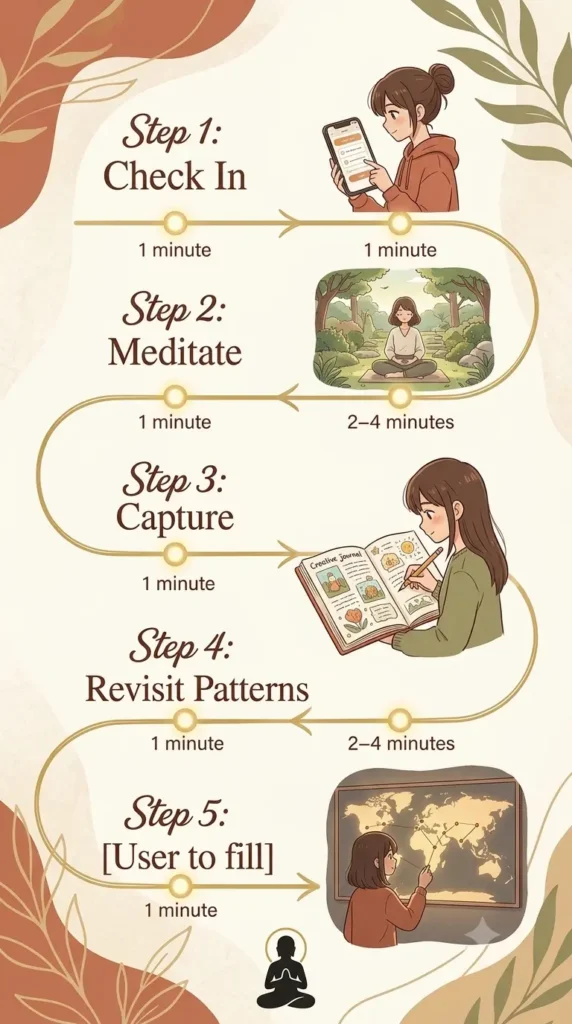
This tiny structure works because it removes the guesswork. You’re not deciding what to write. You’re just following four steps, in order, for five minutes. A gratitude worksheet offers the same kind of scaffolding. Just built around thankfulness instead. And if the “revisit patterns” step feels vague, how to practice gratitude breaks a similar review habit into steps this small too.
Do You Need a Prompt Every Time You Meditate?
No. Sometimes the most useful entry is just what you noticed. Nothing fancier.
Reach for a prompt when you feel stuck, distracted, or curious about something that keeps repeating. Other days, write freely. Skip the structure entirely.
The point was never a perfect prompt for every sit. It’s paying closer attention to your own practice. Not creating one more task you have to perform flawlessly.
Want a broader set of present-moment questions to pull from? Mindfulness journal prompts covers well over 300 of them, sorted by mood and time.
30+ Meditation Journal Prompts for Gen Z Adults
Meditation journal prompts work best as a record. Not a wish list of what you hoped would happen. Just what actually showed up.
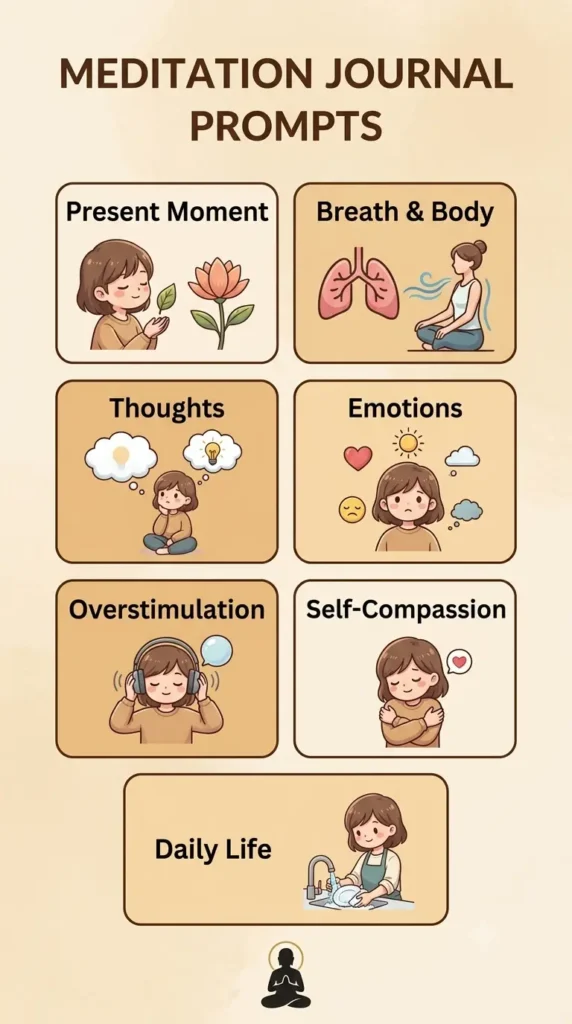
The 35 meditation journal prompts below cover attention, body sensations, looping thoughts, emotions, overstimulation, self-compassion, and one habit that ties it all together: carrying a single observation into your day. Meditation settles your attention. Journaling holds onto what that attention found.
That’s why meditation and journaling work so well together. If you want a wider net of prompts across nearly every mood and situation, our mindfulness journal prompts guide covers 300+ more.
Prompts for Noticing the Present Moment
Noticing comes first in meditation. Meaning comes later, if at all. Your job isn’t to explain every sensation. Just record what your attention actually picked up.
These prompts stick to sensory awareness and attention. Not interpretation.
- What did you notice first when you stopped trying to focus on anything specific?
- Which sound became more noticeable once you settled into meditation?
- What physical sensation made you most aware of where you were sitting?
- When did your attention feel most present during the meditation, and what was happening at that moment?
- What did you notice that you would normally overlook while checking your phone, working, or moving through your day?
That last prompt earns its spot if your attention usually splits five ways at once. You don’t need to judge the distraction as good or bad. Just notice the difference between attention that’s scattered and attention that holds.
Prompts for Your Breath and Body
This isn’t about meaning. Keep it physical.
A tight shoulder isn’t a personality diagnosis. Describe what your body did. Don’t invent a story about why it did it.
- How did your breathing feel at the beginning compared with the end of meditation?
- Where in your body did you notice the most tension, pressure, warmth, heaviness, or lightness?
- Did your posture change during meditation without you deliberately changing it? What did you notice?
- Was there a moment when your breathing became easier, slower, deeper, shallower, or more noticeable?
- Which physical sensation stayed in your awareness the longest?
Use ordinary words here. “My jaw felt tight” tells you more than “I released negative energy from my jaw.” The first is an observation. The second is a story. Why does that gap matter? Because interpretation is where journaling quietly turns into fiction. It matters more the longer you keep at this.
Prompts for Thoughts and Mental Chatter
Most thoughts don’t deserve investigation. This category is different. Watch for recurring or looping thoughts, the ones that keep circling back even after you’ve already noticed them once.
- What thought or topic kept coming back during your meditation?
- Did the same thought return in exactly the same form, or did it change each time?
- What situation did your mind repeatedly try to rehearse, predict, replay, or solve?
- When the recurring thought appeared, what happened to your attention afterward?
- Which thought kept returning even though you had no immediate reason to act on it?
These aren’t “how do I stop overthinking” prompts. That’s on purpose.
The goal isn’t another productivity exercise. Spot the thought, diagnose the problem, build an action plan before the timer runs out? Skip all that.
You’re simply tracking the pattern of mental repetition. Nothing more.
That alone can be revealing. Maybe your mind keeps circling tomorrow’s presentation. Or an awkward text from yesterday. Or something you’ve been putting off for weeks. You don’t have to solve any of it on the page.
Prompts for Emotions That Surface During Meditation
Peace isn’t guaranteed here. Sitting still can make an emotion louder, simply because there’s less noise competing for your attention.
Write down the emotion. Don’t rush to decide what it means.
- What emotion became noticeable during meditation, and when did you first recognize it?
- Did the emotion become stronger, weaker, or simply easier to notice as you stayed with it?
- Where in your body did you notice the emotion most clearly?
- What happened when you stopped trying to push the emotion away or make it disappear?
- Did you notice yourself resisting, holding onto, or judging an emotion? What did that look like in the moment?
That last prompt sneaks in letting go, without a separate “letting go” category. Resistance is worth watching too. It can become part of the meditation itself.
You don’t need a perfect label either. “Something heavy came up” is a real journal entry, if that’s actually what you noticed.
Prompts for Restlessness, Distraction, and Overstimulation
This is where meditation journaling meets modern attention habits head-on.
Spent the last hour bouncing between messages, short videos, ten tabs, and notifications? Sitting still afterward can feel oddly uncomfortable. That discomfort isn’t proof you’re bad at this. The distraction itself becomes something you observe.
- How often did your attention reach for something else during meditation?
- What did you most want to check, open, replay, or think about when you became restless?
- What happened in your body when you couldn’t immediately satisfy the urge to switch tasks?
- Did your mind seem more comfortable with silence as the meditation continued, or did it keep searching for stimulation?
- What did you notice about your attention after several minutes without checking your phone or responding to anything?
It’s minute three. The urge to check your phone shows up fully formed. You don’t act on it. That gap, right there, is the meditation.
These prompts target notification fatigue and fragmented attention on purpose, instead of treating distraction as some generic meditation obstacle.
And don’t turn the journal into another place to criticize yourself.
Spent half the session thinking about your phone? Write that down. That’s useful information. Skip the decoration. No “I failed my meditation” required.
The more interesting question is what your attention kept reaching for.
Prompts for Self-Compassion and Acceptance
Self-compassion here isn’t about forcing positivity. It’s simpler than that. Just notice how you talk to yourself when meditation doesn’t go according to plan.
- What did you say to yourself internally when you became distracted?
- Would you speak to a friend the way you spoke to yourself during a difficult moment in meditation?
- What were you expecting yourself to experience, and what happened when reality didn’t match that expectation?
- What did you find difficult to accept during the meditation?
- What could you allow to be unfinished, uncomfortable, or unclear without immediately trying to fix it?
Prompts four and five are where acceptance turns practical.
You might notice the sensation itself isn’t the real struggle. It’s your demand that the sensation disappear. Maybe your mind wandered and you judged it instantly. Maybe restlessness showed up and you called the whole session pointless.
Record the reaction. Don’t attack yourself for having it.
That beats forcing a profound insight out of every single session. If gratitude tends to soften your inner critic too, how to practice gratitude walks through a version of that same self-compassion, built specifically around thankfulness.
Prompts for Intention and Daily Life
A meditation journal isn’t a museum for stray thoughts. The real question is smaller: what, if anything, do you want to carry from this session into the next few hours?
- What is one thing you noticed during meditation that you want to pay attention to today?
- Did meditation change how you want to approach something already on your schedule?
- What could you do differently today if you remembered the quality of attention you experienced during meditation?
- What intention feels realistic for the next few hours, not the rest of your life?
- If you could carry one sentence from this meditation into your day, what would it say?
Keep that last prompt grounded. “Become a calmer person” is too vague to act on.
Try something smaller instead: I want to finish one conversation without checking my phone.
Or: I want to notice when I’m rushing, before I automatically speed up.
Or decide nothing needs to change today. That’s valid too.
Meditation journaling isn’t built to hand you a lesson every morning. Sometimes the most honest entry is just a record of what you noticed, and a choice to leave it there. Pairing this closing habit with a running list of things to be thankful for can make that daily carryover stick even longer.
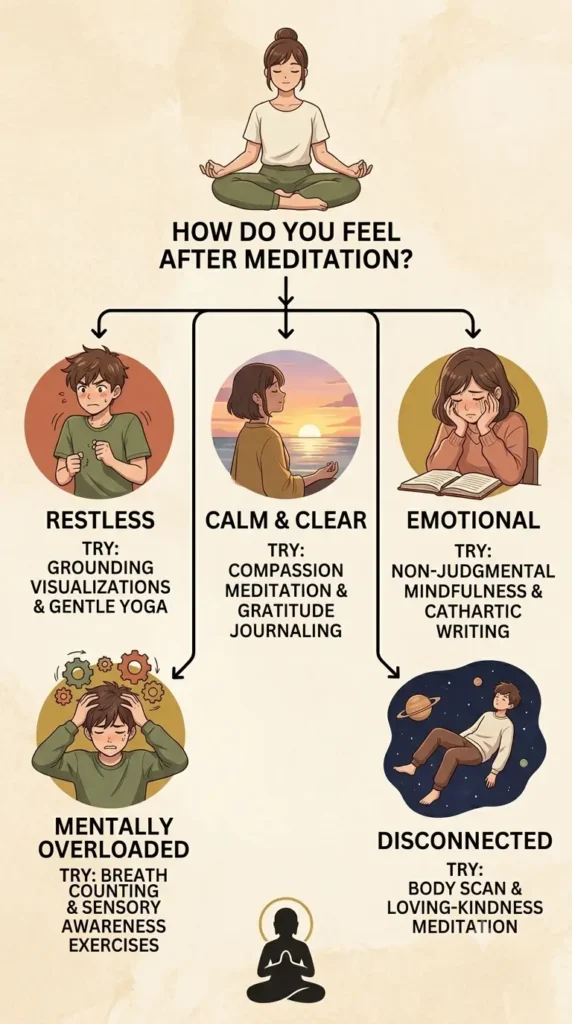
Choose a Meditation Journal Prompt Based on How You Feel
Forget what you hoped to feel. Base your meditation journal prompt on what you actually noticed. A restless session needs a different question than a calm one. Start from your post-meditation state. Then write from observation. Not from some insight you’re trying to force onto the page.
If You Feel Restless
Restlessness isn’t a failed session. Not even close.
Focused-attention meditation works like this: your attention wanders, you notice, you bring it back. Researchers Lutz, Slagter, Dunne, and Davidson describe this monitoring-and-return cycle as central to the practice itself. So restlessness isn’t the opposite of meditating. It’s part of it.
Try:
- What kept pulling my attention away?
- When did I first notice myself becoming restless?
- What was happening in my body when I wanted to stop?
If You Feel Calm or Clear
Don’t explain the feeling right away. Describe it instead.
Was your breathing easier to notice? Did thoughts feel less sticky than usual? Did the room around you feel sharper, closer, more real? Sit with those questions before reaching for a conclusion. If naming what’s good comes easily to you, a page from gratitude worksheets can help you hold onto that clarity a little longer.
If You Feel Emotional
Write what surfaced. Not what it means. Not yet.
Meditation and journaling research treats attention and emotional regulation as connected processes, not separate ones. Your journal entry doesn’t need to explain a single session into a life lesson. That’s not the job today.
Ask: What emotion did I notice, where did I feel it, and what changed when I simply stayed with it?
If You Feel Mentally Overloaded
Keep the prompt narrow. Your brain already has enough tabs open.
Try: What thought or concern kept returning during meditation, and did its intensity or quality change when I noticed it without following it?
If You Feel Disconnected
Don’t force calm you don’t have. Don’t perform presence either.
Start smaller instead. One sound. One sensation. One breath. One thought. That’s the whole ask.
What could I actually notice, right now, without reaching for more than that?
Meditation isn’t a performance review. Your journal doesn’t need to pretend it was one. This is exactly why pairing meditation journaling with the broader library of mindfulness journal prompts tends to help. Some days call for stillness. Other days call for naming what you’re actually thankful for once the noise settles. Either way, the prompt should meet you where you are. Not the other way around.
How to Get More From Your Meditation Journal
A meditation journal works best when it records what actually happened. Not what you think a “good” session should have produced. Write plainly. Separate what you noticed from what you think it means. Then go back and review your entries over time. You don’t need long entries. You don’t need deep insights either, or some perfect journaling setup, to start noticing real patterns.
If you ever run dry on what to write, a rotating list of meditation journal prompts can hand you a starting line before your mind wanders off somewhere else.
Write What You Actually Experienced
Start with the session you had. Not the one you expected.
If your mind wandered for most of it, write that down. If your shoulders relaxed halfway through, write that too. Irritated, bored, restless, peaceful, completely ordinary, every one of those counts.
Try sentences such as:
- “I kept returning to the same thought about tomorrow.”
- “My jaw felt tense for most of the session.”
- “My breathing became slower near the end.”
- “I noticed myself checking how much time was left.”
The point of a meditation journal is observation. Not performance review. Sound backwards? It isn’t. A rough session can actually teach you more than a peaceful one, as long as you record it honestly.
Separate Observation From Interpretation
This is where meditation and journaling get genuinely useful together.
An observation describes what you noticed. An interpretation explains what you think it means. Keep those two things apart. That’s what makes a journal worth rereading, because you get to examine an experience before turning it into a story about yourself.
Consider this entry:
“My chest felt tight, so I must be anxious about my future.”
The first half is an observation. The second is an interpretation.
A cleaner version: “I noticed tightness in my chest when my thoughts moved toward my future.”
That leaves room for curiosity. Maybe the tightness was worry. Maybe it was posture. Maybe it was just a sensation that had been sitting there all morning, waiting to be noticed. You don’t have to decide right away.
Why does this distinction matter so much? Because meditation makes ordinary sensations feel unusually loud. Noticing something does not explain why it happened. Your journal should hold onto that uncertainty instead of rushing to fill it in.
The same rule applies to good moments. “I felt calm during the last two minutes” holds up. “Meditation has finally fixed my stress” is a much bigger claim than one session can carry.
This idea also connects to the wider mindfulness tradition tied to Jon Kabat-Zinn, whose work centers on paying attention to the present moment without rushing to judge it. Your meditation journal is simply where that attention keeps going once the timer stops.
You can even split a page into two columns:
| What I noticed | What I think it might mean |
|---|---|
| My breathing felt shallow | I may have been distracted |
| I kept thinking about work | Something about work may be occupying my attention |
| My shoulders relaxed | I was holding tension there |
Don’t treat the second column as fact. Treat it as a guess worth testing.
And if nothing meaningful happened that day, don’t force one. “I felt distracted and didn’t notice much else” is a completely legitimate entry.
Look for Patterns Over Time
One entry tells you what happened once. A journal, given enough time, shows you what keeps happening.
Go back after a week or two and look for repeats. Do the same thoughts show up whenever you meditate at night? Does tension arrive before hard days? Does your attention feel different after an hour of scrolling compared to a screen-free morning?
You don’t need to track everything. Just watch for repetition.
Patterns beat isolated “breakthroughs” almost every time, because a pattern gives you something concrete to sit with and reconsider. A single insight, on its own, rarely holds up past the day you wrote it.
Keep Entries Short When You Need To
Your meditation journal shouldn’t turn into another task you dodge.
Some days, two sentences are plenty. A quick line right after meditation can catch a detail that would otherwise vanish by lunch. On days you have more to say, say it.
Consistency matters more than a full page. It always has.
Digital or Paper: Whichever You’ll Actually Maintain
There’s no special virtue in handwriting if the notebook never gets opened.
Paper can feel slower and less distracting. That slowness is often the point. A digital journal works better if your phone is already sitting next to you when you meditate, and you’d rather search old entries than flip through pages. Both can work fine.
The better choice is whichever creates the least friction between finishing your session and actually writing something down.
If you’re using your phone, try writing before you open messages, social media, or any notifications. Otherwise, the very experience you sat down to capture gets swapped out for whatever your feed decides to show you next.
Common Mistakes When Meditation Journaling
Meditation journaling can become less useful when you try too hard to do it “right.” The goal isn’t to produce profound insights after every session. It is to notice what actually happened, put it into words, and let patterns emerge without forcing them.
Expecting Every Session to Feel Peaceful
A quiet mind isn’t the only sign that meditation worked. Some sessions leave you calm. Others leave you aware of how restless, distracted, or tense you already were. That awareness still gives you something worth writing about.
Your journal should record the session you had, not the session you expected to have.
Turning Every Thought Into a Problem to Solve
Not every thought needs an explanation.
You might notice yourself replaying an awkward conversation, planning tomorrow’s work, or thinking about something you saw online five minutes ago. Write down the pattern if it matters. You don’t have to investigate its meaning immediately.
This distinction matters because mindfulness practice emphasizes observing thoughts without automatically becoming entangled in them. Jon Kabat-Zinn’s work on mindfulness similarly centers attention on present-moment experience without judgment.
Writing What You Think You “Should” Have Experienced
There is no correct meditation experience you need to report.
If you felt bored, write bored. If your attention kept drifting, write that. If nothing particularly memorable happened, “nothing much came up” is a perfectly honest journal entry.
Trying to manufacture insight only gives your future self a polished version of what happened.
Using Too Many Prompts at Once
Five prompts can look more helpful than one. Usually, they just give you five directions to think about.
Start with one prompt that matches what you actually noticed. Give yourself enough space to follow that thread before moving elsewhere. Your meditation journal doesn’t need to become an interrogation.
Quitting Because Your Mind Wanders
Your mind wandering isn’t proof that you’re bad at meditation.
Research by Matthew A. Killingsworth and Daniel T. Gilbert found that mind-wandering is a common feature of everyday mental life. Meditation gives you an opportunity to notice that movement and return attention, rather than expecting the mind to stay perfectly still.
So if your attention wandered twenty times, you still have something to journal about: what kept pulling you away, and what happened when you noticed?
How to Build a Meditation Journaling Habit
You do not need a perfect morning routine, a 30-minute meditation, or pages of reflection. A meditation journaling habit works better when it is small enough to repeat. Start with one session, one prompt, and a predictable moment to write. Consistency matters more than volume.
Start With One Meditation and One Prompt
Begin with one meditation and one journal prompt. That is enough. After meditating, write for a few minutes about what you actually noticed. If your mind wandered the entire time, write that down. The goal is to observe your experience, not produce an impressive entry.
Attach Journaling to an Existing Routine
Connect journaling to something you already do. Write after your morning tea, before opening social media, or immediately after an evening meditation. This removes the need to decide when to journal every day. The more automatic the cue becomes, the less motivation you need.
Review Your Entries Weekly Instead of Overanalyzing Daily
Daily entries are snapshots. Weekly review lets you see patterns. Set aside a few minutes to notice recurring thoughts, emotions, distractions, or physical tension. Research on expressive writing, including the work of James Pennebaker and colleagues, supports the value of putting experiences into words, but reflection does not require constant analysis.
What to Do When You Miss a Day
Do nothing dramatic. Just return to the practice. Do not compensate by doubling your meditation or writing a long entry. Missing one day is information, not failure. Notice what interrupted the routine, adjust the cue if necessary, and continue with the next meditation.
Meditation Journal Prompts vs. Mindfulness Journal Prompts
They sound the same. They aren’t.
Meditation journal prompts stay close to the cushion. They ask about what you noticed while you sat, or right after you got up. Mindfulness journal prompts wander further. You can use them on a crowded train, mid-scroll, or halfway through a boring meeting. No meditation required first.
Here’s the anatomy of that difference, side by side.
| Meditation Journal Prompts | Mindfulness Journal Prompts |
|---|---|
| Session-focused: built around one specific sit. | Life-focused: built around ordinary moments and everyday activity. |
| Breath and body: tracks breathing, tension, stillness, and shifting sensation. | Present-moment awareness: tracks sights, sounds, thoughts, and surroundings as they happen. |
| Meditation thoughts: looks at the distractions and loops that showed up while sitting. | Everyday thoughts: looks at the patterns that show up while studying, scrolling, working, or talking. |
| Post-session reflection: captures what shifted once the timer stopped. | Anytime reflection: works whenever you want to pause and look. |
Notice the pattern? One column needs a meditation session behind it. The other doesn’t.
That’s not a small distinction. A meditation journal prompt like “what did my breath feel like at minute five” only makes sense after you’ve actually sat down. A mindfulness prompt works standing in a checkout line. Same muscle, different reach.
Want the reflection tied specifically to your sit? Stay with this guide. Want something that follows you through the rest of the day too? Our mindfulness journal prompts library covers 300+ prompts built for exactly that, everyday awareness, not just the ten minutes on the cushion.
Meditation is the practice. Mindfulness is what happens with the other 23 hours.
Frequently Asked Questions
What should I write in a meditation journal?
Write what you actually noticed. Not what you think you should have noticed.
Your breathing. Body sensations. A thought that kept circling back. Whatever emotion showed up, even a flat or bored one. Distractions count too, and so do the small shifts in attention you catch mid-session.
You don’t need a big insight. Most sessions don’t produce one. That’s the core of honest meditation journaling: recording your experience without turning every sensation into something you’re required to explain.
It works on the same present-moment noticing behind mindfulness journal prompts, just aimed at your practice instead of your whole day.
Should I journal before or after meditation?
Either works. They just do different jobs.
Writing beforehand clears the noise before you sit down. It helps you set an intention, or dump whatever’s loud in your head so it stops competing for attention once you close your eyes. Writing afterward catches detail while it’s still fresh, before the day pulls it away.
For most beginners, a short post-meditation reflection is the easier place to start. Pick one. See how it fits. Switch it later if it doesn’t.
Can journaling make meditation more effective?
Not automatically. That’s the honest answer.
The real value of pairing meditation and journaling is pattern-spotting. Over weeks, it shows you how your attention drifts, which thoughts keep resurfacing, and how your reactions shift from one sitting to the next. None of that shows up in a single session.
Research backs this loosely. Work on expressive writing by psychologist James Pennebaker suggests that putting an experience into words supports reflection and can ease its emotional weight.
Journaling isn’t required for meditation to work, though. It’s a second layer, one that hands you something a single sit can’t: a written record to look back on.
How long should I journal after meditation?
There’s no required length. Five minutes covers it, especially while you’re still building the habit.
Got more to say? Keep writing. Nobody’s counting words.
The goal was never a full page. It’s catching what you noticed before notifications, messages, or the rest of your day pull your attention somewhere else. A few honest lines beat a rushed paragraph forced out just to hit some invisible minimum.
Are meditation journal prompts good for beginners?
Yes. Especially for beginners.
“Reflect on your meditation” is vague enough to freeze anyone. A concrete prompt gives your attention somewhere to land instead. That’s the whole advantage of using meditation prompts over a blank page.
Pick one prompt. Not five. Answering several at once turns reflection into a checklist, and checklists kill the honesty that makes journaling useful in the first place. Focus on what you actually noticed, not whether you meditated “correctly” or hit some particular emotional state.
If a blank page still feels intimidating, a few gratitude worksheets work the same way, handing you structure until the habit sticks on its own.

It’s Bhaskar!
Well, I am not a psychologist a monk, or a philosopher by training. I’m just an engineering graduate.
‘The Empty Self’ is where I write about that idea, and what it actually means for ordinary life, anxiety, identity, habits, the stories we tell ourselves about who we are. I don’t have a psychology degree, and I’m not offering therapy or clinical advice. What I do have is thought and clarity, and genuine curiosity about why we suffer the way we do and how much of it might loose once we shed this ‘fixed identity’.