

Anxiety pulls your focus toward what’s uncertain. What’s missing. What might go wrong next.
Gratitude journaling for anxiety works by interrupting that pull. Gently. It won’t ask you to pretend everything’s fine. It won’t tell you to brush off hard feelings either.
Instead, it trains your mind to notice something else. Moments of safety. People who show up. Small good things anxiety tends to bury. The benefits of gratitude journaling don’t show up overnight. They build slowly, one page at a time, until the noticing starts to feel automatic.
This guide breaks down what the research actually shows about gratitude journaling. Then it covers how to build a habit that sticks past week one. Last comes 30 prompts built to shift your focus, without dismissing what you’re going through.
That’s the quiet power behind a gratitude journal. It doesn’t erase anxiety. It just gives your attention somewhere else to land.
Table of Contents
Why Gratitude Journaling Helps With Anxiety Beyond “Positive Thinking”
Gratitude journaling for anxiety isn’t about faking a smile. It works because it moves your attention somewhere new. That’s the whole mechanism. A steady gratitude practice can interrupt anxious loops, cut down on time spent replaying worst-case scenarios, and help you spot moments of safety without brushing off what’s actually hard. No forced positivity required.
Anxiety’s Negativity Bias and Rumination Loop
Anxiety pulls your attention toward danger. That’s just what it does. Psychologists call this a negativity bias, meaning your brain gets sharper at spotting threats than at noticing what’s already going fine. Left alone, that bias curdles into rumination. The same worry loops on repeat, going nowhere, solving nothing.
Gratitude journaling doesn’t erase those thoughts. It gives your mind a second road to take. Notice real moments of support or steady ground often enough, and anxious thinking starts to feel a little less automatic. Not gone. Just quieter.
Gratitude as a “Competing Response”
Here’s why gratitude journaling works for so many people: gratitude and rumination are fighting for the same seat. Your brain can’t fully occupy both at once. The Anxiety & Depression Association of America points out that staying lost in anxious spiraling gets a lot harder when you’re also actively naming something you genuinely appreciate.
That doesn’t mean gratitude wins every round. Anxiety is stubborn. What gratitude does is break the cycle just long enough to open some space. Enough space to respond instead of getting swept along by worry. That’s one of the real benefits of gratitude journaling, and it’s a small one that adds up.
Present-Moment Awareness Interrupts “Mental Time Travel”
Anxiety mostly lives in the future. Sometimes it drags you back into the past instead. Gratitude does neither. It pulls your focus into right now, this exact minute.
Maybe that’s the friend who texted to check in. Maybe it’s the coffee going cold beside your notebook. Maybe it’s just noticing you handled today a little better than yesterday. Picture a camera lens shifting focus. The worries stay in frame. They just stop filling the whole picture.
That shift toward the present is one of the most useful benefits of gratitude journal work you’ll find. It’s simple. It’s also not nothing.
Gratitude Doesn’t Mean Pretending Everything Is Fine
This one gets misunderstood constantly. Gratitude does not mean pretending pain isn’t there. It never did.
You can feel thankful for a good conversation and still dread tomorrow. Both things fit. You can appreciate five quiet minutes and still admit life feels heavy right now. The healthiest version of gratitude journaling leaves room for all of it at once. Hard feelings and gratitude aren’t opposites. They sit together just fine.
Force the positivity instead, and you usually make things worse. Pressure isn’t the same as honesty. People can tell the difference, especially from themselves.
Gratitude in Your Journal vs. Gratitude in the Moment
Journaling builds the habit of noticing. Using gratitude in real time is where that habit actually pays off. Catch yourself spiraling? Pause. Name one thing that feels safe or steady right now. A person. A blanket. A closed door.
You don’t need to wait for your next journal entry to redirect your attention. The page trains the skill. Real life is where you use it.
What a Real Study Found About Gratitude Journaling for Anxiety
Research on the benefits of gratitude journaling looks promising. But it needs a careful read. One well-known study found that gratitude writing can lower stress and negative feelings over time. Still, it doesn’t prove that gratitude journaling for anxiety works the same way for everyone. That gap matters.
The Study: A Plain-Language Look at Fekete & Deichert (2022)
During the COVID-19 pandemic, researchers Fekete and Deichert (2022) compared three groups of adults over a set journaling period. One group wrote daily gratitude entries. Another explored their thoughts and emotions through expressive writing. A control group stuck to neutral writing tasks. Everyone got reminder emails to keep them on track.
Here’s what made this study different. The researchers didn’t just ask if people liked journaling. They tracked psychological well-being, stress, anxiety, gratitude, and mood over time. That let them compare gratitude writing against writing alone, not against doing nothing.
What It Found
The results were promising. But they’re more layered than most headlines suggest. People in the gratitude group reported lower stress and less negative affect a month later, compared to their earlier scores. Their gratitude held steady, too. In the other groups, it dropped.
Why does that matter? Chronic stress feeds anxious thinking. It makes worry loops harder to break. So instead of an instant mood boost, regular gratitude writing seemed to help people hold onto a steadier emotional baseline after the journaling ended.
What the Study Did And Didn’t Show About Anxiety
Here’s the part most people skip. Gratitude journaling improved stress and negative affect scores. It didn’t show a statistically significant effect on the anxiety subscale, at least not in this sample. In plain terms, researchers couldn’t say gratitude journaling directly reduced anxiety.
That’s not a letdown. It’s just honest reporting. Gratitude journaling may build habits that make anxiety easier to manage. But one study isn’t enough to call it a standalone anxiety treatment. Not yet.
The Study’s Limits Matter
Like most psychology research, this one has real limits. The effects were small. The sample skewed white, educated, and female, so the findings may not hold across every group. Women and people from more individualistic cultures seemed to benefit more than others did.
None of that erases the results. It just means don’t oversell them. Good evidence rarely works as all-or-nothing. It’s strongest when you read it next to who was actually studied.
Why Consistency Beats Intensity
One practical lesson has nothing to do with writing well. Participants journaled daily. Reminder emails helped them stay consistent. That consistency may have mattered as much as the writing itself.
Daily feels like a lot? Don’t chase perfect. Skip a day and the whole thing doesn’t collapse. Mental health experts often say three sessions a week still counts. Once a week beats quitting outright. Among the real benefits of gratitude journaling, staying consistent, even imperfectly, tends to outweigh doing it flawlessly for a week and then dropping it. A gratitude journal works best as a routine you can keep, not a burst of motivation that fades by Friday.
How to Start Gratitude Journaling for Anxiety
This isn’t about the perfect notebook. Or a long morning routine. Or pages of tidy writing. When anxiety is already eating your energy, gratitude journaling only works if it’s easy enough to return to tomorrow. A simple, repeatable practice beats an ambitious one you quit after a week. That’s the whole point.
Paper vs. Digital
Pick the format you’ll actually open again. A paper journal feels more intentional and gives your eyes a break from screens. A notes app catches the moment anxiety hits, whether that’s a waiting room or the bus ride home. Neither one wins on its own. No research says paper beats digital, or the other way around. What matters is friction. Whichever option removes the most friction is the one that sticks.
How Often Should You Journal?
Consistency beats frequency, every time. Daily writing sounds good on paper. For most people, it turns into pressure by day three. Start with three sessions a week instead. Build from there once it feels manageable. One thoughtful entry a week still counts. It beats forcing a daily habit you end up resenting. Aim for five to ten minutes per sitting, at roughly the same time each day.
That fixed cue does a lot of the work for you, especially on days when your brain is too tired to decide anything else. This is where the real benefits of gratitude journaling show up: not in a single perfect entry, but in the repetition itself.
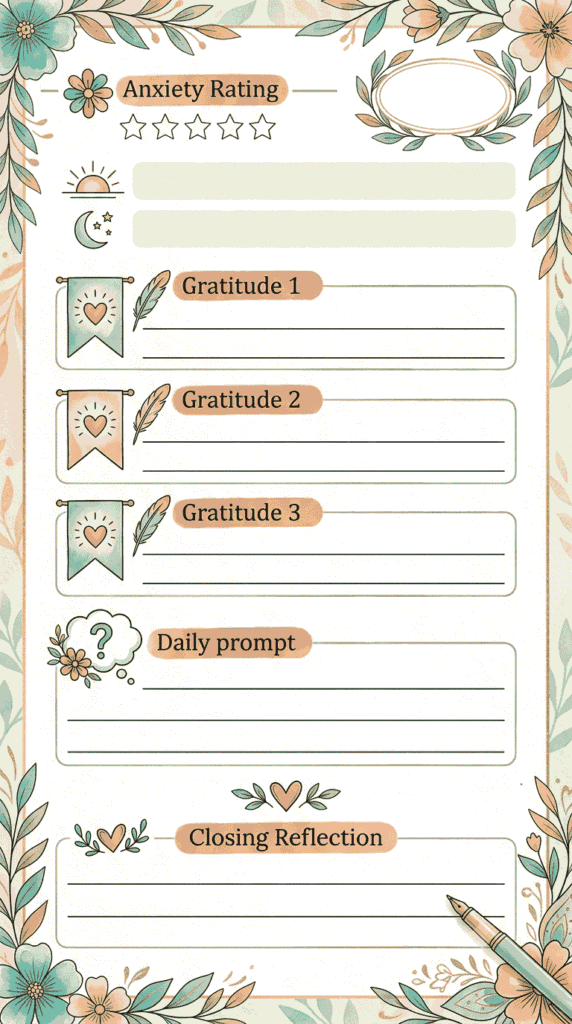
The 5-Minute Anxiety Journaling Routine
A blank page is its own kind of stressful. So give it structure instead. Spend the first minute rating your anxiety from 1 to 10. Just a number. Nothing more. Next, write three specific things you’re grateful for today, no matter how small. A warm coffee counts. So does a text back from a friend. Then answer one prompt that fits where you’re at right now. Something that made you feel safe. Or supported. Or capable of getting through the day. Finish with one line of self-compassion, or one small hope for tomorrow. That’s it.
Sound too small to matter? It isn’t. This short structure works because it doesn’t ask your worries to disappear. It just asks for five minutes of attention somewhere else. Do that enough times, and the benefits of a gratitude journal stop feeling abstract. They start showing up as fewer racing 2 a.m. thoughts and a little more room to breathe.
30 Gratitude Journaling Prompts for Anxiety
Gratitude journaling for anxiety works best when the prompt matches the worry. Not the same list every night. Morning dread feels nothing like bedtime overthinking, and your journal should notice the difference. That’s the whole idea here. Thirty prompts below, sorted by anxiety type, without pretending the worry disappears.
Jump to a section:
- Morning Anxiety
- Overthinking
- Social Anxiety
- Work or School Stress
- Uncertainty About the Future
- Before Bedtime
Morning Anxiety
Mornings get hard fast. Your mind starts predicting disasters before you’ve even had coffee. These prompts pull your focus toward what’s already holding you up right now.
1. What is one thing about today that you’re genuinely glad you get to experience?
Look for something to look forward to. Even something small, like coffee or a text from a friend. This interrupts the worst-case-thinking loop before it builds momentum.
2. Who has made your life a little easier recently, and why does that matter to you?
You’re not carrying everything alone. This prompt makes that fact impossible to ignore.
3. What part of your daily routine quietly makes mornings more manageable?
Familiar routines create stability. When anxiety makes everything feel uncertain, routine is proof that some things stay put.
4. What’s one comfort in your home that you usually walk right past?
Your brain scans for threats by default. Noticing ordinary comfort trains it to scan for safety too.
5. What strength did you show last week that deserves some credit?
Anxiety shrinks your resilience down to nothing. This prompt puts it back on the record.
Overthinking
When thoughts keep looping, gratitude gives your mind somewhere else to land. It won’t erase the anxious thought. But it can shrink how much room that thought takes up.
6. What problem turned out better than you expected?
Think back. Remembering past outcomes chips away at the belief that uncertain situations always end badly.
7. What’s one lesson from a hard experience that you’re actually thankful for?
Struggles feel less like proof of failure once you find the value buried in them.
8. What small moment today gave you even a few seconds of peace?
Small moments count. Anxiety tends to skip right over them.
9. Which person consistently brings you calm?
Reliable people exist outside your anxious thoughts. This prompt puts one of them front and center.
10. What did your body let you do today that you’re grateful for?
Appreciation here shifts focus away from constant symptom-checking. It’s a small redirect, but it works.
Social Anxiety
Social anxiety blows up every awkward pause and shrinks every good moment down to nothing. These prompts push back on that imbalance.
11. Who made you feel accepted recently, even in a small way?
Moments of acceptance chip away at the belief that you’re constantly being judged.
12. What conversation made you smile or feel understood?
Your brain remembers cringe moments louder than kind ones. This prompt evens the score.
13. What quality do you appreciate most in someone close to you?
Real relationships build connection. Isolation loses ground when you focus here.
14. What’s one compliment you’ve received that still means something to you?
Don’t brush it off. Let it land the way it was meant to.
15. What social situation went better than you expected?
Not perfect. Just better. That’s still progress, and it still counts.
Work or School Stress
Deadlines. Exams. Meetings. The list never really ends, and anxiety runs quietly in the background all day because of it. Gratitude journaling for anxiety at work or school widens the lens past whatever’s still unfinished.
16. Which coworker, classmate, teacher, or mentor are you grateful for today?
Success is rarely a solo project. This prompt puts the helpers back in the picture.
17. What skill have you built that makes things easier than they used to be?
Progress happens slowly. Slowly enough that you forget it happened at all.
18. What’s one challenge you’ve already beaten this year?
Old obstacles, once cleared, make the current one look smaller.
19. What opportunity does your work or school give you that you’re thankful for?
Purpose counters burnout better than most advice admits. Find it here.
20. What part of your workspace helps you feel steadier?
Even a lamp or a plant can be a grounding point on a rough day.
Uncertainty About the Future
Anxiety loves an unanswered question. It’ll sit there and turn it over for hours. These prompts drag your attention back to what you already have, instead of everything you can’t predict.
21. What is dependable in your life right now?
Name it. Naming what’s stable creates balance when your thoughts are stuck on what isn’t.
22. What opportunity are you grateful for today, even without knowing where it leads?
You don’t need the ending. Appreciating today is usually more useful than trying to script tomorrow.
23. Which past decision are you glad you made?
Good calls, once made, prove you can navigate uncertainty again.
24. What personal quality has carried you through hard seasons before?
This isn’t flattery. It’s evidence, and evidence builds trust in your own coping.
25. What’s something you’re looking forward to, however small?
One good thing on the horizon changes how threatening the whole horizon feels.
Before Bedtime
Evenings replay conversations. Mistakes. Worries that felt small at 9am and huge by midnight. Gratitude journaling won’t erase any of that. But it stops those thoughts from being the only story your mind tells.
26. What was the best part of today that almost slipped by unnoticed?
This trains your brain to hold onto good moments with the same grip it uses on bad ones.
27. Who showed you kindness today, directly or indirectly?
Small kindness is proof the world isn’t made entirely of stressors.
28. What comfort helped you get through today?
A meal. A shower. A song on repeat. Ordinary comforts deserve some credit too.
29. What are you grateful your body or mind helped you accomplish today?
Effort matters more than perfection here. Give yourself that much.
30. What’s one reason you can end today feeling thankful, despite what went wrong?
Gratitude and hard feelings can sit in the same room together. A rough day can still hold something worth keeping.
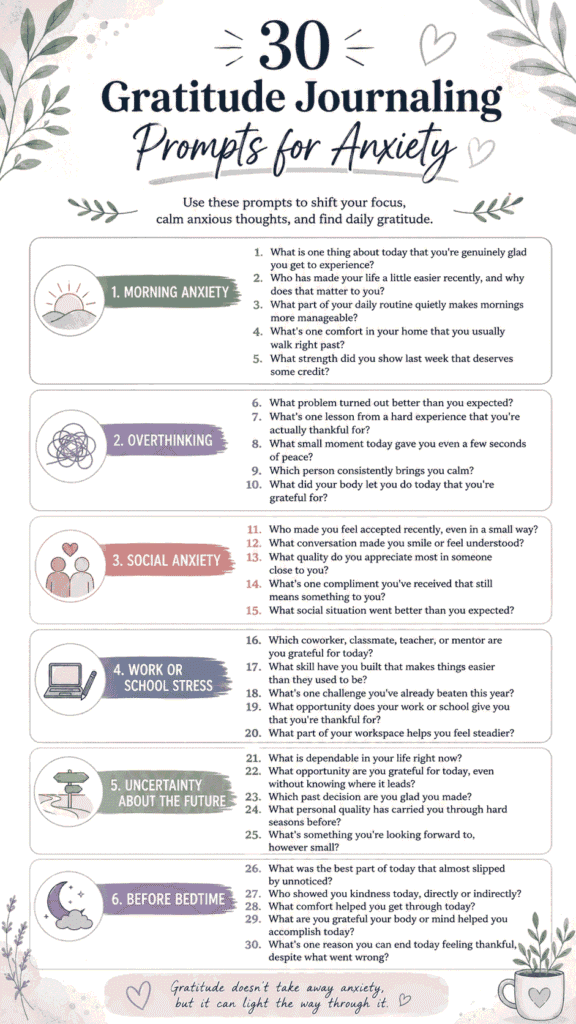
Consistency matters more than which prompt you pick this week. Research on the benefits of a gratitude journal points the same direction: small, regular entries outperform occasional long ones. Pick one prompt. Start there.
Common Mistakes That Harms Gratitude Journaling
Gratitude journaling works best when it’s honest. Not polished. Not performed. The practice loses its power the moment it turns into pressure or another line on your mental to-do list. Skip a few common traps and your journal stays a support system instead of a chore.
Forcing Positivity
Here’s a myth worth killing: you don’t need to feel cheerful to journal. Not even close. If you’re anxious, wiped out, or grieving, faking calm won’t erase any of it. A better move is letting two things sit side by side. “Today was hard, and I’m grateful my friend checked in.” That’s it. This is what makes gratitude journaling for anxiety actually work. It doesn’t erase the hard stuff. It just makes room for something good next to it.
Using Gratitude to Guilt Yourself Out of Pain
This one’s sneaky. Thoughts like “I have no right to feel anxious, I have so much to be grateful for” turn gratitude into a weapon against yourself. That’s not gratitude. That’s self-punishment wearing a nicer outfit. The Anxiety & Depression Association of America makes a point worth repeating: gratitude and emotional pain live together just fine. Feeling thankful for parts of your life doesn’t cancel out your anxiety. Your journal should hold your feelings, not put them on trial.
Writing the Same Things Every Day
Family. Home. Morning coffee. Sound familiar? If every entry repeats the same three items, the exercise goes on autopilot. Those things still matter. But your brain leans toward specific, fresh detail over recycled lists. Try noticing something smaller. The way rain smells after a rough afternoon. A text that came at the right moment. The relief of finally sending that email you’d been avoiding for days. The more specific your gratitude journaling gets, the more it actually sticks with you.
Treating Gratitude as a Cure
The benefits of gratitude journaling are real. Writing things down can ease emotional strain, quiet rumination, and shift your perspective a little each day. But it won’t cure an anxiety disorder. It won’t stop a panic attack on its own. If your symptoms stick around or start running your daily life, treat journaling as one piece of the puzzle. Not the whole picture. Therapy, medication, and professional support still matter. Nothing here replaces that.
Expecting Immediate Results
Three days in, and you’re waiting for the anxious thoughts to vanish? They won’t. Not yet. Real change comes from repetition, not intensity. Think of it like a muscle. One workout barely moves the needle. Consistent reps do. Some entries will hit deep. Others will feel routine, maybe even pointless in the moment. Both are normal. The long-term benefits of gratitude journal habits show up slowly, through the days you almost skipped it and wrote one line anyway.
Tips for Making Gratitude Journaling a Daily Habit
Gratitude journaling for anxiety works because you keep showing up. Not because you write some perfect entry. The benefits of gratitude journaling come from repetition, not from getting it right. A messy five-minute habit beats an ambitious plan you drop after a week. That’s the whole point. These habits turn gratitude journaling into something that feels normal, not one more task stacked on your day.
Habit Stacking
Habit stacking means you attach journaling to something you already do. No new time slot needed. Write for five minutes after your morning coffee. Or while the kettle boils. Or right before the lamp goes off. Why does this work when nothing else did? Because the old routine becomes the cue. That beats counting on motivation, which runs out fast.
Keeping Prompts Visible
A blank page can freeze you up. Especially when your mind’s already loud. Keep a short list of prompts somewhere you’ll actually see them: a bookmark in the journal, a sticky note on the desk, a note on your phone. Pick one prompt and start. Skip the guessing. The less friction at the start, the more likely the habit sticks.
Tracking Progress
Progress isn’t just full pages. It’s also how you respond to stress now versus before. Every week or two, reread old entries. You’ll spot things you missed in the moment, like noticing calm faster or bouncing back quicker after a rough day. Some people rate their anxiety before and after each entry. Sound too simple to matter? It adds up. The numbers won’t tell the whole story, but they show a trend worth sticking with, and that’s often what keeps the benefits of gratitude journal practice visible over time.
Being Specific
“I’m grateful for my family” is fine. It just doesn’t land the same way specific details do. Write about the tea a partner made when things felt like too much. Or the text a friend sent at exactly the right second. Or the walk that cleared your head. What makes one memory stick over another? The details. Specific memories pull your brain back into the moment, which is what makes gratitude journaling feel real instead of repetitive.
Writing Even on Difficult Days
The hardest days are usually when this matters most. That doesn’t mean faking it. You can admit you’re struggling and still name one small comfort: a warm blanket, a coworker who checked in, a pet curled up next to you, or just getting through the day. Gratitude journaling for anxiety works best alongside hard feelings, not instead of them. One honest sentence is enough. Don’t skip the day just because it’s a bad one.
When Gratitude Journaling Isn’t Enough
Gratitude journaling for anxiety works. Up to a point. It’s a real coping practice, not a cure. When worry gets persistent, overwhelming, or starts eating into your daily life, a notebook won’t touch the root of it. Gratitude journaling belongs in a bigger mental health toolkit. It’s one tool, not the whole kit, and it was never meant to replace evidence-based care when you need more than self-help can give.
Persistent Anxiety Isn’t the Same as Normal Worry
Feeling nervous before a big presentation is normal. So is a rough few days after bad news. Persistent anxiety is a different animal. If worry trails you from morning to night, keeps circling back no matter what you try, or makes it hard to work, sleep, study, or hold onto relationships, self-help strategies alone aren’t going to cut it.
Gratitude journaling can soften constant threat-scanning. That’s genuinely useful. But it isn’t built to treat an anxiety disorder, and weeks or months of symptoms sticking around is the signal that you need something more comprehensive.
Panic Attacks Need a Different First Move
A panic attack hits fast and hits hard. Racing heart, shortness of breath, dizziness, shaking, that gut-level sense that something terrible is about to happen. In that moment, forcing yourself to write down what you’re thankful for isn’t the move. Not even close.
Your nervous system needs calming first, through slow breathing, grounding exercises, or a coping plan you built with a healthcare professional. Once the intensity fades, that’s when journaling earns its place again, as a way to look back on the episode instead of dreading the next one.
When Professional Support May Help
This isn’t a sign you’ve failed. If anxiety is boxing you out of the life you want, reaching out to a mental health professional is just the next practical step. A licensed psychologist, psychiatrist, counselor, or therapist can help pin down what’s actually driving your anxiety and point you toward treatments backed by research.
Cognitive Behavioral Therapy (CBT), medication where appropriate, or some combination of the two. The Anxiety & Depression Association of America’s guide to finding professional help is a solid place to start. Recovery tends to come easier when you reach out early, before symptoms have a chance to build.
Gratitude as One Coping Tool, Not a Replacement for Treatment
Here’s what gratitude journaling does well: it makes you notice the safety, connection, and meaning that anxiety tends to push out of view. That matters. But it was never meant to carry your whole mental health on its back.
The benefits of gratitude journaling show up best alongside other strategies, not instead of them; think therapy, mindfulness, regular movement, real sleep, medication, or leaning on people you trust. A gratitude journal supports treatment. It doesn’t replace it. Used that way, the benefits of a gratitude journal become something that lasts, a habit that works with professional care instead of standing in for it.
Conclusion
Gratitude journaling for anxiety won’t erase uncertainty. It was never meant to. What it does is smaller, and more useful. It nudges your attention away from the mind’s habit of hunting for what’s wrong. Toward proof that safety, support, and small good moments still exist. That’s a real shift. Not flashy. But real.
The benefits of gratitude journaling show up slowly, not overnight. Practiced often, they add up. Start with one prompt today. Not a full page. Just one line about something that felt okay. That’s it.
Over weeks, those short entries turn into something bigger. A record you can revisit on hard days. Proof, in your own handwriting, that you’ve made it through before. That’s one of the quiet benefits of a gratitude journal most people never talk about.
Progress with gratitude journaling doesn’t come from a perfect entry. It comes from showing up. Even on days when thanks feels far away. Especially then, actually. That’s when it matters most.
Frequently Asked Questions
Can a gratitude journal help with anxiety?
Yes, for many people. Gratitude journaling for anxiety works by pulling your focus away from constant threat-scanning. It points you toward moments of safety, support, or meaning instead. That shift matters more than it sounds. It’s not a cure. It won’t replace therapy.
But research tells a different story here. Consistent practice, paired with other healthy coping strategies, can ease stress and negative emotions. That’s one of the clearest benefits of gratitude journaling researchers keep coming back to.
What is the 3 3 3 rule for anxiety?
Grounding is the whole point here. The 3 3 3 rule pulls you out of an anxious spiral in real time. Look around. Name three things you can see. Then listen. Pick out three sounds nearby.
Finally, move three different parts of your body, a hand, a foot, your neck. Simple as that. The exercise drags your attention out of anxious thoughts and back into the room you’re standing in.
What is the 3 2 1 method of journaling?
This one’s a reflection exercise, not a grounding trick. The 3 2 1 journaling method breaks your entry into three quick parts. Write down three things you’re grateful for. Add two good moments, or lessons, from your day. Then close with one intention for tomorrow. That’s it.
The structure keeps gratitude journaling easy. It doesn’t feel like homework. And it ends your session looking forward, not stuck in today. Among the real benefits of gratitude journal habits like this one, a calmer bedtime mindset ranks high.
What are the 4 A’s of gratitude?
Four words, one framework. The 4 A’s of gratitude are Appreciation, Approval, Admiration, and Attention. Appreciation means noticing the good already around you. Approval is about valuing the people who show up for you.
Admiration means acknowledging the good in others, out loud if you can. Attention is the hardest one. It asks you to focus on what enriches your life, not just what feels hard. Put together, the four A’s nudge you toward what’s working instead of only what’s broken.
Does gratitude cancel out anxiety?
No. It doesn’t work that way. Expecting it to just sets you up for frustration. You can feel grateful and anxious in the very same breath. Both can be true at once. Gratitude journaling for anxiety isn’t about erasing hard feelings.
The goal is broader than that. It widens your perspective and breaks the loop of rumination. It doesn’t ask you to deny what’s difficult. And it definitely doesn’t ask you to fake being fine.
What is the 6:30 p.m. rule for anxiety?
This isn’t a clinical treatment, just so we’re clear. The 6:30 p.m. rule is a boundary people set for themselves in the evening. Pick a cutoff time, often around 6:30. After that, no work email. No stressful news.
No replaying the day’s worries in your head. It’s a small rule with a real effect. A consistent boundary before bed helps your mind ease into a calmer evening.

It’s Bhaskar!
Well, I am not a psychologist a monk, or a philosopher by training. I’m just an engineering graduate.
‘The Empty Self’ is where I write about that idea, and what it actually means for ordinary life, anxiety, identity, habits, the stories we tell ourselves about who we are. I don’t have a psychology degree, and I’m not offering therapy or clinical advice. What I do have is thought and clarity, and genuine curiosity about why we suffer the way we do and how much of it might loose once we shed this ‘fixed identity’.
Great insights on managing anxiety. Learning to sit with the feeling rather than fighting it makes such a difference. For more trusted health tips, visit https://bzpharmacy.com/