Some days the hard part isn’t finding time to write. It’s staring at a blank page with nothing to say. That’s where 365 journal prompts for mental health earn their place. One question. That’s all you need. It slows you down, points you toward what you’re actually feeling, and asks you to notice without judging.
This isn’t another list thrown together for the sake of length. Inside, you’ll find mindful journal prompts built around reflection, emotional awareness, thanks, and getting back up after a hard stretch. Some days call for gentle mindfulness journal prompts. Other days need something sharper, something that pushes you toward growth instead of comfort.
Starting a new habit? Coming back after months away from your notebook? Doesn’t matter. These 365 journal prompts for self-discovery meet you exactly where you’re standing. One day. One page. One honest answer at a time.
Table of Contents
Why Daily Journaling Supports Mental Health
365 journal prompts for mental health aren’t just writing exercises. They’re structured chances to notice patterns and process emotions. Small steps, page by page. Research suggests reflective writing can improve emotional well-being for many people who stick with it. But there’s a catch. It works best as one piece of a bigger approach to mental health, not a stand-alone fix.
Naming What You Feel Comes First
Emotional regulation starts small. It starts with a single word. Journaling turns something vague into something you can see. An anxious knot in your chest. A tense conversation replayed in your head. Writing forces you to slow down and give it words. That alone makes it easier to manage. Nothing mystical about it.
Many people spot their triggers or repeating thought patterns only after seeing them on the page. That’s why 365 journal prompts for mental health work so well. They give you a place to start on days you don’t know where to begin. Mindful journal prompts do something similar. They nudge you toward noticing instead of reacting.
What the Research Actually Shows
Psychologist James W. Pennebaker didn’t set out to write self-help advice. He spent decades studying expressive writing instead. The practice means writing openly about experiences that actually matter to you. His findings were hard to ignore. Participants wrote about difficult emotions in short sessions. They did this over a handful of consecutive days. Many showed real gains in psychological well-being.
Some studies even found fewer visits to healthcare providers in the months that followed. The polish of the writing meant nothing. Honest reflection mattered most. You can read more in James W. Pennebaker’s expressive writing research from the University of Texas at Austin. Journaling won’t cure a mental health condition on its own. Still, the findings point somewhere useful. Regular reflective writing supports healthier emotional processing over time.
Self-Awareness Grows Slowly. It Has Limits Too.
There’s no single breakthrough entry that changes everything. Self-awareness builds through repetition, week after week. Your journal becomes a record of how your moods, reactions, and priorities shift. Look back far enough and the patterns show themselves. You start responding to what’s actually happening. Not just reacting to today’s mood. That’s where 365 journal prompts for self-discovery earn their keep.
They work even better paired with mindfulness journal prompts that slow the pace down further. But there’s a limit here, and it matters. Journaling supports mental health. It is not a substitute for therapy or professional care. If writing consistently leaves you feeling worse, stuck, or like it’s too much to carry, that’s a signal. Talk to a qualified mental health professional. Don’t try to carry all of it alone.
How to Get the Most From These Prompts
365 journal prompts for mental health won’t do much sitting on a page you never open. The real value shows up when you actually use them. Consistency beats volume every time. A short daily habit works better than a long session you only do once a month. Below are a few honest, practical habits. They’ll help your journaling feel like support, not one more task on the list.
Building a Realistic 10-Minute Daily Habit
Ten minutes is plenty. Most people notice more self-awareness within weeks of sticking to it. Set a timer. Pick one prompt. Write without checking grammar or worrying if your thoughts sound deep enough. They don’t need to. On rough days, five honest minutes beats zero. That’s still a win.
The goal was never perfect entries. It’s a regular check-in with yourself, nothing fancier than that. Length doesn’t build the habit. Showing up does. That’s the whole shift.
Morning vs. Evening Journaling
There’s no perfect time to journal. Not really. Morning works if you want to set intentions or clear mental clutter before the day gets loud. Some mindful journal prompts are built exactly for this, helping you focus before anything else pulls your attention. Evening tends to suit reflection better. Processing a hard conversation. Naming one small win before you sleep.
Sound too flexible to matter? It isn’t. Your schedule shifts. Some days start early, some end late. Chasing a “correct” routine just adds pressure you don’t need. The best time is the one you’ll actually return to. Nothing more complicated than that.
Avoiding the Overthinking Trap
Journaling should clear your head. Not trap you inside it. If you catch yourself circling the same worry with no new angle, that’s the signal to shift. Try mindfulness journal prompts instead, ones that pull your focus back to right now. Or close the entry with one small action for today. Just one.
Why does this matter? Because a journal that only replays old worries stops being useful. It becomes another loop. Think of the page as a mirror, not a courtroom. Its job is to reflect what happened, not put you on trial for it.
When to Pause and Talk to Someone Instead of Journaling Alone
Journaling helps. It isn’t a substitute for real support. If writing regularly leaves you more distressed, or brings up feelings that won’t settle, that’s worth noticing. Struggling to function day to day is worth noticing too. This is where a trusted person, or a licensed professional, matters more than another page.
What changes when you talk instead of write? Another person can respond. A journal can’t. Sometimes the healthiest next step isn’t more reflection through 365 journal prompts for self-discovery. It’s a real conversation with someone who can actually respond back.
If you’re not sure where to start, the American Psychological Association offers resources for finding mental health support that can point you toward the right kind of help.
How This Collection Is Organized
This set of 365 journal prompts for mental health isn’t built to overwhelm you. It’s built to be used.
You’ll find a printable monthly version further down. Save it. Print it. Come back to one month at a time instead of scrolling through the whole page.
Here’s the twist. The prompts aren’t sorted by clinical categories. Instead, the year moves through twelve themes that follow how personal growth actually feels: New Beginnings, Stillness, Curiosity, Courage, Connection, Gratitude, Balance, Renewal, Creativity, Self-Discovery, Purpose, and Reflection.
Each month opens a new angle. But it also builds on the one before it. That’s on purpose. These mindful journal prompts are meant to progress, not repeat.
Maybe you write one prompt a day. Maybe you skip weeks and come back. Either way works. This isn’t about hitting a streak. These 365 journal prompts for self-discovery build a steady rhythm. Not a perfect one.
And once mindfulness journal prompts become a habit, perfection stops mattering anyway.
365 Journal Prompts for Mental Health
A year of journaling doesn’t need a rulebook. It needs a rhythm. Scrolling through 365 journal prompts for mental health in one flat list feels like homework, not reflection. So instead, work month by month. Each theme below gives you a handful of prompts to start with, plus a nudge toward the full 31-day set through a printable version.
Sound too simple? It is. That’s why it sticks.
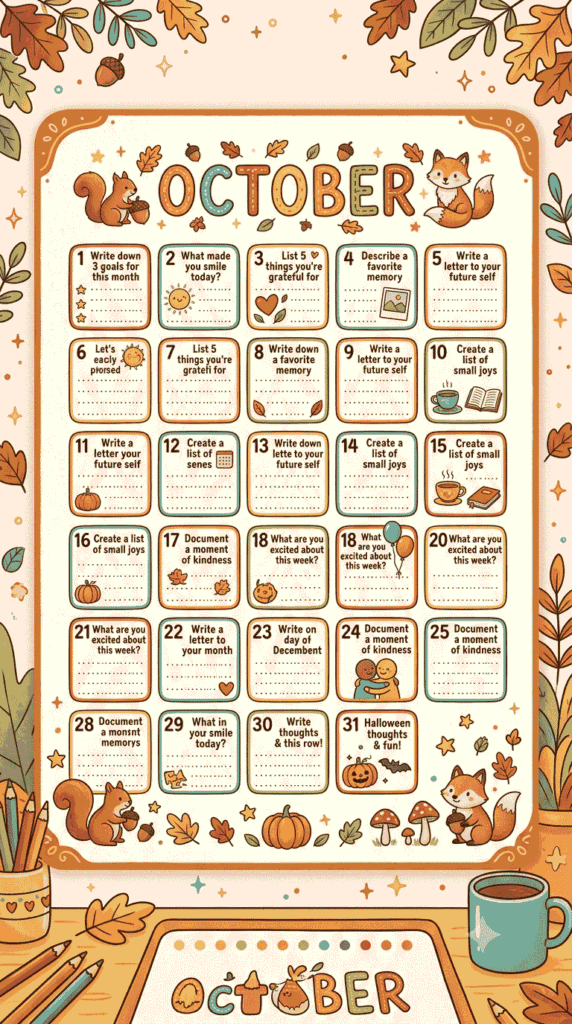
Every month pairs with a printable Pinterest pin holding all 31 prompts for that theme. Journal daily without drowning in choices.
Month 1: New Beginnings
January doesn’t need a dramatic resolution. Not even close. Think of it as a chance to notice where you stand before deciding where to go next.
Sample prompts
What feels different about me compared with last year?
What habit has quietly made my life better?
Which expectation can I drop this month?
When do I feel most like myself?
What’s one small promise I can actually keep this week?
What’s been draining more energy than it gives back?
What am I curious about right now?
If I simplified one part of my life, what would it be?
Month 2: Living in the Present (Mindful Journal Prompts)
Mindful journal prompts aren’t about clearing your head. They’re about noticing your thoughts, feelings, and surroundings without rushing to judge them.
Sample prompts
What are five things I can notice with my senses right now?
When did I last feel fully present?
What thought keeps repeating today?
Which everyday moment do I usually rush past?
How does my body feel after one slow breath?
What am I grateful to notice today?
Which small moment deserves more attention?
What helped me feel grounded this week?
If today had a soundtrack, what would it sound like?
Mental health isn’t only about working through hard emotions. Writing down helps you chart new courses with your growth journey and foster a strong mindset.
Sample prompts
What is one lesson you’ve learned recently that changed the way you think?
Describe a challenge that ultimately helped you become stronger, even if you didn’t appreciate it at the time.
What skill, personal or professional, would you like to develop this year? Why does it matter to you?
Write about a time when stepping outside your comfort zone led to something worthwhile.
What limiting belief about yourself would you like to replace? What new belief feels more accurate?
Think about someone you admire. Which qualities do you hope to cultivate in yourself?
What does progress look like in your life right now? Be specific.
Write about a recent mistake. Instead of focusing on regret, identify what it taught you.
Which personal strength has become more noticeable over the past year?
What’s something you once struggled with that now feels much easier?
365 journal prompts for self-discovery push you past who you should become. They dig into who you already are, your values, your beliefs, your shifting identity.
Sample prompts
Which value shapes most of my decisions?
When do I feel most like myself?
What part of my personality has changed the most?
Which labels no longer fit?
What motivates me beyond achievement?
What belief deserves a closer look?
What have I learned about myself this year?
What kind of legacy do I want to leave?
If I described myself without my job or relationships, what would I write?
Things Therapists, Coaches & Educators Need to Know
These 365 journal prompts for mental health exist for one job, i.e., guided reflection. Not diagnosis. Not treatment. Not a replacement for real care.
Used well, though, they add something. They slot into therapy sessions, coaching check-ins, or SEL classroom work without competing with any of it. A client who journals between sessions shows up different. Sharper. Less foggy on what they actually feel.
That’s the real value here. Someone writes down a pattern at home. Then they walk into the room already halfway to naming it. The session moves faster because the noticing already happened.
For therapists, one prompt can work as light homework between visits. Nothing heavy. Just enough to keep the thread alive until next time.
Coaches use them differently. Drop one at the start of a check-in and it opens the door. Drop one at the end and it closes the loop. Either way, the goal stays the same: deeper self-awareness, without steering anyone toward an answer you already had in mind.
Educators can adapt these for the classroom too. Age-appropriate versions work fine for SEL exercises. Two conditions matter, though. Participation stays voluntary. Privacy stays protected. Skip either one and the exercise stops being reflection and starts being surveillance.
Sometimes writing surfaces more than expected. Someone gets distressed. Someone reveals something that needs a professional in the room, not a notebook. When that happens, the journal isn’t the endpoint. It’s the opening line of a harder conversation. Reflection only works when real support shows up right behind it.
This applies whether someone’s working through structured mindfulness journal prompts, open-ended mindful journal prompts, or a full year of 365 journal prompts for self-discovery. The format doesn’t matter. The follow-through does.
A full year of prompts in one giant list feels heavy before you even start. That’s the problem this fixes. This collection breaks 365 journal prompts for mental health into 12 monthly Pinterest pin downloads instead of one massive file. Each month sticks to a single theme. You’re not staring down 365 days at once.
That matters more than it sounds. One document, hundreds of pages, and most people quit before page ten. Twelve smaller ones? Different story entirely.
Download one month. Work through it at your own pace. Grab the next one when you’re ready, not before. Simple as that. This setup works well if you’re just starting your first journaling habit. It also works in a classroom, a coaching program, or a therapy support setting, where pacing actually matters.
These aren’t just mindful journal prompts dropped into a template. Each monthly pack builds toward something. Some months lean into mindfulness journal prompts for grounding and body awareness. Others shift toward 365 journal prompts for self-discovery, digging into identity, values, and the stuff people avoid thinking about.
Paper notebook or digital journal, doesn’t matter which. What matters is whether you’ll actually open it again tomorrow. That’s what these monthly packs are built for. Not a perfect system. A realistic one. One you can keep all year, not just the first excited week of January.
Conclusion
365 journal prompts for mental health were never meant to feel like homework. Think of them as a tool you reach for, not one more box to check. Some days you’ll fill a whole page. Other days, a few honest lines are enough. Both count.
The real value isn’t in getting it right. It’s in showing up. Again and again, even on the days it feels pointless. Use these mindful journal prompts as a starting point, not a script. Adapt them to whatever you’re carrying that day. Skip around. Ignore the order if it doesn’t fit.
Why does that matter more than finishing every prompt? Because showing up beats getting it perfect, every time. Over time, something bigger takes shape. Not just a journal, but a record. A record of your thoughts, your setbacks, and how you climbed out of them. That’s what turns 365 journal prompts for self-discovery into more than a list. You start to notice the pattern. Where you get stuck. Where you grow.
These mindfulness journal prompts won’t fix everything, and they’re not supposed to. If something you write ever feels too heavy to carry alone, let that be the sign. Reach out. A friend, or a licensed mental health professional, can hold what a page can’t.
Frequently Asked Questions
Are 365 journal prompts good for improving mental health?
Yes. Used consistently, 365 journal prompts for mental health can support emotional well-being. They build self-reflection. They sharpen emotional awareness. They push you toward better coping habits over time.
Here’s the catch. The prompts themselves don’t create change. The habit does. Writing every day, even a few lines, is what shifts things. A prompt just gives you somewhere to start.
Journaling works well next to therapy or self-care. It’s not a swap for professional treatment when that’s what someone actually needs.
What’s the difference between mindfulness prompts and self-discovery prompts?
They’re not the same tool. Mindfulness journal prompts pull your attention to right now: your thoughts, your body, what’s happening around you, all without judging it. 365 journal prompts for self-discovery work differently. They send you inward, toward your values, your goals, and who you’re becoming.
One’s about noticing the present moment. The other’s about tracing a longer arc. Both matter. They just answer different questions.
How long should I spend on one prompt each day?
Ten to fifteen minutes is usually enough. That’s the sweet spot. Long enough to get past surface thoughts, short enough that journaling doesn’t turn into another chore on your list.
Want to write longer some days? Go for it. Showing up matters more than how many words you fill the page with.
Is there a printable or downloadable version of these prompts?
Yes, and for good reason. A printable format helps a lot of people stick with it. That’s why this collection also comes as monthly printable prompt sheets, not just one long year-long challenge.
Breaking it into smaller monthly sets makes a real difference. A single, massive document feels heavy before you even start. Twelve small ones don’t.
Is journaling scientifically proven to help mental health, or is it just popular advice?
It’s more than a trend. Journaling has been studied for decades now. Research on expressive writing, most notably the work from James W. Pennebaker at the University of Texas at Austin, suggests it can help people process emotions, ease stress, and support psychological well-being.
Results aren’t identical for everyone, though. Journaling isn’t a cure for mental health conditions. But as a well-researched piece of a broader self-care routine, it holds up. For more general guidance on managing stress and mental health, the American Psychological Association’s resources are worth a look too.
Well, I am not a psychologist a monk, or a philosopher by training. I’m just an engineering graduate. ‘The Empty Self’ is where I write about that idea, and what it actually means for ordinary life, anxiety, identity, habits, the stories we tell ourselves about who we are. I don’t have a psychology degree, and I’m not offering therapy or clinical advice. What I do have is thought and clarity, and genuine curiosity about why we suffer the way we do and how much of it might loose once we shed this ‘fixed identity’.