
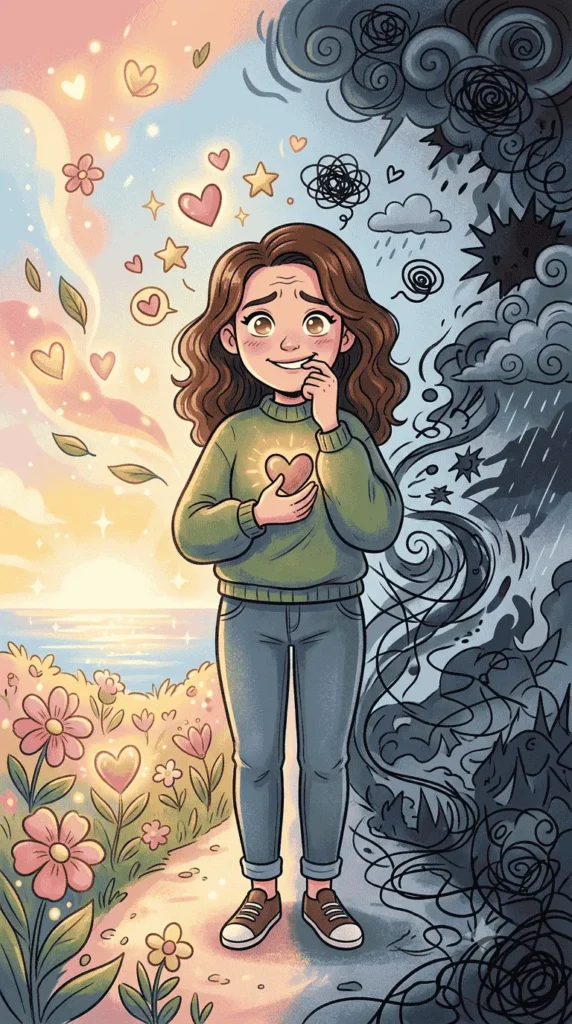
The Short Answer. Yes!
Can gratitude and anxiety exist at the same time? Yes. That’s the short answer. And it holds up in real life. It holds up in modern psychology too.
Still, you’ve probably heard the opposite. Gratitude and anxiety can’t coexist, the claim goes. It shows up in talks. It shows up in wellness blogs. It shows up in social posts, over and over. But hard proof doesn’t back it up. Most versions never point to solid research. That’s a problem.
So why has the idea stuck anyway? People use it as a shortcut. A mental one. What they usually mean is narrower: gratitude can pull your focus away from anxious thoughts for a while. Fair enough. That’s true.
But that’s not what gets claimed. The claim goes further. It says your brain loses the ability to feel both emotions at once. That’s a much bigger leap. And the evidence just doesn’t support it.
Table of Contents
Where the “Cannot Coexist” Idea Comes From
Look beyond the slogan first. The claim that gratitude and anxiety cannot coexist did not start in peer-reviewed psychology journals. Instead, it spread through motivational talks, coaching circles, and wellness blogs. That matters.
Search long enough and a pattern shows up. One article repeats another. Then a quote gets shared. Someone calls it settled science. But solid research rarely puts it in such absolute terms.
Here’s the odd part. Some websites pushing the phrase quietly walk it back later. They admit people can still feel anxious while practicing gratitude. That’s a real contradiction. So what does it tell you? The slogan works as encouragement, yet it fails as a literal claim about the mind.
So, can gratitude and anxiety exist at the same time? Most are pointing to a shift in attention, not a fixed law of emotion. Gratitude can pull focus away from anxious thoughts for a while. That’s a useful mental reframe. But it isn’t proof that one emotion cancels out the other.
Can Gratitude and Anxiety Exist at the Same Time? What Psychology Says
Yes. You can feel both at once.
Anxiety and thanks often share the same room. One just talks louder. Psychology stopped treating feelings like a light switch a long time ago. A person can hold two opposite states about one single moment. That’s the real question here. Not whether both fit. It’s how they pull your focus.
Feelings Don’t Cancel Each Other Out
Mixed feelings show up more than people admit. Feeling thankful doesn’t erase fear. Feeling anxious doesn’t block warmth either. Both can grow from the same event.
Picture waiting on a medical test result. You feel thankful for the people sitting next to you. You also dread the call. Both feelings are real. Neither one cancels the other.
Researchers at USC scanned brains during mixed feelings. Something odd turned up. Positive and negative states each lit up separate activity in the amygdala and nucleus accumbens. That pattern didn’t match pure joy. It didn’t match pure fear either. Their study, published in the journal Cerebral Cortex, treated mixed emotion as something real. Not noise in the data.
Larsen and his colleagues proposed something called the co-activation model, decades back. The idea: positive feelings mixed with negative ones can soften them. A hard moment turns into material for meaning-making instead of just pain. Follow-up research backs the idea up. Mixed emotional states link to better well-being over time, not worse. So, can gratitude and anxiety exist at the same time? The research says yes, and trying to force one out doesn’t reflect how emotion actually works.
Attention Moves Faster Than Feelings Do
Shift your focus first. Your emotional state follows slower. That gap matters more than most people realize.
Notice it during a gratitude practice. The anxious replay in your head goes quiet for a second. Relief shows up. But the anxiety hasn’t left. It’s just sitting further back.
Did it actually disappear? Not really. Attention works like a flashlight beam. It lights one corner of a room. The rest stays dark, but it’s still there. Gratitude redirects your focus away from worry. It rarely deletes the worry underneath.
So don’t wait for the knot in your stomach to leave before you write down what you’re thankful for. Write it while the knot is still there. That’s the whole method. The notebook is open. Your hand is shaking a little. You write the sentence anyway.
A study published in PLOS ONE looked at how people cope with mixed feelings. Adults who named a specific blend, like hopeful but nervous, handled hard moments better than people who just swung between one emotion and its opposite. That’s not intuitive. The research called this pattern secondary mixed emotion. It showed up again across three separate studies.
Why Both Feel True at Once
So, can gratitude and anxiety exist at the same time? Psychology says yes, flatly. The mind doesn’t file emotions into single-file lines. Different feelings share space constantly. That’s normal, not broken.
Picture someone on their first day at a new job. Thanks for the shot feels real. Nerves about messing it up feel just as real. Neither one wins. Both shape the day.
Sound too simple to matter? It isn’t. Here’s an honest take most self-help content skips: forcing one feeling out to make room for the other usually backfires. Naming both works better than forcing one out. That’s the shift.
What Neuroscience Actually Says
Gratitude and anxiety are not natural enemies. Neuroscience never proved they cancel each other out. Instead, gratitude shifts how your brain handles stress. It redirects attention. It nudges emotional regulation somewhere new. The relationship is dynamic, not absolute. That’s exactly why gratitude tends to soften anxiety instead of erasing it.
Sympathetic vs. Parasympathetic Activation
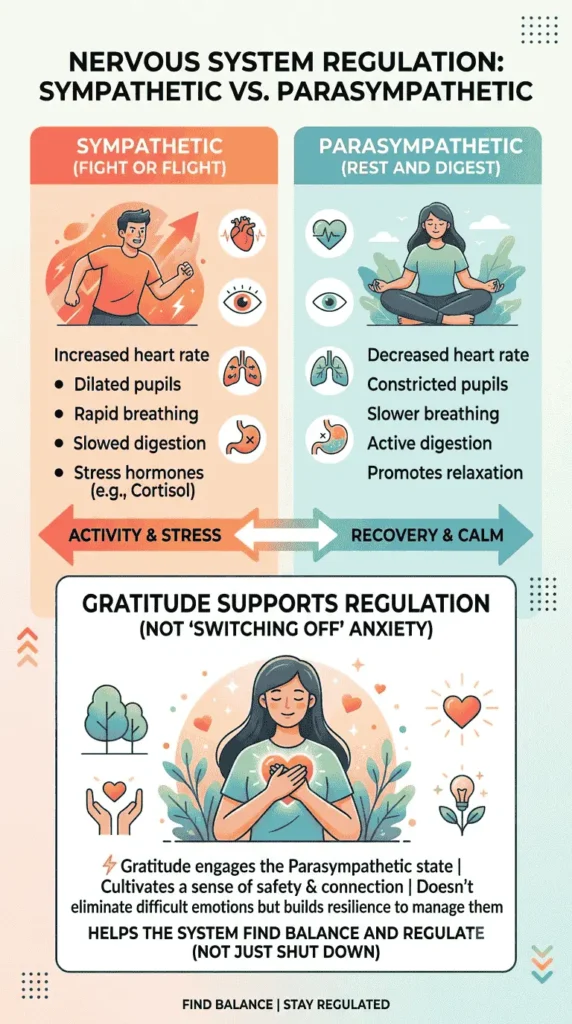
Your sympathetic nervous system braces for danger. Heart rate climbs. Muscles tighten. Alertness spikes. The parasympathetic system does the opposite. It slows your breath. It calms your heart. It helps your body recover. Gratitude practices often boost parasympathetic activity, which is part of why they can help the body settle after stress.
But these systems don’t flip like light switches. They overlap constantly. Both can fire at once, at different strengths, depending on what’s happening around you. You can feel your pulse race before a big presentation. You can still notice a colleague’s kindness in that same moment. That overlap isn’t a contradiction. It’s just how the brain runs complex emotional states.
So can gratitude and anxiety exist at the same time? Gratitude doesn’t shut anxiety off, so what does it actually do?
The Real Role of Attention and Cognitive Appraisal
Forget the on/off framing. The better lens is attention and cognitive appraisal. Cognitive appraisal is just how your brain reads a situation, deciding if it’s dangerous, manageable, or meaningful. Gratitude nudges that reading. It highlights resources, relationships, or good moments anxiety tends to skip past.
Picture attention as a flashlight in a dark room. Wherever you aim it gets clearer. The rest of the room doesn’t vanish. Anxiety yanks that flashlight toward danger. Gratitude pulls some of that light toward safety, support, or progress. Anxious thoughts feel lighter. They don’t disappear completely.
This tracks with brain-imaging work. Researchers have found gratitude activates regions tied to value judgment and reward processing, the same circuitry your brain uses to decide what deserves attention in the first place.
So, can gratitude and anxiety exist at the same time? Yes, one doesn’t erase the other; it just changes where the light falls.
How Gratitude Can Interrupt Anxious Thought Loops
Anxiety feeds on repeat thinking. One worry sparks another. Your mind starts treating imagined outcomes like real threats. Gratitude won’t force those thoughts to stop. But it can break the loop. It hands your brain different information to chew on.
Specificity matters most here. Writing “I’m grateful for my life” barely moves the needle. Noticing something real changes that. A friend who texted today. A quiet walk. Getting through yesterday’s mess in one piece. Each of those forces your brain to pull up an actual memory instead of a hypothetical fear. Gratitude works best as a way to widen the lens. Not to argue with anxious thoughts. Not to suppress them either.
That widening effect isn’t just theory. A gratitude-letter study out of Indiana University found the change stuck around three months after the writing stopped, showing up as altered activity in brain scans. Specific, repeated attention to good things appears to leave a mark that outlasts the exercise itself.
What’s Still Unknown – and Where the Popular Claim Overreaches
Most gratitude claims oversell the science. Research links gratitude to lower anxiety and better emotional well-being for plenty of people. So can gratitude and anxiety exist at the same time? The science says it’s complicated. But nobody has shown it makes anxiety impossible in the same moment. That gap matters. The popular line that gratitude and anxiety can’t coexist works better as a motivational slogan than a neuroscience fact.
The evidence has limits, too. Many studies lean on self-reports. Some run for only a few weeks. Others pull from narrow participant groups. Broad conclusions get shaky fast.
The fairest read: gratitude is a strong emotional regulation tool. It’s not a switch that shuts anxiety off. Sitting with that nuance makes gratitude more realistic. And, in a lot of cases, more effective.
For more on how anxiety functions in the brain, see the National Institute of Mental Health’s overview of anxiety disorders. For the neuroimaging behind gratitude’s effects on emotional processing, the Frontiers study on gratitude and neural change over time goes deeper into the mechanisms touched on above.
What the Evidence Says About Gratitude and Anxiety
Gratitude helps with anxiety. For some people, anyway. Research backs that up again and again, but the effect is usually small. Not dramatic. Nobody’s evidence supports the idea that gratitude replaces therapy or wipes out anxiety on its own.
So what does it do? It works best as a sidekick. A useful add-on when paired with treatments that actually have a track record.
Findings from the Systematic Review of Gratitude Interventions
The strongest evidence so far comes from a recent systematic review of gratitude interventions, which pulled together studies on gratitude journaling, gratitude letters, and other structured exercises across different groups of people. The review found real improvements. Anxiety went down. So did depression. Overall well-being went up too. But the size of those gains bounced around a lot from study to study.
That bounce matters. Researchers call it heterogeneity, which is a fancy way of saying the studies didn’t match. Different participants. Different lengths. Different ways of measuring outcomes. A related meta-analysis covering 27 studies on depression and anxiety symptoms found only a limited effect from gratitude interventions at both the end of treatment and at follow-up, which lines up with what the bigger review saw.
Some studies followed university students. Others tracked older adults, or people managing chronic illness. Because nobody used the same gratitude practice the same way, it’s hard to say which version works best. Harder still to know how long someone should stick with it before expecting real change.
There’s another wrinkle. Many of these studies carried a moderate to high risk of bias. Small sample sizes. No blinding. Short follow-up windows. Reporting that didn’t always match across studies. None of that erases the findings. It just means the results deserve a healthy dose of caution instead of blind trust. So, can gratitude and anxiety exist at the same time? The evidence says yes, but consistent practice and realistic expectations matter.
For more context on how gratitude research generally connects to well-being, Harvard Health’s overview on gratitude is worth a look too.
Who Benefits Most, and Where Evidence Is Weaker
Gratitude tends to help most with everyday stress. Mild anxiety. The rough patches that don’t come with a diagnosis. Why? It shifts attention. Away from worry, toward things that build perspective or connection. That shift won’t erase anxiety. But it can shrink the amount of mental real estate anxiety takes up.
Sound too simple? It kind of is. That’s also where its limits show up fast.
Move into clinical territory and the evidence gets shakier. Generalized Anxiety Disorder. Panic Disorder. Social Anxiety Disorder. People with these diagnoses sometimes report feeling better after gratitude exercises. Fair enough. But no study has shown gratitude alone produces the kind of reliable, clinically meaningful change you’d get from something like Cognitive Behavioral Therapy for Anxiety, or medication when that’s appropriate.
Trauma changes the picture again. So does complex grief, or serious mental illness. Push gratitude on someone too early, or skip acknowledging what they’re actually going through, and it can land as dismissive instead of helpful. That’s most likely why so many mental health professionals treat gratitude as a companion to established treatment. Not a replacement for it.
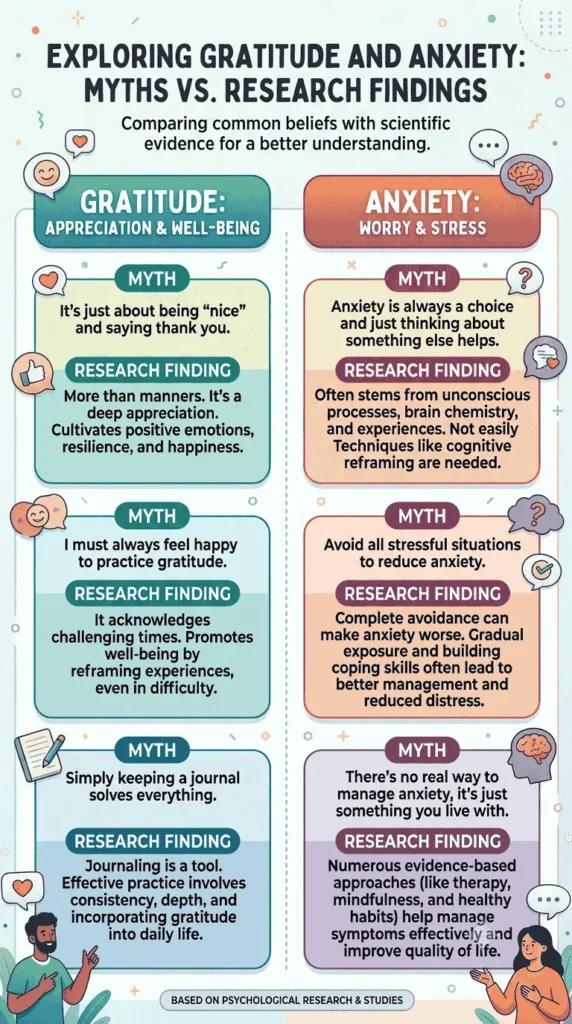
Myth vs. What the Evidence Shows
| Myth | What the Evidence Shows |
|---|---|
| Gratitude and anxiety cannot coexist. | They coexist all the time. Gratitude can soften anxious thoughts. It doesn’t remove them. |
| Gratitude rewires the brain to stop anxiety. | Gratitude shapes attention, emotional regulation, and well-being. Current neuroscience won’t back a claim that absolute. |
| Gratitude journaling works for everyone. | Plenty of people benefit. Responses still shift based on personality, circumstances, and mental health status. |
| Gratitude is an effective treatment for anxiety disorders. | It can support mental health. It’s not a first-line treatment for diagnosed anxiety disorders. |
| More gratitude always means less anxiety. | Benefits stay modest for most people. Forcing gratitude can even backfire, especially during trauma or heavy emotional strain. |
When Gratitude Helps and When It Doesn’t
Gratitude eases anxiety. Sometimes. The trick is knowing which kind of anxiety you’re dealing with. For everyday stress, a quick shift in perspective often does the job. For anxiety disorders, gratitude plays backup, not lead. Chronic worry needs more than a thankful list. Grief needs something else entirely. Know where gratitude fits and where it runs out of road, and you’ll stop expecting it to fix what it was never built to fix.
Mild Stress / Everyday Worry
Everyday worry responds well to gratitude. Surprisingly well. You’re dreading a presentation. Stuck in traffic again. Spinning through “what if” thoughts that go nowhere. Noticing what’s actually going right can break that spiral. Not because the problem vanishes. It doesn’t. Your brain just gets a reminder: this isn’t the whole picture.
This is where gratitude does its best work. A two-line journal entry. A quick mental list of people in your corner. Even just clocking one good moment in a rough day. So can gratitude and anxiety exist at the same time? The science says yes, at least for everyday stress.
Research out of University of Utah Health links regular gratitude practice to lower cortisol and steadier heart function, and those effects show up fastest in ordinary, situational stress rather than deep-seated anxiety.
Small stuff, big payoff. That’s the whole point.
Chronic Anxiety
Can gratitude and anxiety exist at the same time? For chronic anxiety, the honest answer is yes, but not in the way people hope. Chronic anxiety doesn’t play by the same rules. It sticks around, uninvited, most days. Three things you’re thankful for won’t undo a pattern that took years to build. Gratitude still helps here. Just not as the main event.
What it does is buy you distance. Brief distance. Picture cracking a window in a stuffy room. The air clears a little. The house is still falling apart in the corner you can’t see from there. One app-based gratitude intervention published in a clinical journal found that a nightly “Three Good Things” exercise eased worry and uncertainty over a two-week stretch. Researchers framed it as a support, not a fix.
Pair it with mindfulness. Or a steady sleep routine. Or therapy. Gratitude layers steadiness on top of those. It doesn’t stand in for them.
Diagnosed Anxiety Disorders
Diagnosed anxiety disorders change the math. Generalized Anxiety Disorder. Social Anxiety Disorder. Panic Disorder. Gratitude has a seat at this table. It doesn’t run the meeting.
Why not? Because a large-scale meta-analysis of psychotherapies for GAD, covering thousands of participants, points to cognitive behavioral therapy as the first-line, evidence-backed treatment. Medication, when a doctor prescribes it, does its own job too. Gratitude was never built to replace either.
So what can it do? Reinforce the good days. Widen the gap between a hard thought and the power that thought gets over you. That’s real. It’s still not treatment.
Would you skip antibiotics for a lung infection because you felt thankful for your health? Gratitude works the same way here. Alongside care. Never instead of it.
Trauma and Grief
Grief doesn’t want gratitude showing up uninvited. Not right away. Tell someone grieving a death to “just be grateful,” and watch what happens. Guilt creeps in first. Isolation follows close behind. This raises a real question: can gratitude and anxiety exist at the same time? In grief, the answer is yes, the two don’t cancel each other out, they coexist, often in the same hour.
This is the edge where gratitude turns toxic. Psychology Today’s coverage of toxic positivity describes how forced cheerfulness dismisses real pain instead of sitting with it, and grief is exactly the terrain where that backfires hardest. Forced thankfulness doesn’t heal a wound. It tells the wound to stay quiet.
The better move? Let both feelings share the room. Grieve hard. Also notice the neighbor who brought soup, if that moment shows up on its own. Nobody has to summon it.
Gratitude that grows on its own timeline helps. Gratitude on command doesn’t. That’s the difference that actually matters.
The Risk of Toxic Positivity
Thanks helps. But only when it’s a choice, not a chore.
The trouble starts when gratitude turns into a rule instead of an option. You feel like you owe the world a thank-you list, even while your chest is tight with worry. That’s when the practice curdles.
Here’s what actually happens when you use thankfulness to shove anxiety out of view. You’re not managing the feeling. You’re just hiding it. And hidden feelings don’t stay quiet. Research on emotional suppression backs this up: pushing feelings down tends to raise distress rather than lower it, not lower it.
So what’s the actual goal here? Not to swap worry for thanks. It’s to make space for both at once.
Why Forcing Gratitude Can Backfire
A gratitude habit loses its power the moment it becomes an obligation. Telling yourself “I should be thankful, so I shouldn’t feel anxious” adds a second layer of stress on top of the first. Now you’re not just anxious. You’re anxious and judging yourself for it.
That’s one reason the popular idea ‘can gratitude and anxiety exist at the same time’ falls under scrutiny. Five things on a list don’t erase worry. They just sit next to it.
In fact, trying to muscle anxious feelings out of view often makes them louder. Suppression doesn’t quiet the nervous system. It winds it tighter, and the effect shows up in the body, not just the mind. So gratitude works best as a wider lens, not a rebuttal. Use it to open your view. Don’t use it to argue with what you’re already feeling.
Acknowledging Anxiety Without Amplifying It
You can name anxiety without letting it run the whole show. A steadier version of self-talk sounds like this: “I’m nervous about tomorrow’s presentation, and I’m thankful for the people backing me up.” Neither sentence cancels the other.
Can you actually be anxious and thankful in the same breath? Yes. Emotions aren’t a single dial that swings from bad to good. Neuroscience research on mixed emotions shows that brain regions involved in complex thinking, like the anterior cingulate, let people register two opposite feelings at once. Nostalgia works this way. So does watching your kid leave for college. Bittersweet is a real state, not a contradiction.
Naming anxiety takes the fight out of it. You stop spending energy resisting what’s already there. Gratitude then does something quieter. It nudges your attention toward what’s still steady, or still meaningful, or still kind.
Balancing Gratitude With Emotional Honesty
The gratitude habits that last are built on honesty, not on relentless optimism. Skip the search for a silver lining in every setback. Name what you’re actually feeling first.
Then, if it rings true, notice something you appreciate sitting right alongside it. That order matters. It keeps gratitude from turning into avoidance wearing a nicer outfit.
This approach builds something sturdier over time, because you’re responding to what’s real instead of editing it. Sound too simple? It is. That’s usually why it works.
Can gratitude and anxiety exist at the same time? Yes. Anxiety can stick around, feel like too much some days, and gratitude still earns a place. Just don’t ask it to do a treatment’s job. Pair it with real support instead of using it as a replacement.
Ways to Practice Gratitude Without Denying Anxiety
Can gratitude and anxiety exist at the same time? Yes. That’s the whole point of this piece. Gratitude doesn’t erase anxious thoughts. It sits next to them. Research backs simple, repeatable practices that ease anxious thinking for some people. But only when the practice stays realistic and specific. And only when it works alongside other coping tools, not instead of them.
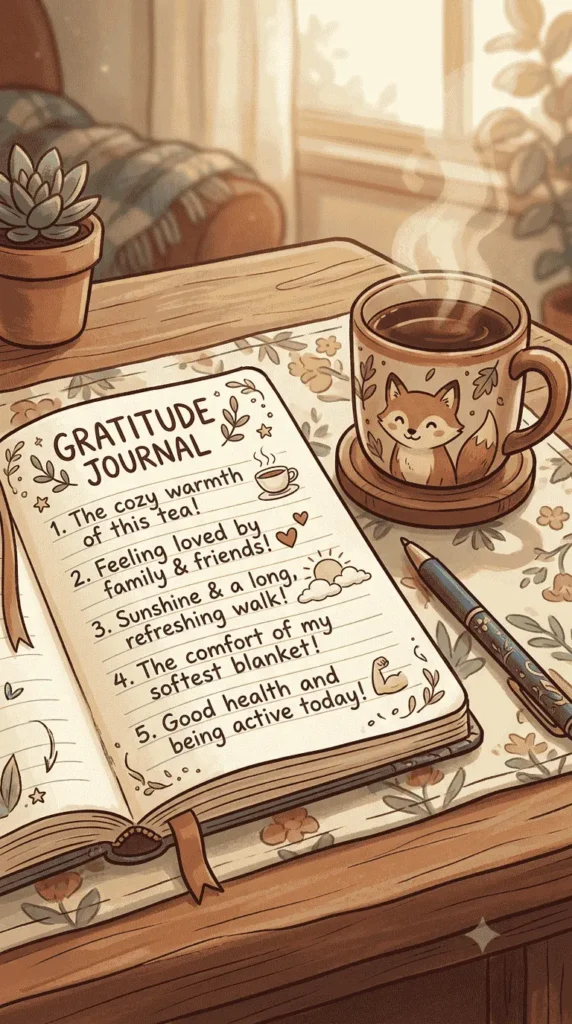
Gratitude Journaling Works Better When It’s Specific
Vague gratitude doesn’t stick. “I’m grateful for my family” sounds nice. It also barely registers in your brain. Compare that to “my friend checked in after my bad meeting.” That second one pulls up an actual memory. Your brain revisits something real, not a fuzzy category.
Psychologists Robert Emmons and Michael McCullough, whose work anchors much of the gratitude field, found that gratitude interventions improve mood and reduce distress more than simply logging general daily events. Specificity is the mechanism. Generic praise doesn’t ask your brain to do anything. A concrete memory does.
Still, don’t turn this into homework. If journaling feels like one more task on the list, shrink it. Two or three specific notes, a few times a week, beat a daily entry you’ll abandon by Thursday.
One caveat worth naming here: gratitude journaling isn’t magic. A meta-analysis out of Ohio State, reviewing 27 separate studies, found gratitude interventions had only limited effects on anxiety and depression symptoms. That doesn’t mean skip it. It means keep your expectations honest.
If you wish to experiment with prompts for journaling, you can check out this guide on 365 journal prompts that can help improve your mental health.
Why Mindfulness and Gratitude Work Better Together
Mindfulness and gratitude aren’t the same tool. They just work well side by side. Mindfulness notices what’s happening, no judgment attached. Gratitude notices what’s still good, even mid-mess.
Try this. A few slow breaths. Name the anxiety out loud, don’t fight it. Then find one steady thing nearby, warm tea, a dog at your feet, a text that made you laugh. You’re not swapping one feeling for another. You’re holding both.
That combination matters more than people assume. Gratitude practice appears linked to lower negative emotion and reduced physiological stress, which is exactly the terrain mindfulness already works in. Pairing them isn’t redundant. It’s reinforcing.
Using Gratitude During an Anxious Moment, Not as a Replacement for It
Gratitude is not a command to think positive. Say that twice if you need to. When anxiety spikes, gratitude isn’t there to shut it down. It’s there to widen the frame around it.
Start with the truth: “I’m feeling anxious right now.” Then, deliberately, notice one thing that’s still steady. This won’t stop a panic attack. It won’t erase a spiral of worry either. What it can do is interrupt the loop long enough to respond instead of react.
So can gratitude and anxiety exist at the same time, even in the worst moment? They have to. Pretending otherwise is where most gratitude advice goes wrong.
Pair Gratitude With Therapy. Don’t Use It Instead.
For people with chronic or diagnosed anxiety, gratitude is a supporting habit. Not the main event. CBT, exposure therapy, and other evidence-based approaches target the patterns that keep anxiety running. Gratitude reinforces the gains between sessions. That’s its job, and it does that job well.
One study out of the University of Indianapolis compared gratitude journaling against expressive writing during a stretch of real-world crisis, the early pandemic lockdowns. Both approaches helped. Neither replaced professional support, and nobody involved claimed they should.
If you’re already seeing a therapist, bring this up. Ask how a gratitude practice fits your treatment plan. Used together, these approaches tend to reinforce each other far more than either does alone.
For a broader look at anxiety treatment backed by clinical research, the American Psychological Association’s overview of anxiety is a solid starting point. For more on how gratitude research applies outside a clinical setting, the Greater Good Science Center at UC Berkeley covers the Fekete study in full.
When to Seek Professional Help Instead of Relying on Gratitude Alone
Gratitude helps. It’s not a cure.
So can gratitude and anxiety exist at the same time, with real relief still possible? Often, yes. But only to a point. When worry runs your whole day and steals your sleep, a thanks list won’t fix that. Evidence-based care will. Knowing where self-help ends and treatment starts can save you months of needless struggle.
Warning Signs It’s More Than Everyday Anxiety
Nerves before a job interview are normal. Anxiety that won’t quit is not.
The shift happens when fear becomes constant, out of proportion, or disruptive. Maybe you’re skipping work meetings. Maybe social plans feel impossible. Frequent panic attacks, weeks of broken sleep, or a mind that can’t focus on anything else are all flags. That’s the line. When it’s crossed, a mental health professional is worth calling. Months of lingering distress rarely fade through gratitude practice alone, no matter how consistent you are.
Therapy and Medication as First-Line Treatments for Anxiety Disorders
CBT is the frontline treatment for diagnosed anxiety disorders. Not gratitude journaling.
Cognitive Behavioral Therapy works by targeting the exact thought patterns and behaviors that keep anxiety alive. Research reviews describe CBT as a reliable first-line approach for this class of disorders, with added benefits for related symptoms like poor sleep. Some studies even show combining CBT with medication outperforms CBT on its own, especially for more severe cases. A doctor may also suggest medication when symptoms run deep or block daily life. Gratitude can sit alongside these treatments. It widens perspective. But it’s a supplement, not a stand-in for a plan built by a licensed professional.
For a fuller clinical picture, the National Institute of Mental Health’s overview of anxiety disorders is a solid place to start.
Where to Find Support
Start with your doctor. That’s step one.
A primary care physician, psychologist, psychiatrist, or licensed therapist can all point you toward the right next step. Many workplaces and universities offer confidential counseling too, often free. Not sure where to look? The Anxiety and Depression Association of America’s therapist directory connects people with licensed providers by specialty and location. That’s a real resource, not just a suggestion.
Final Words
Can gratitude and anxiety exist at the same time? Yes. They often do, in the very same breath.
The claim that they can’t mix sounds neat. Neat answers sell fast. But feelings rarely cooperate that way. You can feel thankful for your family while your health worries won’t quiet down. You can enjoy a solid day at work and still lie awake over tomorrow. That’s not a contradiction. It’s just how emotions work. Human feelings are rarely all-or-nothing. They stack.
Gratitude doesn’t erase worry. It shifts attention. Softens anxious thought patterns over time. Builds resilience, slowly, the way exercise builds strength. One session doesn’t do it. Repetition does. Still, a habit isn’t a cure.
Pair gratitude with real coping strategies. Bring in professional support when things get heavy, not as a last resort, but as part of the same toolkit. Used together, gratitude becomes what it always was: one solid tool among several.
If there’s one thing worth remembering, it’s this. You don’t need anxiety gone before you start being thankful. Hold both, honestly, without judging yourself for it. That’s often exactly what moves people forward.
Frequently Asked Questions
Can Gratitude and Anxiety Exist at the Same Time?
Yes, they can. The evidence says so. You can feel real thanks for your life and still worry about work, health, relationships, or what’s coming next. That’s not a contradiction. It’s just how emotions work.
Gratitude doesn’t erase anxiety. It softens it. One study on adults in Lebanon, done after the 2023 earthquake, found that gratitude didn’t lower death anxiety on its own. It worked through optimism instead. Higher gratitude led to more optimism. More optimism led to less fear of death. Gratitude alone wasn’t the fix.
So if you’re thankful and still anxious, nothing is broken. Both can sit in the same chest at once.
What Cannot Coexist With Gratitude?
Not much, honestly. The idea that gratitude and anxiety cannot coexist gets repeated a lot online. It sounds tidy. It sounds like science. It isn’t, not exactly.
What gratitude actually does is pull your attention somewhere else. Anxious thoughts feel less overwhelming when you’re not staring straight at them. They don’t vanish. They just lose some volume.
A 2020 analysis out of Ohio State looked at 27 separate studies on gratitude and mental health. The result? Gratitude exercises had only a small effect on anxiety and depression, barely more than unrelated writing tasks. Being thankful still has real value. It just isn’t a switch that shuts anxiety off.
How to Stop Feeling Anxious for No Reason?
Anxiety doesn’t always explain itself. It’s 2pm, nothing’s wrong, and your chest is tight anyway. That’s the moment to work with your body first. Don’t try to think your way out yet.
Why does this order matter? Anxious thoughts feed off physical tension. Calm the body, and the thoughts have less fuel to run on. So breathe slowly. Move your body regularly. Sleep enough. Practice mindfulness. These won’t fix everything overnight. They do lower the physical noise anxiety runs on.
If none of that helps, pay attention. Anxiety that sticks around, shows up often with no clear trigger, or gets in the way of daily life is worth raising with a mental health professional. The NIMH page on generalized anxiety disorder is a solid place to learn what that looks like in more detail.
What Are 5 Warning Signs of Anxiety?
Anxiety leaves clues before it takes over completely. Five show up most often:
Worry that’s excessive or hard to control
Feeling restless or constantly on edge
Trouble concentrating
Muscle tension
Trouble sleeping
One or two of these on a rough week isn’t a red flag. Everyone gets that. It’s a different story when these symptoms stick around for weeks, cause real distress, or start interfering with work, relationships, or everyday tasks. That’s when it stops being ordinary stress. Both Mayo Clinic and NIMH list these same patterns as reasons to talk with a doctor or therapist.
What Is the 3-3-3 Rule for Anxiety?
Ground yourself first. Sort your thoughts after. That’s the whole idea behind the 3-3-3 rule, a quick technique for moments when anxiety spikes.
Here’s how it works:
Look around and name three things you see
Listen and name three sounds you hear
Move three different parts of your body
Sound too simple to matter? It kind of is. That’s the point. The rule doesn’t cure anxiety. It interrupts the spiral long enough to bring your mind back to the room you’re actually standing in. Sometimes that’s all a moment needs.
It’s Bhaskar!
Well, I am not a psychologist a monk, or a philosopher by training. I’m just an engineering graduate.
‘The Empty Self’ is where I write about that idea, and what it actually means for ordinary life, anxiety, identity, habits, the stories we tell ourselves about who we are. I don’t have a psychology degree, and I’m not offering therapy or clinical advice. What I do have is thought and clarity, and genuine curiosity about why we suffer the way we do and how much of it might loose once we shed this ‘fixed identity’.